

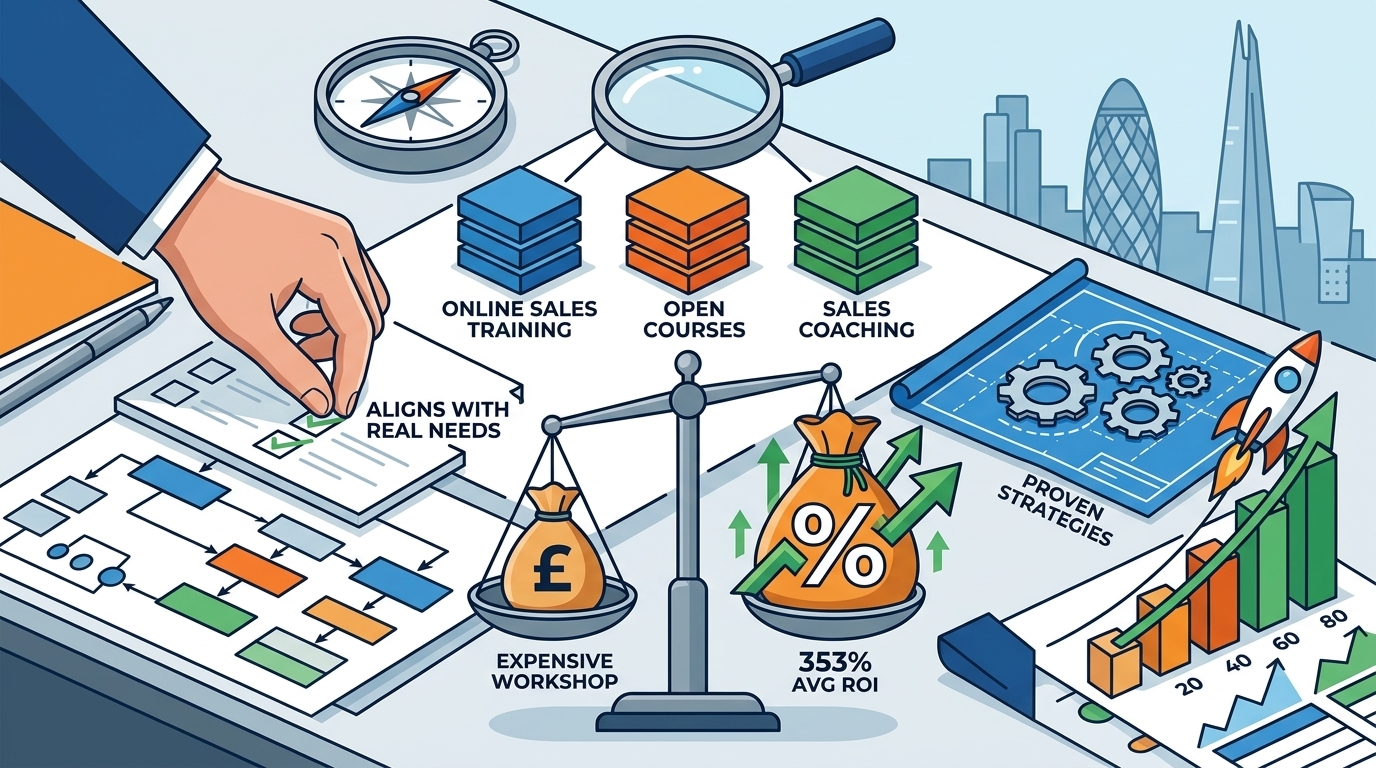
Selecting the right sales training solution can be the difference between a high-performing revenue team and a stagnant pipeline. With the UK sales training market packed with providers promising transformational results, how do you separate genuine value from expensive workshops that fail to stick? Research suggests that professional sales training can deliver an average ROI of 353%, but only when you pick a programme that aligns with your team's real needs. This guide walks you through proven strategies for evaluating, comparing, and choosing a sales training partner that drives measurable business growth.
1. Define Your Sales Goals and Skill Gaps
Before contacting any provider, identify the specific business problem training should solve. Are you struggling to fill the top of the funnel? Losing deals at the negotiation stage? Failing to cross-sell into existing accounts?
A skill gap analysis is a structured assessment that compares your team's current competencies against the skills required to hit targets. Once you define the areas you want to strengthen, you can select the course that provides coverage or ask a provider to recommend the right programme.
Map Problems to Metrics
Tie each gap to a measurable KPI such as conversion rate, average deal size, or sales cycle length. This gives you a baseline to evaluate training impact later.
2. Evaluate Delivery Formats
A delivery format is the medium through which training content reaches your team. Modern providers typically offer in-person workshops, virtual instructor-led sessions, e-learning modules, or blended programmes that combine several methods.
Companies need to accommodate buyers who prefer omnichannel communication, and your training should mirror that flexibility. Providers like Impel Dynamic offer virtual sales training using workshops, one-on-one coaching, and simulations to engage different learning styles. Consider whether your team is co-located or distributed before committing to a single format.
Blended Learning Advantage
Research from Sybill's 2026 sales training guide notes that people forget up to 70% of new information within 24 hours unless it is reinforced. Blended approaches that pair live sessions with ongoing digital resources dramatically improve retention.
3. Assess Trainer Credentials and Track Record
The people delivering your training matter as much as the curriculum. Look for trainers with first-hand selling experience in B2B and B2C markets, not just theoretical knowledge. At Impel Dynamic, every trainer is a professional with extensive selling experience who has co-created best practices in diverse markets.
Questions to Ask Any Provider
Ask potential partners: "What other clients have you helped and what did success look like for them?" as The Brooks Group recommends. References you can call are even better than written testimonials.
4. Prioritise Customisation Over Off-the-Shelf Content
Generic programmes often fail because they do not account for your industry, sales cycle, or competitive landscape. A customised sales training programme is a tailored curriculum designed around your team's specific challenges, products, and market position.
The best providers analyse your current processes before building content. Bespoke programmes from Impel Dynamic include pre-training questionnaires so course content is relevant to each delegate's daily reality. Their clients have closed between $100,000 and $1,000,000 in new deals after completing tailored training.
5. Demand Clear ROI Measurement
Always ask: "How will you prove the ROI of my investment?" ROI measurement should be built into the programme from day one, not calculated retroactively. The Kirkpatrick model combined with Phillips ROI analysis is widely regarded as the most comprehensive evaluation framework, assessing reaction, learning, behaviour change, and business results.
Impel Dynamic reports that 92% of their clients experience a high ROI and 88% say courses exceeded expectations. These figures give you a benchmark when comparing providers.
6. Look for Post-Training Reinforcement
Training that ends when the workshop finishes rarely produces lasting results. Effective providers offer follow-up coaching, action plans, and review sessions. Impel Dynamic schedules post-course reviews at 8 to 12 weeks to identify areas for one-on-one coaching, ensuring skills transfer into daily behaviour.
Ongoing sales coaching and consultancy should complement any formal training programme. Coaching is the single greatest multiplier of training success, with research showing 4x higher adoption of new behaviours when coaching accompanies training.
7. Sales Training Feature Comparison
| Evaluation Criterion | What to Look For | Red Flags |
|---|---|---|
| Customisation | Pre-training needs analysis, tailored content | One-size-fits-all slide decks |
| Trainer Experience | Proven sales track record in your market | Trainers with no real-world selling background |
| Delivery Flexibility | In-person, virtual, and blended options | Single format with no alternatives |
| ROI Measurement | Defined KPIs agreed before the programme | No metrics discussion until after completion |
| Post-Training Support | Coaching, reviews, and action plans | No follow-up after the final session |
| Client Satisfaction | Verifiable testimonials and case studies | Vague or unattributed success claims |
Key Takeaways
- Start with a thorough skill gap analysis tied to measurable KPIs before speaking to any provider.
- Choose a delivery format that matches your team's location, learning preferences, and schedule.
- Verify trainers have hands-on selling experience, not just facilitation skills.
- Insist on customised content that reflects your industry, products, and sales cycle.
- Require ROI measurement to be designed into the programme from the outset.
- Prioritise providers that include post-training coaching and structured review sessions.
- Use client satisfaction rates and case studies as a key differentiator when comparing options.
Frequently Asked Questions
What is the most important factor when choosing a sales training provider?
Alignment with your specific business goals is the most critical factor. The right provider will conduct a needs analysis, customise content to your challenges, and agree on measurable outcomes before training begins.
How much does sales training typically cost in the UK?
Costs vary widely depending on format and scope. Open courses can start from a few hundred pounds per delegate, while fully bespoke multi-day programmes for entire teams command a higher investment. Always evaluate cost against projected ROI rather than price alone.
Should I choose in-person or virtual sales training?
Both formats can be highly effective. In-person training works well for team-building and role-play exercises, while virtual training offers flexibility for distributed teams. Blended programmes that combine both tend to maximise retention and engagement.
How do I measure the ROI of sales training?
Use the formula: ROI = ((Training Benefits minus Training Costs) divided by Training Costs) multiplied by 100. Track leading indicators such as conversion rates and pipeline velocity alongside lagging indicators like revenue growth over three to six months post-training.
How long does it take to see results from sales training?
Initial behaviour changes often appear within weeks, but meaningful revenue impact typically emerges over three to six months. Programmes that include ongoing coaching and reinforcement accelerate this timeline.
What questions should I ask a prospective sales training provider?
Key questions include: What experience do your trainers have in my industry? How do you customise content? What post-training support is included? How will you measure the impact on my business? Can you share client references?
Can sales training work for small businesses?
Absolutely. Small businesses often see outsized returns because each salesperson represents a larger share of total revenue. Open courses provide a cost-effective way for smaller teams to access expert-led training without commissioning a full bespoke programme.
What is the difference between sales training and sales coaching?
Sales training is a structured programme that teaches skills, frameworks, and techniques to a group. Sales coaching is an ongoing, individualised process that helps reps apply those skills in real selling situations. The most effective development strategies combine both.
Ready to Find the Right Sales Training Solution?
Choosing the right partner starts with a conversation about your goals. Impel Dynamic offers bespoke sales programmes, open courses, and virtual training designed to deliver measurable results from day one. Contact Impel Dynamic today to discuss your team's needs and get a tailored recommendation.