

Solving Sales Training Challenges: A Practical Guide for Businesses
Implementing sales training should be a growth catalyst, yet most organisations struggle to turn programmes into lasting results. Research shows that 87% of sales reps forget training content within a month, and 72% of sales leaders say training fails because it tries to be one-size-fits-all. The good news? Every one of these challenges has a proven solution. In this guide, we break down the most common obstacles businesses face when rolling out sales training and share actionable strategies to overcome each one. Whether you are building a programme from scratch or refining an existing one, this roadmap will help you maximise your return on investment.
1. Beating the Forgetting Curve
The forgetting curve is a psychological phenomenon first documented by Hermann Ebbinghaus showing that memory of new information decays rapidly without reinforcement. According to recent industry data, 70% of sales reps forget most of what they learned within one week, and 87% forget it within a month.
Reinforce with Continuous Learning
The solution is replacing one-off workshops with ongoing reinforcement loops. Microlearning modules, spaced repetition, and post-training reviews keep concepts fresh. Impel Dynamic builds this into every engagement, offering bespoke sales programmes that include structured post-training follow-ups to cement new skills.
Use Scenario-Based Practice
Scenario-based training is rated effective by 69% of salespeople. Realistic role-play anchors abstract concepts to real-world situations, dramatically reducing knowledge decay.
2. Moving Beyond One-Size-Fits-All Training
Generic training is a leading reason programmes fail. A 2025 study of over 8,500 sales leaders found that 72% say training fails because it tries to be one-size-fits-all. Different roles, industries, and experience levels demand different content.
Customise for Your Sales Environment
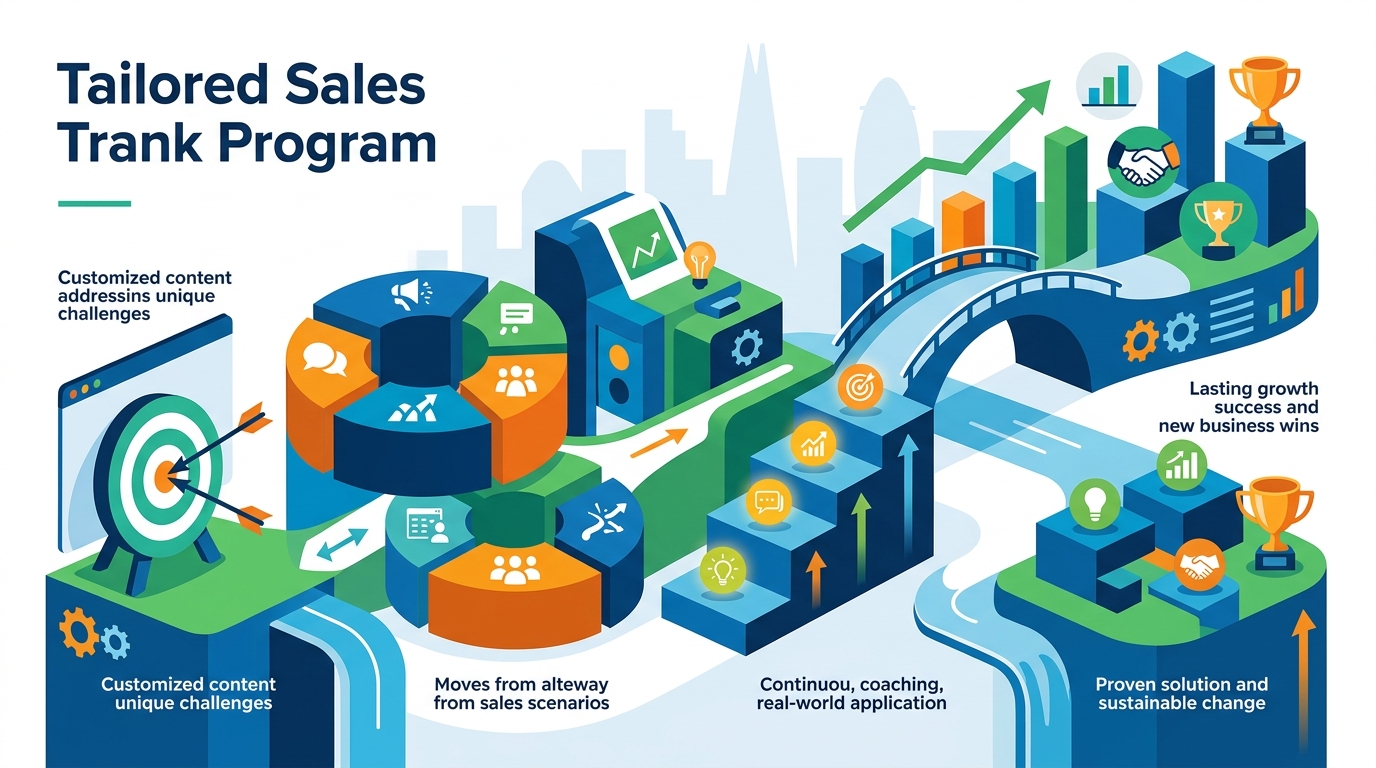
Effective sales training is training that maps directly to a team's actual deals, buyer personas, and competitive landscape. At Impel Dynamic, every sales training course begins with a pre-training questionnaire so content is tailored to each delegate's real-world challenges.
| Challenge | Impact | Recommended Solution |
|---|---|---|
| Knowledge retention | 87% forget content within a month | Spaced reinforcement and coaching |
| One-size-fits-all content | 72% cite this as reason for failure | Role-specific, customised programmes |
| Time constraints | Sellers struggle to dedicate time to learning | Modular, blended delivery formats |
| Measuring ROI | 52% lack proper analytics | Tie training KPIs to business outcomes |
| Lack of manager coaching | Only 26% of reps receive weekly coaching | Train managers to coach consistently |
| Outdated training material | 62% of leaders say it is their top barrier | Regular content audits and updates |
3. Overcoming Time Constraints
Sales teams are under constant pressure to prospect and manage accounts, leaving little room for learning. As RAIN Group's research highlights, time commitment is one of the most frequently cited barriers to training success.
Adopt Blended and Modular Delivery
A blended approach is a training model that combines self-paced digital content with live instructor-led sessions. This format lets reps learn key concepts on their own schedule while reserving group time for practice and feedback. Impel Dynamic's virtual sales training uses workshops, one-on-one work, and simulations to accommodate different learning styles and busy diaries.
4. Measuring Training ROI Effectively
Almost 52% of sales teams lack proper analytics to measure training ROI. Without clear metrics, it is impossible to justify continued investment or identify what needs to change.
Connect Training to Business Metrics
Go beyond satisfaction surveys. Track quota attainment, deal velocity, pipeline growth, and conversion rates before and after training. Impel Dynamic clients have reported closing over £1,000,000 in deals they would not have accessed before, providing concrete evidence of programme value.
Use a Simple ROI Formula
Training ROI equals (Revenue Gains Minus Training Cost) divided by Training Cost, multiplied by 100. Establishing a baseline before training starts makes this calculation straightforward and keeps stakeholders aligned.
5. Ensuring Manager Buy-In and Coaching
Even the best training falls flat without manager reinforcement. Data from Fit Small Business research shows only 26% of reps receive weekly coaching, yet coaching leads to significantly higher quota attainment.
Reps who receive coaching during training are 44% more likely to hit their targets. Organisations with the most effective sales training are 5.2x more likely to prepare managers to motivate and coach their teams.
Impel Dynamic's sales management course equips managers with frameworks for ongoing performance coaching, goal setting, and team motivation so training gains stick long after the classroom session ends.
6. Keeping Training Content Current
A significant 62% of sales leaders say outdated training is their top barrier to delivering effective programmes. Buyer behaviour, technology, and competitive landscapes evolve constantly. Static slide decks and old scripts lose relevance fast.
Build an Evergreen Training Framework
Schedule quarterly content reviews tied to market changes. Supplement core skills modules with timely add-ons covering topics like social selling, virtual engagement, and AI tools. Impel Dynamic's advanced sales training course is continually updated and customised to each cohort through pre-course assessments.
Explore how to put your sales training into action with practical strategies for applying new techniques the moment you return to your desk.
Key Takeaways
- Replace one-off training events with continuous reinforcement to combat the forgetting curve.
- Customise every programme to your team's roles, industry, and experience level.
- Use blended delivery (virtual plus in-person) to work around time constraints.
- Measure ROI through business outcomes like deal size, win rate, and pipeline growth.
- Train managers to coach consistently, not just during annual reviews.
- Audit and refresh training content at least quarterly to keep it relevant.
- Partner with a provider that tailors content and includes post-training follow-up.
Frequently Asked Questions
What is the biggest reason sales training fails?
The most commonly cited reason is a one-size-fits-all approach. Research from over 8,500 sales leaders shows that 72% attribute training failure to generic content that does not address role-specific needs.
How quickly do sales reps forget what they learn?
Without reinforcement, reps forget roughly 70% of training content within a week and up to 87% within a month. Spaced repetition and coaching are essential to counter this effect.
How can I measure the ROI of sales training?
Track metrics such as quota attainment, average deal size, conversion rates, and pipeline velocity before and after training. Use the formula: (Revenue Gains minus Training Cost) divided by Training Cost, multiplied by 100.
What role do managers play in sales training success?
Managers are the frontline of reinforcement. Reps who receive coaching during training are 44% more likely to consistently hit their targets. Without active manager involvement, even excellent training loses its impact.
Is virtual sales training as effective as in-person?
A blended model combining virtual and in-person elements works for 90% of sales leaders according to 2025 data. The key is choosing the right format for each learning objective, not defaulting to one channel.
How often should training content be updated?
At minimum, review content quarterly. With 62% of sales leaders naming outdated material as their top barrier, regular updates aligned to market shifts and buyer behaviour changes are critical.
What makes Impel Dynamic's approach different?
Impel Dynamic customises every programme through pre-training assessments, delivers training via experienced salespeople with proven track records, and includes structured post-training reviews. Their clients have reported significant, measurable improvements across key performance indicators.
How long does it take to see results from sales training?
Initial behaviour changes can appear within weeks, but meaningful business outcomes typically emerge over 3 to 6 months. Post-training coaching accelerates this timeline significantly.
Ready to Solve Your Sales Training Challenges?
Impel Dynamic partners with businesses across the UK to deliver customised, results-driven sales training that sticks. From bespoke programmes to open courses and one-on-one coaching, every solution is built around your team's real-world needs.
Explore Impel Dynamic's sales training courses and take the first step toward measurable sales growth today.