

Solving Sales Training Challenges: A Practical Guide for Businesses
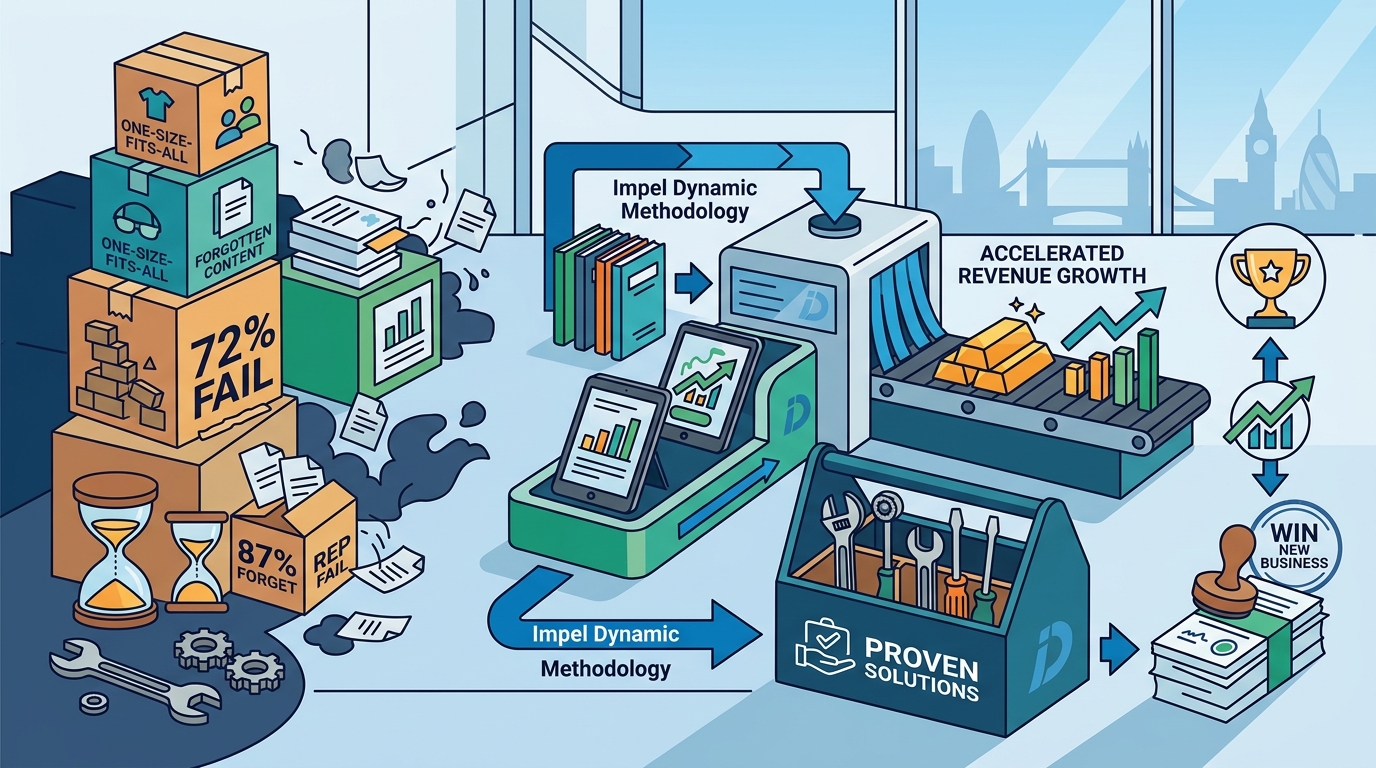
Implementing sales training should accelerate revenue growth, but many organisations struggle to turn programmes into lasting results. Research shows that 72% of sales leaders say training fails because it tries to be one-size-fits-all, while 87% of reps forget training content within a month without reinforcement. The good news? Every common challenge has a proven solution. This guide walks you through the most frequent obstacles businesses face when rolling out sales training and provides actionable strategies to overcome each one. Whether you are launching your first programme or optimising an existing one, these insights will help you maximise your return on investment.
Challenge 1: One-Size-Fits-All Training Does Not Work
Generic training is the single biggest reason programmes underperform. A 2025 survey of over 8,500 sales leaders found that 72% attribute training failure to a one-size-fits-all approach. Different roles require different skills: inside reps favour digital learning, field reps prefer live coaching, and hybrid sellers need blended formats.
The Solution: Customise by Role and Skill Level
Tailored sales training is a programme designed around the specific goals, skill gaps, and market context of each team. Rather than delivering identical content to everyone, effective providers analyse your processes first and then build relevant modules. At Impel Dynamic, our bespoke sales programmes meet teams at their current knowledge level through 1-to-5-day tailored programmes, ongoing academies, or fully customised approaches.
Challenge 2: Time Constraints and Scheduling Conflicts
Sales teams are under constant pressure to hit targets while managing existing accounts. According to RAIN Group research, time commitment is one of the most frequently cited barriers to effective training. Sellers struggle to dedicate blocks of time to learning when quotas loom large.
The Solution: Modular and Blended Delivery
A modular approach breaks training into shorter, focused sessions that fit around selling schedules. Using a flipped-classroom model with microlearning, video, and exercises before interactive sessions allows participants to absorb concepts at their own pace. Impel Dynamic offers both virtual sales training and in-person delivery in London, Manchester, and Birmingham, so teams can choose the format that causes the least disruption.
Challenge 3: Poor Knowledge Retention After Training
The forgetting curve is a well-documented cognitive phenomenon showing that people lose most new information within days unless it is reinforced. Studies indicate that B2B sales reps forget 70% of training content within one week and 87% within a month. This means one-off seminars simply cannot drive long-term behaviour change.
The Solution: Ongoing Reinforcement and Coaching
Post-training reinforcement is the practice of revisiting and applying new skills through coaching, practice, and refresher sessions after the initial programme ends. Reps who receive coaching during and after training are 44% more likely to hit their targets. Impel Dynamic builds reinforcement into every engagement through post-training reviews and ongoing sales development programmes designed to lock in new habits.
Challenge 4: Measuring ROI and Training Effectiveness
Almost 52% of sales teams lack proper analytics to measure training ROI, which makes it difficult to justify continued investment. Without clear metrics, training risks being seen as a cost centre rather than a growth driver.
The Solution: Define Metrics Before You Start
Agree on measurable KPIs at three levels before the programme begins: identifiable, quantifiable, and auditable. The Kirkpatrick model, a four-level framework that evaluates learner reaction, knowledge gain, behaviour change, and business results, provides a proven structure. At Impel Dynamic, we work with clients to set clear action plans and KPIs upfront, which is why 95% of our course participants rate our courses as outstanding and 92% of clients experience a high ROI.
Challenge 5: Lack of Organisational Alignment
Training programmes falter when leadership is not invested or when the content does not align with the company's sales process and culture. Organisations with the most effective sales training are 5.2 times more likely to prepare sales managers to motivate and coach their teams. Without manager buy-in, even brilliant content goes unused.
The Solution: Engage Leadership from Day One
Sales managers should be active participants in the training process, not passive sponsors. Equipping managers with coaching frameworks ensures they reinforce new skills daily. Impel Dynamic's leadership and management training teaches managers to coach, implement, and inspire so that training outcomes persist long after the sessions end.
Challenge 6: Budget Limitations and Cost Concerns
More than 43% of small businesses cite high implementation costs as a barrier to adopting advanced sales training. However, organisations that focus on ROI rather than cost-per-person consistently see better outcomes. For every dollar spent on effective sales training, companies see an average return of $4.53.
The Solution: Start Small, Scale on Results
Begin with a pilot group, measure results, then expand based on demonstrated success. Open courses offer a cost-effective entry point for individuals or small teams. Impel Dynamic's open sales management course lets you send one or two delegates without committing to a full programme, and you can scale to tailored training when the ROI is proven.
Challenges vs. Solutions at a Glance
| Common Challenge | Root Cause | Recommended Solution | Expected Impact |
|---|---|---|---|
| Generic content | No needs assessment | Bespoke, role-based programmes | Higher engagement and relevance |
| Time constraints | Long, inflexible sessions | Modular and blended delivery | Less disruption, better attendance |
| Knowledge loss | No post-training reinforcement | Coaching, reviews, microlearning | 44% higher target attainment |
| Unclear ROI | No pre-set KPIs | Kirkpatrick model, agreed metrics | Easier budget justification |
| Leadership disconnect | Managers excluded from process | Manager coaching integration | 5.2x more effective training |
| Budget restrictions | High upfront costs | Pilot programmes, open courses | $4.53 return per $1 spent |
Key Takeaways
- 72% of sales training fails because it is not customised to the audience. Tailor content by role, skill level, and industry.
- Reps forget 87% of training within a month. Build ongoing reinforcement and coaching into every programme.
- Define measurable KPIs before training starts to prove ROI and secure continued investment.
- Engage sales managers as active coaches, not passive observers. Manager involvement multiplies results by over five times.
- Use modular, blended delivery (virtual and in-person) to work around selling schedules.
- Start with a pilot group or open course to demonstrate value before scaling organisation-wide.
- Choose a training provider with a proven track record and real-world selling experience.
Frequently Asked Questions
What is the biggest reason sales training fails?
The most common reason is a one-size-fits-all approach. Research from 2025 shows that 72% of sales leaders attribute training failure to generic content that does not address the specific challenges their teams face.
How can I stop my team from forgetting what they learned?
Implement post-training reinforcement through coaching sessions, refresher modules, and practical application exercises. Without reinforcement, 87% of reps will forget the material within a month.
How do I measure sales training ROI?
Use the formula: ROI = (Training Benefits minus Training Costs) divided by Training Costs, multiplied by 100. Track lag indicators such as win rates, quota attainment, and revenue per rep over 6 to 12 months post-training.
Should sales training be virtual or in-person?
A blended approach works best for most organisations. Research shows 90% of sales leaders find a mix of in-person and virtual training most effective. Choose a provider that offers both formats flexibly.
How long does effective sales training take?
It depends on scope. Intensive open courses can be completed in one to two days, while bespoke programmes may span weeks or months with ongoing reinforcement built in.
What should I look for in a sales training provider?
Look for trainers with a proven sales track record, customisation capabilities, post-training support, and clear ROI measurement. A provider who analyses your processes before training begins will deliver far better results.
How much does sales training typically cost?
Costs vary widely based on customisation and delivery format. Rather than focusing on cost per person, evaluate expected ROI. Effective sales training returns an average of $4.53 for every $1 invested.
Can small businesses afford professional sales training?
Yes. Open courses provide a cost-effective entry point, and pilot programmes let you prove value before scaling. Many providers, including Impel Dynamic, offer flexible options for businesses of all sizes.
Take the Next Step: Solve Your Sales Training Challenges
Every challenge covered in this guide has a practical solution, and the cost of inaction is far greater than the investment in getting it right. If your sales team is not performing at its potential, it is time to explore a tailored approach. Get in touch with Impel Dynamic for a free consultation and discover how our customised sales training programmes can deliver measurable results from day one.