

Investing in sales training should accelerate revenue, sharpen skills, and build lasting confidence across your team. Yet many organisations find that their programmes fall short of expectations. Research from RAIN Group shows that time constraints, lack of accountability, budget pressures, and poor customisation are among the most common obstacles sales leaders face. The good news is that every one of these challenges has a proven solution. In this guide, we break down the biggest barriers to effective sales training and show you exactly how to overcome them so your investment delivers measurable results from day one.
Why Most Sales Training Fails
Sales training is a structured programme designed to improve a salesperson's skills, behaviours, and results through targeted learning and practice. The global sales training market was valued at USD 6,257 million in 2025 and continues to grow, yet a staggering 72% of sales leaders say training fails because it tries to be one-size-fits-all, according to The Sales Collective's 2025 research.
Meanwhile, only 55% of leaders feel their current sales training programme is truly effective. The disconnect is clear: organisations spend heavily but often lack the strategy to make training stick. Understanding the root causes is the first step toward fixing them.
Challenge 1: Time Constraints
Sales teams are under constant pressure to hit targets, manage accounts, and prospect for new business. Finding time for learning feels like a luxury they cannot afford. RAIN Group's survey of 242 sales professionals confirms that time commitment is one of the most frequently cited barriers to effective training.
The Solution: Modular, Blended Delivery
A modular approach breaks training into short, focused sessions that fit around selling schedules. Combining microlearning, video pre-work, and interactive workshops means reps absorb concepts at their own pace before applying them in collaborative classroom sessions. Virtual sales training options let teams learn without travel, while in-person intensives create deeper engagement for complex topics.
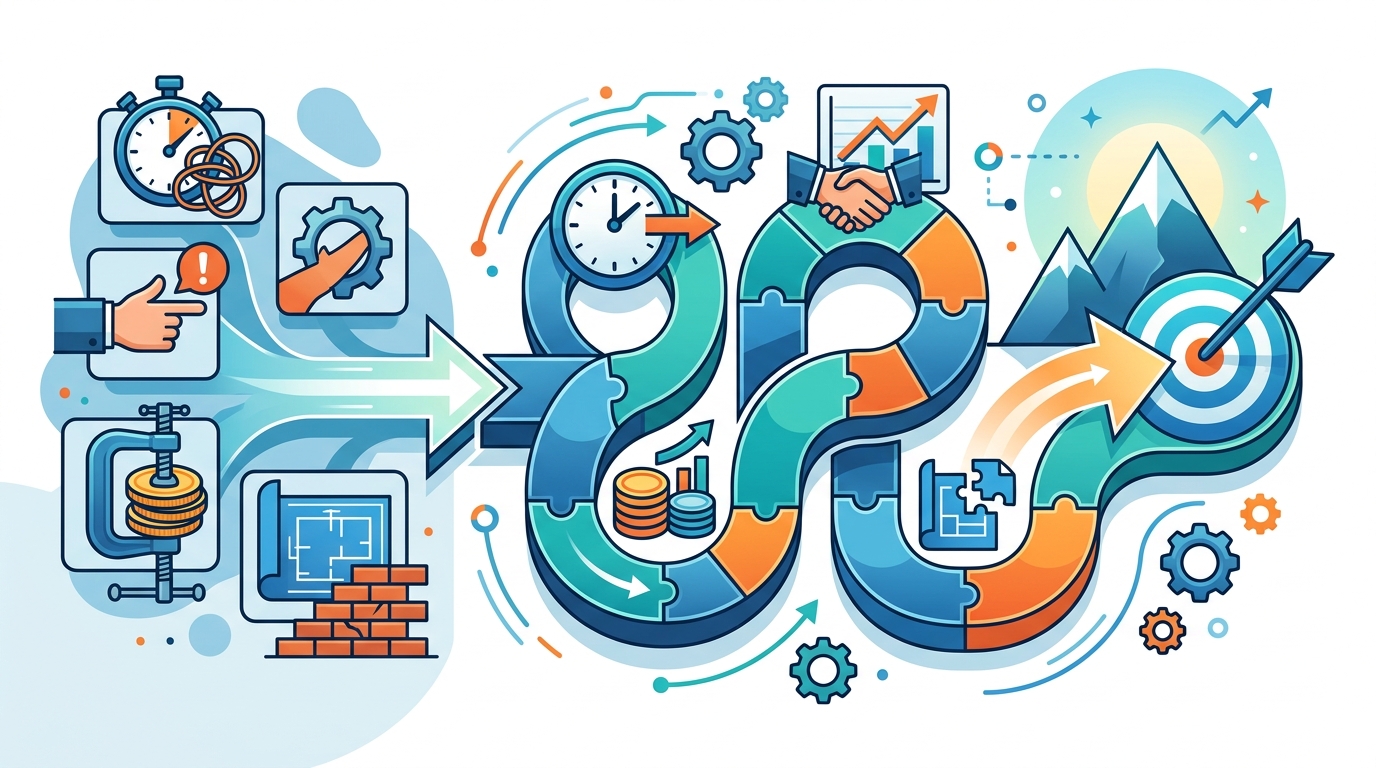
Challenge 2: One-Size-Fits-All Content
Generic training is the enemy of engagement. A one-size-fits-all programme is a training approach that delivers identical content to every participant regardless of role, experience level, or industry context. According to LinkedIn's Sales Enablement Report, inside reps favour digital learning, field reps prefer live coaching, and hybrid sellers need blended formats.
The Solution: Tailored, Role-Specific Programmes
Effective training starts with a thorough needs assessment. At Impel Dynamic, every bespoke sales programme begins with an analysis of your team's strengths, weaknesses, and real-world selling environment. Pre-training questionnaires ensure course content is customised for each delegate, so the skills taught are immediately applicable to their daily challenges.
Challenge 3: Poor Knowledge Retention
The forgetting curve is a cognitive phenomenon showing that people lose most new information within days without reinforcement. Research widely cited by Gartner indicates that B2B sales reps forget 70% of training content within one week and 87% within a month. This means even excellent training evaporates if there is no follow-up strategy.
The Solution: Reinforcement and Ongoing Development
Post-training reviews, coaching sessions, and structured action plans are essential. Impel Dynamic builds reinforcement into every programme, including post-training reviews at 8 to 12 weeks and one-on-one coaching to embed new behaviours. Scenario-based practice is rated effective by 69% of salespeople, making role-play and real-deal application critical tools for long-term retention.
Challenge 4: Lack of Accountability and Coaching
Sales coaching is the ongoing, personalised support a manager provides to help individual reps apply training, improve performance, and hit targets. Without it, even the best programme falls flat. Data shows that sellers who receive coaching during training are 44% more likely to consistently hit their sales targets. Yet only 26% of reps receive weekly coaching.
The Solution: Equip Your Managers First
Organisations with the most effective sales training are 5.2x more likely to invest in preparing sales managers to motivate and coach their teams. Leadership and management training gives your managers the frameworks to deliver consistent coaching, set clear objectives, and hold reps accountable through structured performance reviews rather than annual check-ins.
Challenge 5: Measuring ROI
Almost 52% of sales teams lack proper analytics to measure training ROI, making it difficult to justify continued investment. Without clear metrics, training risks being viewed as a cost centre rather than a growth driver.
The Solution: Define Metrics Before You Start
Set baseline KPIs before training begins and track them at 30, 60, and 90 days post-programme. The Phillips ROI formula (Benefits minus Costs, divided by Costs, multiplied by 100) provides a straightforward financial lens. Impel Dynamic agrees on measurable metrics at three levels before every programme: identifiable, quantifiable, and auditable. Organisations that connect training to business metrics like quota attainment and deal velocity consistently outperform those that rely on satisfaction surveys alone.
Training Approaches Compared
| Factor | Generic Off-the-Shelf Training | Bespoke Tailored Training |
|---|---|---|
| Content Relevance | Low; identical for all roles | High; customised to team and industry |
| Knowledge Retention | Poor without reinforcement | Strong with built-in follow-up coaching |
| Manager Involvement | Often minimal | Managers trained alongside reps |
| ROI Measurability | Difficult; vague outcomes | Clear KPIs set before programme starts |
| Delivery Flexibility | Fixed format | Virtual, in-person, or blended |
| Practical Application | Theory-heavy | Real-deal scenarios and action plans |
Impel Dynamic's sales training courses are designed around the bespoke model, with 97% of attendees rating programmes as highly practical and easy to implement and 92% of clients experiencing a high ROI.
Key Takeaways
- 72% of sales training fails because it tries to be one-size-fits-all. Customisation is non-negotiable.
- Use modular, blended delivery to overcome time constraints without pulling reps off the floor for days.
- Combat the forgetting curve with post-training reviews, coaching, and scenario-based reinforcement.
- Equip managers to coach first. Organisations that prepare managers see 5.2x better training outcomes.
- Set measurable KPIs before training starts and track results at 30, 60, and 90 days.
- Sellers who receive coaching during training are 44% more likely to hit their targets.
- Focus on ROI rather than cost per person when budgeting for sales development.
Frequently Asked Questions
What are the most common sales training challenges?
The most common challenges include time constraints for busy sales teams, generic content that does not match real-world roles, poor knowledge retention after sessions end, lack of manager coaching and accountability, and difficulty measuring return on investment.
How can I make sales training more effective?
Tailor content to your team's specific roles and selling environment, use blended delivery formats, build in post-training reinforcement, and ensure managers are equipped to coach reps on an ongoing basis.
Why do sales reps forget training so quickly?
The forgetting curve means reps lose up to 70% of new information within a week. Without reinforcement through coaching, practice, and refresher sessions, the initial investment fades rapidly.
How do you measure sales training ROI?
Set baseline metrics before training, then track improvements in KPIs such as win rate, deal size, pipeline velocity, and quota attainment at regular intervals. Use the Phillips ROI formula for a clear financial picture.
Should sales managers receive training too?
Absolutely. Managers are the frontline of skill development. Research shows that organisations investing in manager readiness see dramatically better training outcomes across the entire sales force.
What is bespoke sales training?
Bespoke sales training is a fully customised programme designed around your organisation's goals, team skill levels, and market context rather than a fixed off-the-shelf curriculum.
How long does it take to see results from sales training?
Initial behaviour changes can appear within weeks, but meaningful business outcomes such as increased revenue and higher win rates typically emerge over 3 to 6 months with proper reinforcement and coaching.
Is virtual sales training as effective as in-person?
Yes, when designed correctly. A blended approach combining virtual workshops, one-on-one coaching, and simulations can match or exceed in-person results while offering greater scheduling flexibility.
Take the Next Step
If your sales training is not delivering the results you expect, it is time to rethink your approach. Impel Dynamic specialises in bespoke sales programmes that are tailored to your team, reinforced through coaching, and measured against clear KPIs. Explore our sales training courses or get in touch with our experts for a free consultation to identify exactly where your current programme is falling short and how to fix it.