

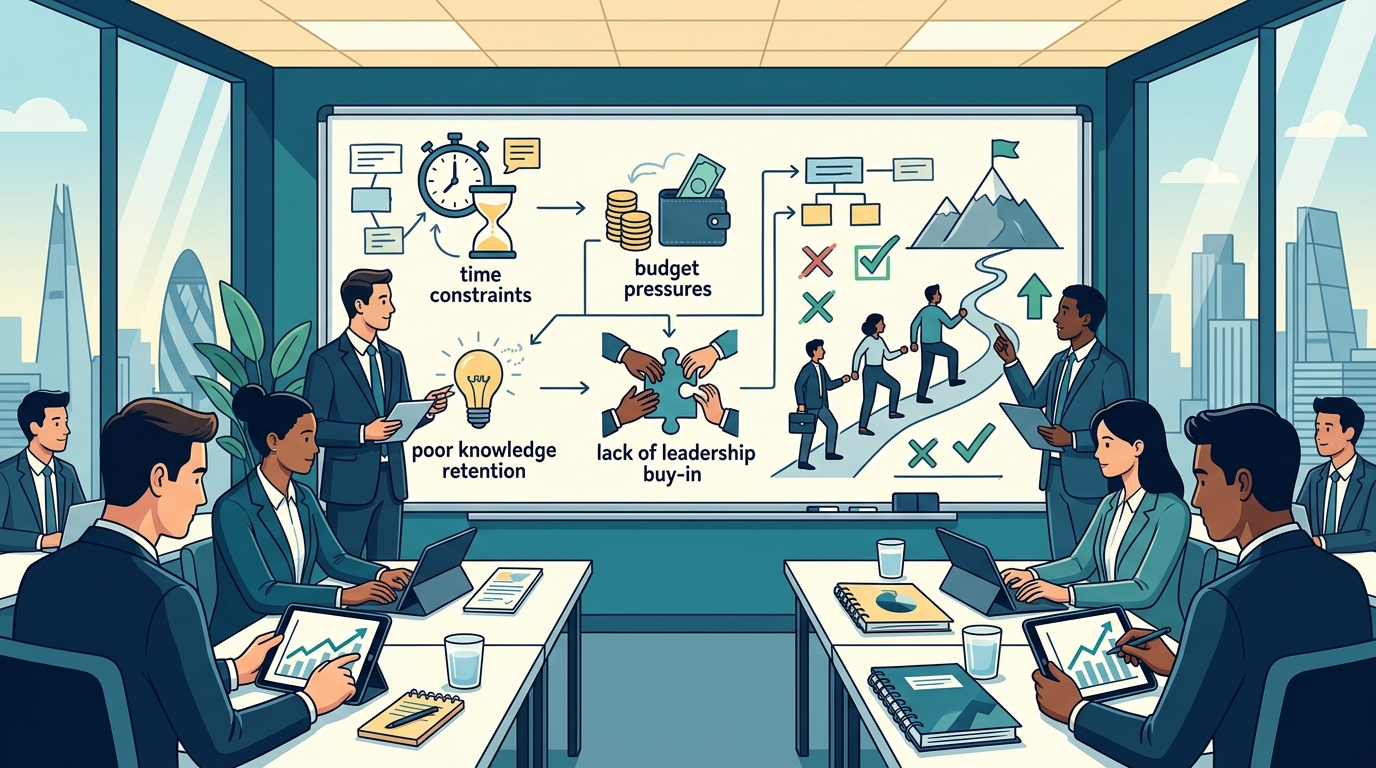
Implementing sales training sounds straightforward, but the reality is far messier. From time constraints and budget pressures to poor knowledge retention and lack of leadership buy-in, businesses across the UK and beyond face persistent obstacles that undermine their training investments. According to recent research from The Sales Collective, 72% of sales leaders say training fails because it tries to be one-size-fits-all. The good news? Every one of these challenges has a proven solution. This guide walks you through the most common pitfalls and shows you exactly how to overcome them.
1. Combating Poor Knowledge Retention
The forgetting curve is the single biggest threat to your training budget. Research shows that B2B sales reps forget 70% of training content within one week, and 87% forget it within a month. Without reinforcement, even the best sessions fade fast.
Use Spaced Reinforcement
Breaking content into bite-sized modules delivered over time leverages cognitive science for better retention. Microlearning, post-session exercises, and quick refresher resources keep skills sharp long after the classroom session ends.
Post-Training Reviews
At Impel Dynamic, every programme includes a post-training review designed to strengthen new skills and identify areas for follow-up coaching. This structured reinforcement is what separates lasting behavioural change from a forgettable workshop.
2. Moving Beyond One-Size-Fits-All Programmes
Generic training is a recognised problem. According to 2025 data, 72% of sales leaders attribute training failure to a one-size-fits-all approach. Sales training customisation is the process of tailoring programme content, delivery, and exercises to match the specific industry, team skill level, and sales environment of each organisation.
Tailor Content to Your Team
Effective providers analyse your business before designing a programme. Impel Dynamic's bespoke sales programmes begin with a needs assessment that examines your current processes, team strengths, and knowledge gaps. This ensures every session is directly relevant to your daily selling reality.
| Challenge | Root Cause | Solution |
|---|---|---|
| Poor retention | No reinforcement after training | Spaced learning, post-training reviews, coaching |
| Generic content | One-size-fits-all programmes | Pre-training needs assessment, bespoke design |
| Time constraints | Pressure to sell rather than learn | Modular, blended delivery (virtual + in-person) |
| Budget limitations | High upfront costs, unclear ROI | Pilot programmes, ROI-focused budgeting |
| No ROI measurement | Reliance on satisfaction surveys only | KPI tracking, before/after comparison |
| Lack of accountability | No manager reinforcement | Sales coaching, 90-day action plans |
3. Overcoming Time Constraints
Sales teams are under constant pressure to generate new clients and manage existing accounts. Finding time for training is one of the most frequently cited obstacles. A modular, blended approach can help solve this problem.
Using a flipped classroom model with microlearning before interactive sessions allows reps to absorb concepts in advance and then practise application during shorter live workshops. Impel Dynamic offers both virtual sales training and in-person courses across London, Manchester, and Birmingham, giving teams the flexibility to train without losing valuable selling days.
4. Addressing Budget Limitations
Budget constraints are a genuine barrier. More than 43% of small businesses cite high implementation costs as a reason they avoid advanced sales training. A sales training budget is the allocated financial resource an organisation commits to developing its salesforce through structured learning initiatives.
The smartest approach is to focus on return on investment rather than cost per head. For every dollar spent on sales training, companies see an average of $4.53 in return. Starting with a small pilot group, demonstrating measurable results, and then expanding is a proven strategy that reduces financial risk. Explore Impel Dynamic's range of sales training courses to find options that match your budget and goals.
5. Measuring Training ROI Effectively
Almost 52% of sales teams lack proper analytics to measure training ROI. Without evidence of business impact, leaders are left guessing whether their investment worked. Sales training ROI is the measurable financial return generated by improved sales performance relative to the cost of the training programme.
Use a Proven Framework
The Kirkpatrick evaluation model provides a four-level structure: reaction, learning, behaviour, and results. This progression moves beyond satisfaction surveys to track actual behavioural change and revenue impact over 6 to 12 months.
Track Lead and Lag Indicators
Lead indicators include pipeline activity and call quality scores. Lag indicators cover win rates, deal velocity, and quota attainment. Together, they paint a complete picture. 92% of Impel Dynamic clients report a high ROI from their programmes, backed by measurable KPI improvements.
6. Embedding Coaching and Accountability
Even the best training programmes fall flat without reinforcement from direct managers. Sellers who receive coaching during training are 44% more likely to hit their targets. Yet only 26% of sales reps receive weekly coaching.
Organisations with the most effective sales training are 5.2x more likely to prepare sales managers to motivate and coach their teams. That is why Impel Dynamic pairs its programmes with strategic one-on-one sales coaching that turns knowledge into daily habits. Structured 90-day action plans, peer accountability, and manager-led reviews create the multi-layered support system that drives lasting change.
Key Takeaways
- Sales reps forget up to 87% of training content within a month without reinforcement. Build spaced learning and coaching into every programme.
- 72% of training failures stem from generic, one-size-fits-all content. Always customise to your team's environment.
- Blended delivery (virtual plus in-person) solves time constraints and suits different learning styles.
- Focus on ROI, not cost per person. Companies see an average $4.53 return for every $1 invested in sales training.
- Use the Kirkpatrick model or similar frameworks to measure real business impact, not just satisfaction scores.
- Manager coaching is the single most important factor in translating training into results.
- Start with a pilot group, prove measurable results, then scale the programme across your organisation.
Frequently Asked Questions
What is the biggest challenge in implementing sales training?
The most common challenge is poor knowledge retention. Without reinforcement strategies like coaching, spaced learning, and post-training reviews, reps forget the majority of what they learn within weeks.
Why does one-size-fits-all sales training fail?
Generic programmes ignore role-specific challenges, industry context, and individual skill levels. Research shows 72% of sales leaders attribute training failure to this approach. Tailored, bespoke programmes consistently produce better outcomes.
How can businesses measure sales training ROI?
Use established frameworks such as the Kirkpatrick model, which tracks reaction, learning, behaviour, and business results. Compare KPIs like win rates, deal velocity, and quota attainment before and after training over a 6 to 12 month window.
How much should a company budget for sales training?
Rather than setting a fixed number, budget based on expected ROI. The global sales training market is valued at over $6.2 billion (2025), and companies that invest strategically report an average return of $4.53 per $1 spent.
What role does coaching play in sales training success?
Coaching is critical. Reps who receive feedback during training are 44% more likely to hit targets. Ongoing one-on-one coaching after the programme ensures skills are applied consistently in real selling situations.
Is virtual sales training as effective as in-person?
When designed properly, virtual training is highly effective. A blended approach combining virtual workshops, simulations, and in-person sessions accommodates different learning styles. 53% of sales leaders have adopted more virtual training in response to hybrid work.
How long does it take to see results from sales training?
Lead indicators such as improved pipeline activity can appear within weeks. Lag indicators like higher win rates and revenue growth typically materialise over 3 to 6 months, which is why ongoing measurement matters.
What makes Impel Dynamic's approach different?
Impel Dynamic customises every programme based on a pre-training assessment, uses experienced salespeople as trainers, and provides structured post-training reviews and coaching. 95% of course participants rate the programmes as outstanding.
Get Started With Sales Training That Works
If your sales training is not delivering lasting results, it is time to take a different approach. Impel Dynamic's expert-led, fully customised programmes are designed to solve the exact challenges outlined above. From bespoke content and blended delivery to post-training coaching and measurable KPIs, every element is built around your team's success. Explore our sales training courses or get in touch today for a free consultation and discover how we can help your team close more, sell smarter, and grow faster.