

Solving Common Sales Training Challenges: A Practical Guide for Businesses
Implementing sales training should accelerate revenue growth, but many organisations struggle to turn investment into lasting results. Research shows that 72% of sales leaders say training fails because it tries to be one-size-fits-all, while 62% cite outdated content as their top barrier. If your team has ever walked out of a training session energised only to revert to old habits weeks later, you are not alone. This guide breaks down the most common sales training implementation challenges and gives you proven strategies to overcome each one, so your next programme delivers measurable impact from day one.
1. The Knowledge Retention Problem
The forgetting curve is a well-documented phenomenon first identified by psychologist Hermann Ebbinghaus. It explains why B2B sales reps forget 70% of training content within one week and 87% within a month. For businesses investing thousands of pounds in development, that statistic is alarming.
How to Fix It
Replace one-off workshops with continuous learning systems. Microlearning is the practice of delivering training in short, focused bursts that align with how the brain retains information. Pair microlearning modules with scenario-based practice sessions. According to industry data, scenario-based training is rated effective by 69% of salespeople. A bespoke sales programme that includes ongoing reinforcement ensures skills are practised, not just learned.
2. Outdated or Generic Content
Sales training content is the material, frameworks, and methodologies used to upskill your team. When that content has not been updated to reflect modern buyer behaviour and digital selling, it becomes a barrier rather than an enabler. A 2025 study found that 48% of sales leaders cite digital selling skills as the least addressed area in training.
Tailor Training to Your Reality
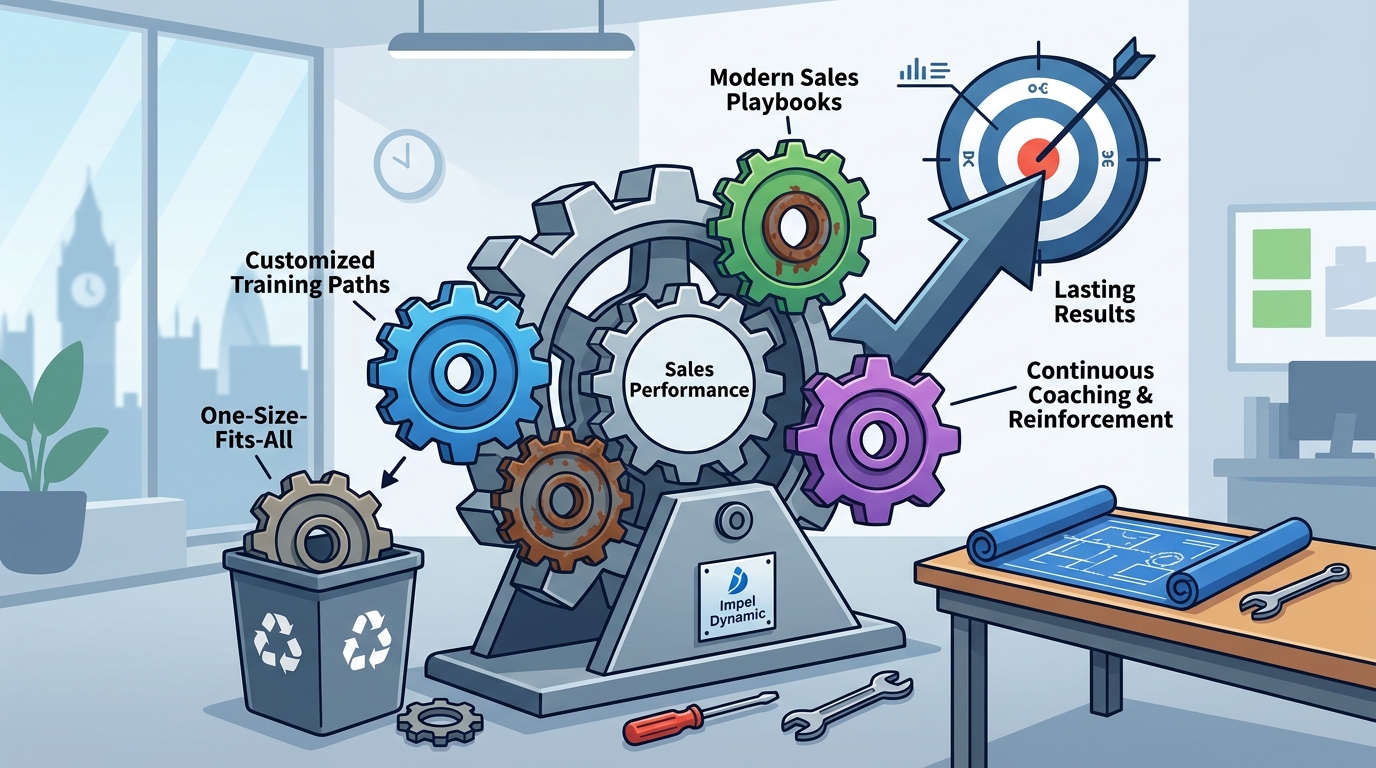
Generic programmes that ignore your industry, sales cycle, and team maturity level will underperform. The most effective providers customise content around your real-world challenges. At Impel Dynamic, for example, delegates are asked to bring their action plans, targets, and objections to the training so every session is immediately relevant. This approach is why 95% of Impel Dynamic course participants rate the experience as outstanding.
3. Time Constraints and Competing Priorities
Sales teams are under constant pressure to hit targets, manage accounts, and prospect for new business. Finding time for development feels like a luxury. RAIN Group's 2025 research confirms that time commitment is one of the most frequently cited barriers to effective training implementation.
Adopt a Modular, Blended Approach
A blended learning model combines virtual modules with focused in-person sessions so reps learn without losing entire selling days. Virtual sales training allows teams to access workshops, simulations, and one-on-one coaching from anywhere. This flexibility is why 53% of sales leaders have shifted to more virtual training in response to hybrid working.
| Challenge | Root Cause | Recommended Solution |
|---|---|---|
| Knowledge forgotten quickly | No post-training reinforcement | Microlearning + ongoing coaching |
| Content feels irrelevant | Generic, one-size-fits-all design | Customised programmes with real scenarios |
| No time for training | Competing revenue targets | Modular, blended virtual delivery |
| No behaviour change | Lack of accountability systems | Manager coaching + peer reviews |
| Cannot prove ROI | No baseline metrics or tracking | Pre/post KPIs + lag indicators |
| Managers not involved | No leadership enablement | Sales management training |
4. Lack of Accountability and Reinforcement
Accountability is the system of follow-through that ensures sales reps apply what they learn. Without it, even the best training fades. Organisations with highly effective training are 5.2 times more likely to offer resources that prepare sales managers to motivate and coach their teams.
Build a Reinforcement System
Structured post-training reviews, peer accountability groups, and sales coaching sessions create layers of support. Impel Dynamic builds this into every programme with post-training reviews at 8 to 12 weeks and clear action plans delegates can implement immediately. Reps who receive coaching during training are 44% more likely to hit their targets.
5. Difficulty Measuring ROI
Nearly 52% of sales teams lack proper analytics to measure training ROI, which makes it difficult to justify continued investment. If you cannot show executives a clear link between training spend and revenue, budget approvals become harder every year.
Use a Structured Measurement Framework
Adopt the Kirkpatrick model or Phillips ROI framework to evaluate training at multiple levels, from learner satisfaction to business impact. Establish baseline KPIs before any programme begins and track lag indicators such as win rates, deal velocity, and quota attainment for six to twelve months after training. When clients work with Impel Dynamic, measurable improvements in KPIs are a consistent outcome, with 92% of clients reporting a high return on investment.
6. Under-Equipped Sales Managers
Sales managers are the frontline of skill reinforcement, yet many have never received formal training in coaching or leadership. Without capable managers reinforcing new behaviours, training gains evaporate.
Invest in Management Development
Equip your managers with the tools to coach, motivate, and hold teams accountable. Leadership and management training should be a prerequisite before rolling out team-wide sales programmes. The open sales management course from Impel Dynamic covers coaching, performance management, and sales forecasting so managers can sustain the change long after the trainer leaves the room.
Key Takeaways
- The forgetting curve means one-off training events waste budget; continuous reinforcement is essential.
- 72% of training failures stem from generic, one-size-fits-all approaches; always customise.
- Blended and virtual delivery models solve the time-constraint problem for busy sales teams.
- Accountability systems, including manager coaching and peer reviews, multiply training impact.
- Measure ROI with structured frameworks and baseline KPIs, not just satisfaction surveys.
- Sales manager development is a prerequisite for lasting behaviour change across the team.
- Organisations that invest in tailored, reinforced training see measurable improvements in win rates, deal size, and revenue.
Frequently Asked Questions
What is the biggest reason sales training fails?
The most common reason is a one-size-fits-all approach. Research from 2025 shows that 72% of sales leaders attribute training failure to generic content that does not address role-specific challenges or the team's actual selling environment.
How quickly do sales reps forget training content?
Studies indicate that B2B sales reps forget 70% of training material within one week and 87% within a month. This is driven by the forgetting curve, a cognitive phenomenon that makes ongoing reinforcement critical.
How can I measure the ROI of sales training?
Use a structured evaluation model such as Kirkpatrick or Phillips ROI. Establish baseline metrics before training begins and compare win rates, quota attainment, and deal velocity over six to twelve months post-programme.
What is blended learning in sales training?
Blended learning is a training delivery model that combines virtual modules, self-paced content, and live instructor-led sessions. It reduces time away from selling while accommodating different learning styles. Over 60% of sales teams now prefer this format.
How do I get buy-in from sales reps who resist training?
Focus on relevance. When training content mirrors the real deals, objections, and targets reps face daily, resistance drops. Pre-training assessments that capture each delegate's challenges make sessions feel practical rather than theoretical.
Should sales managers be trained before their teams?
Yes. Managers who understand coaching techniques and can reinforce new skills are the single biggest factor in sustaining training results. Organisations with effective training are over five times more likely to have well-prepared managers.
How long should a sales training programme last?
The best programmes are not single events. They combine intensive workshops (one to five days) with ongoing coaching, post-training reviews, and reinforcement modules over several months to embed lasting behaviour change.
Is virtual sales training as effective as in-person?
When designed well, yes. A blended approach using virtual workshops, simulations, and one-on-one coaching can match or exceed in-person results while offering greater flexibility and lower logistics costs.
Take the Next Step
If your organisation is ready to solve these challenges and build a sales team that consistently exceeds targets, speak with the experts at Impel Dynamic. With customised programmes, post-training reinforcement, and a 92% high-ROI track record, Impel Dynamic helps businesses across the UK turn training investment into measurable revenue growth. Explore sales training courses or get in touch today for a free consultation.