

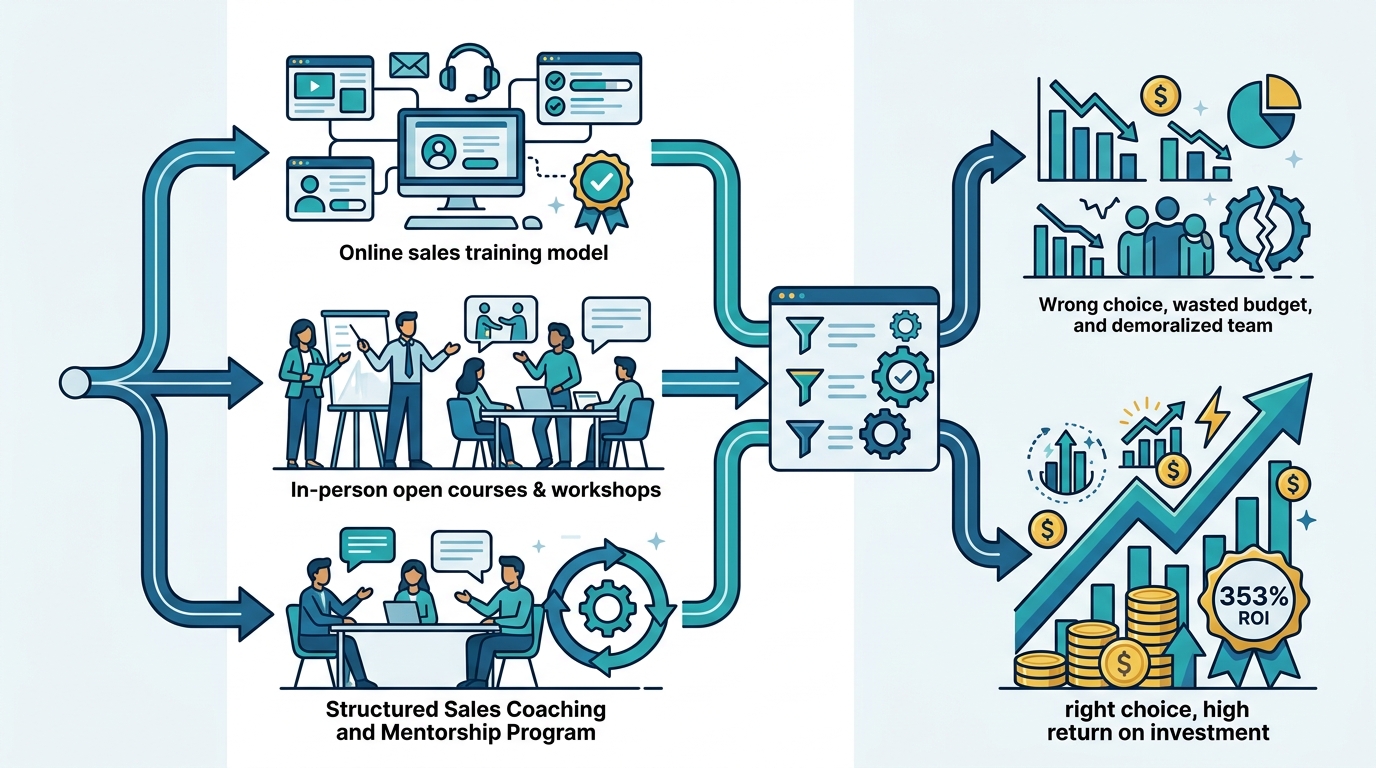
Selecting the right sales training solution is one of the most consequential decisions a business leader can make. With the global sales training market valued at over $10 billion in 2024 and projected to reach nearly $19 billion by 2032, the options available can feel overwhelming. The wrong choice wastes budget and demoralises your team; the right one can deliver a 353% return on investment. This guide walks you through proven strategies for evaluating, comparing, and selecting a sales training provider that truly fits your organisation's goals, culture, and growth ambitions.
1. Define Your Sales Goals and Skill Gaps
A sales training solution is a structured programme designed to equip sales professionals with the skills, frameworks, and confidence needed to close more deals. Before you compare providers, you need absolute clarity on what problem you are solving.
Identify Specific Weaknesses
Are your reps struggling with prospecting, negotiation, or closing C-suite buyers? As Highspot recommends, pinpoint your top problems, desired improvements, and goals so you can pick the right courses for your reps. A provider like Impel Dynamic begins every engagement with a pre-training needs analysis to target the right content.
Align Training to Business Outcomes
Training should map directly to revenue targets. Organisations that align instruction to tangible business outcomes see the greatest gains. Define KPIs such as average deal size, win rate, or pipeline velocity before you begin your search.
2. Understand Delivery Formats
A delivery format is the method through which training content reaches your team, whether in person, virtual, or blended. The best format depends on your team's location, schedule, and learning preferences.
In-Person, Virtual, and Hybrid
Research from The Sales Collective shows that a mix of in-person and virtual training works for 90% of sales leaders. Providers such as Impel Dynamic offer virtual sales training alongside in-person courses in London, Manchester, and Birmingham, giving teams flexibility without sacrificing quality.
Open Courses vs. Bespoke Programmes
Open courses let individuals join scheduled sessions with peers from other companies. Bespoke programmes are fully tailored to your organisation's products, market, and sales cycle. If you have multiple delegates, a tailored sales training programme is often more cost-effective and relevant.
3. Evaluate Provider Credentials and Track Record
Not all training providers are equal. A proven track record is one of the most reliable indicators of quality.
Look for Real-World Sales Experience
The best trainers have extensive first-hand selling experience. At Impel Dynamic, trainers have actively sold in diverse B2B and B2C markets and driven results worth millions of pounds. Ask any prospective provider for case studies and client testimonials before committing.
Check Satisfaction and Outcome Data
Impel Dynamic reports that 95% of course participants rate their courses as outstanding, and 92% of clients experience a high ROI. Request similar data from every provider on your shortlist.
4. Prioritise Customisation Over Generic Content
A customised sales training programme is one that is built around your team's specific challenges, industry, and selling environment rather than a one-size-fits-all curriculum. Generic programmes often fail because they do not reflect your daily reality.
Impel Dynamic's approach includes a pre-training questionnaire and tailored content that addresses each delegate's actual targets, objections, and action plans. This level of personalisation is what separates training that sticks from training that is forgotten within a week. According to industry data, 70% of training content is forgotten within one week if not reinforced.
5. Plan How You Will Measure ROI
Before signing a contract, establish how you will track the impact. Only 33% of sales leaders currently use formal assessments to measure training ROI, which means the majority are investing without a clear feedback loop.
Effective measurement combines multiple approaches: knowledge retention assessments, sales target tracking, and behavioural observation through coaching. Look for providers that offer post-training reviews. Impel Dynamic, for example, includes an 8-to-12-week post-course review to identify areas for ongoing one-on-one coaching.
6. Compare Your Shortlisted Options
Once you have narrowed your list, use a structured comparison to make the final decision. The table below outlines the key criteria to evaluate side by side.
| Evaluation Criteria | What to Look For | Red Flags |
|---|---|---|
| Trainer Experience | Active selling background in your market | Trainers with only academic credentials |
| Customisation | Pre-course assessment and tailored content | Fixed, off-the-shelf curriculum only |
| Delivery Flexibility | In-person, virtual, and hybrid options | Single format with no alternatives |
| Post-Training Support | Coaching reviews, action plans, reinforcement | No follow-up after course delivery |
| Measurable Outcomes | Client ROI data, satisfaction scores, case studies | Vague promises with no evidence |
| Cost vs. Value | Clear pricing tied to scope and outcomes | Hidden fees or unclear deliverables |
Weighing each provider against these criteria removes guesswork and ensures your investment is well placed.
Key Takeaways
- Start by defining specific skill gaps and aligning training to measurable business outcomes before you evaluate providers.
- A blended delivery approach (in-person plus virtual) works for 90% of sales leaders and maximises flexibility.
- Customisation is non-negotiable. Tailored programmes vastly outperform generic, off-the-shelf content.
- Demand evidence of results: satisfaction scores, ROI data, and client case studies from every provider.
- Plan your measurement framework before training begins. Track knowledge retention, target attainment, and behavioural change.
- Post-training reinforcement through coaching reviews prevents the rapid knowledge decay that undermines most programmes.
- Sales training delivers an average 353% ROI, making it one of the highest-return investments a business can make.
Frequently Asked Questions
What is the average ROI of sales training?
Sales training delivers an average ROI of 353%, meaning every pound or dollar invested returns approximately four times its value in revenue gains. Companies that prioritise training are 57% more effective than competitors who do not.
How do I identify the right sales training provider for my team?
Look for providers with real-world selling experience, strong client testimonials, and a willingness to customise content. Impel Dynamic, for instance, only employs trainers who have generated millions in sales themselves and tailors every programme to the client's environment.
Should I choose in-person or virtual sales training?
Most organisations benefit from a blended approach. Virtual training offers flexibility and cost savings, while in-person sessions build deeper engagement. Providers like Impel Dynamic offer both formats across multiple UK locations.
How long does it take to see results from sales training?
Initial improvements in confidence and technique can appear within days. Measurable revenue impact typically emerges within 8 to 12 weeks, which is why post-training coaching reviews are critical for sustained performance gains.
What makes bespoke sales training better than off-the-shelf courses?
Bespoke training is built around your specific products, sales cycle, and competitive landscape. It addresses your team's actual objections and targets, leading to faster adoption and stronger results compared to generic content.
How often should my sales team receive training?
At a minimum, teams should receive training annually. However, continuous coaching and reinforcement produce the best long-term outcomes. Ongoing development prevents knowledge decay and keeps skills sharp as markets evolve.
What criteria should I use to compare sales training providers?
Evaluate trainer experience, customisation depth, delivery flexibility, post-training support, measurable outcome data, and overall cost versus value. Use a structured comparison table to remove bias from the decision.
Ready to Choose the Right Sales Training Solution?
Impel Dynamic helps businesses across the UK and internationally win more deals, grow their talent, and retain valuable clients through fully customised sales training programmes. Whether you need a one-day advanced sales course or a long-term bespoke development programme, our expert trainers will meet you where you are and take your team to the next level. Explore our sales training courses or get in touch for a free consultation today.