

How Sales Training Helps Businesses Retain Valuable Clients and Grow Their Talent Pool
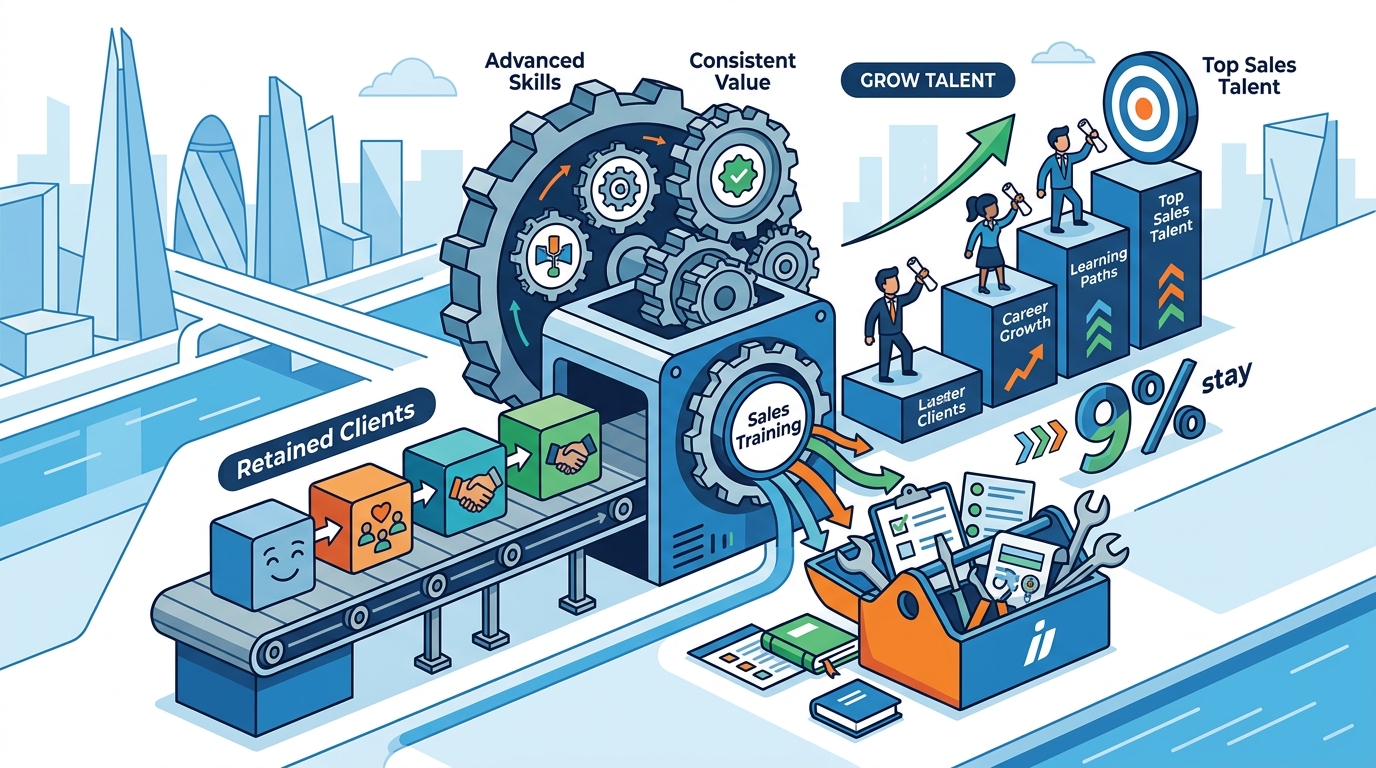
Retaining your best clients and developing top sales talent are two sides of the same coin. When your team lacks the skills to deliver consistent value, clients drift away and high performers follow. Sales training is the structured process of equipping sales professionals with the knowledge, techniques, and confidence they need to sell more effectively and build lasting relationships. According to industry data, 94% of salespeople say they would stay at a company longer if it invested in their learning and career growth. For UK businesses looking to protect revenue and attract ambitious professionals, strategic sales training is no longer optional.
Why Client Retention and Talent Growth Are Business-Critical
Client retention is the ability of a business to keep its existing customers over a given period. Research shows that returning customers spend 67% more than new customers, making retention as critical as acquisition. Losing a key account does not just reduce revenue; it weakens your market position and wastes the relationship-building work your team has already done.
On the talent side, the average voluntary turnover rate in sales is 35%, nearly triple the overall workforce average. Every departure carries recruitment costs, lost institutional knowledge, and disruption to client relationships. Businesses that invest in structured development address both challenges simultaneously.
The Skills Gap Costing You Clients
Many sales teams operate with outdated techniques that fail to meet modern buyer expectations. A RAIN Group study found only 18% of buyers believe salespeople are well-prepared for conversations. When your team cannot articulate value or adapt to a client's evolving needs, competitors step in.
The gap extends to digital selling. Nearly 48% of sales leaders cite digital selling skills as the least addressed area in their training efforts. Businesses that fail to close this gap risk losing clients who now expect seamless virtual and in-person engagement. Virtual sales training helps teams master hybrid selling so they can meet buyers on their preferred channels.
How Sales Training Drives Client Retention
Building Trusted Advisor Relationships
Effective sales training transforms transactional sellers into trusted advisors. When professionals learn consultative selling, they focus on understanding a client's strategic goals rather than simply pushing products. Impel Dynamic's advanced sales training course teaches delegates how to identify purchasing drivers, sell on value, and position themselves as strategic partners to C-suite decision-makers.
Strengthening Key Account Management
Key account management is the systematic approach to nurturing and expanding relationships with a business's most valuable clients. Through bespoke sales programmes, teams learn cross-selling and upselling techniques that deepen client engagement. When your people know how to spot new opportunities within existing accounts, retention becomes a natural outcome of the relationship.
Improving Post-Sale Experience
Client retention does not end at the close. Trained sales professionals understand how to manage expectations, follow through on commitments, and proactively solve problems. This ongoing engagement keeps clients loyal and turns them into advocates for your business.
Growing Your Talent Pool Through Development
Top sales talent gravitates toward organisations that invest in their growth. According to recent data, 62% of graduates prioritise opportunities that offer comprehensive training when choosing employers. A clear development pathway signals that your business is serious about helping people advance.
Structured programmes like the open sales management course from Impel Dynamic give managers the tools to coach, motivate, and develop their teams. When managers can provide effective guidance, the entire team's performance improves, creating a culture that attracts and retains ambitious professionals.
Ongoing sales training courses also reduce onboarding time for new hires. Instead of spending months finding their feet, new team members gain practical frameworks they can apply from day one, accelerating their contribution to revenue targets.
The ROI of Investing in Sales Training
The financial case for sales training is compelling. The table below summarises key metrics from recent industry research:
| Metric | Value | Source |
|---|---|---|
| Average ROI of sales training | 353% | Myers Barnes / Qwilr |
| Companies more effective with training investment | 57% more effective than competitors | Qwilr, 2025 |
| Salespeople who would stay longer with training investment | 94% | LLCBuddy / Continu |
| Sales training content forgotten within 3 months (without reinforcement) | 84% | Qwilr, 2025 |
| Global sales training market value (2025) | $6.26 billion | Global Growth Insights |
| Graduates prioritising training opportunities | 62% | Qwilr, 2025 |
These figures make one thing clear: sales training is not a cost centre. It is a strategic investment that compounds across client retention, talent acquisition, and revenue growth. Impel Dynamic clients consistently report measurable KPI improvements, with 92% experiencing high ROI and 88% saying courses exceeded expectations.
Choosing the Right Sales Training Programme
Look for Customisation
Generic training rarely sticks. High-growth companies are twice as likely to provide customised training to their employees. Look for providers that assess your team's current skill level and tailor content to your market, challenges, and goals. Impel Dynamic's approach begins with a pre-training questionnaire and analysis so every session is relevant to delegates' real-world selling environment.
Demand Ongoing Reinforcement
Since the majority of training content is forgotten within three months without follow-up, reinforcement is essential. Effective programmes include post-training reviews, one-on-one sales coaching, and actionable implementation plans that keep skills sharp over time.
Prioritise Experienced Trainers
The quality of the trainer matters enormously. Sales trainers who have personally closed significant deals bring credibility and real-world insight that theoretical instructors simply cannot match. Impel Dynamic's trainers have driven multi-million pound results across B2B and B2C markets.
Key Takeaways
- Returning customers spend 67% more than new ones, making client retention a primary revenue driver.
- 94% of salespeople would stay longer at companies that invest in their development.
- Sales training delivers an average ROI of 353%, far outweighing its cost.
- Consultative selling skills transform salespeople into trusted advisors, strengthening long-term client relationships.
- Customised, reinforced training programmes outperform generic, one-off courses.
- 62% of graduates prioritise employers offering strong training, giving trained organisations a recruitment advantage.
- Investing in sales management training creates better leaders who retain and develop top talent.
Frequently Asked Questions
What is sales training?
Sales training is a structured learning process designed to improve the selling skills, product knowledge, and strategic thinking of sales professionals. It can include workshops, coaching, online modules, and role-play exercises.
How does sales training improve client retention?
Training equips salespeople with consultative selling, relationship management, and account growth skills. These capabilities help them deliver ongoing value to clients, reducing churn and strengthening loyalty.
Why do sales professionals leave their jobs?
The top reasons include lack of career growth, poor management, and insufficient development opportunities. Sales has a 35% voluntary turnover rate, but structured training and clear career pathways can prevent many departures.
What ROI can businesses expect from sales training?
Research indicates an average ROI of 353% from sales training investments. Companies that prioritise training are also 57% more effective than competitors who do not.
How long does it take to see results from sales training?
Many participants see improvements immediately when training is practical and applicable. However, sustained results require reinforcement through coaching and regular skill reviews over 8 to 12 weeks and beyond.
Is online sales training as effective as in-person?
A blended approach combining in-person and virtual sessions is used by 90% of sales leaders and is considered the most effective model. The key is choosing a provider that designs interactive, practical virtual sessions rather than passive webinars.
How do I choose the right sales training provider in the UK?
Look for providers with a proven track record, experienced trainers who have sold in real markets, and the ability to customise programmes to your business. Check client testimonials and measurable results. Impel Dynamic, for example, reports that 95% of course participants rate their courses as outstanding.
Take the Next Step
If you are ready to retain more clients and build a stronger sales team, explore Impel Dynamic's sales training courses or request a bespoke programme tailored to your business goals. Contact the team today to discuss how targeted training can drive measurable growth for your organisation.