

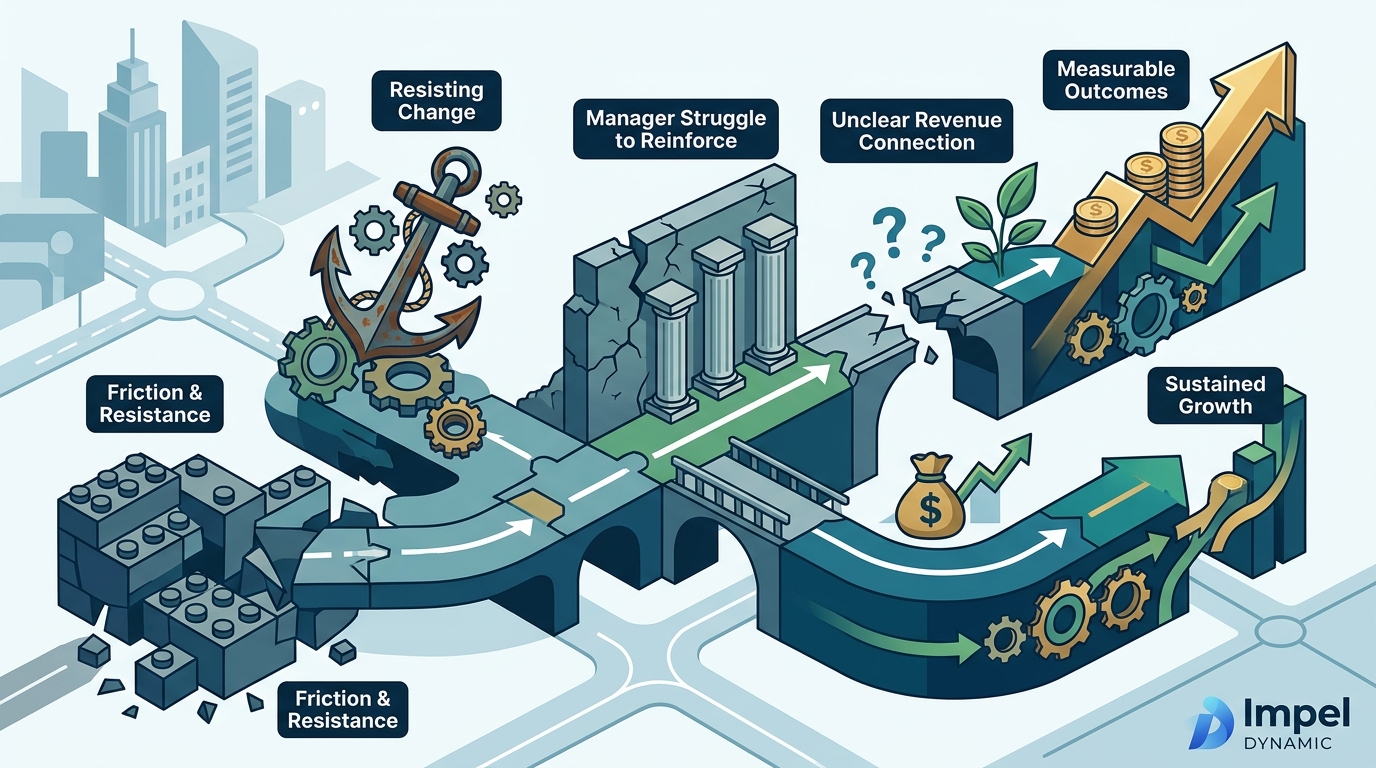
Organizations frequently encounter friction when rolling out new sales education initiatives. Teams often resist changes to established habits, managers struggle to reinforce concepts, and the connection between classroom learning and actual revenue generation remains unclear. Addressing these implementation barriers requires a structured approach that prioritizes relevance, continuous support, and measurable outcomes. Businesses that resolve these issues typically see sustained performance improvements and stronger team cohesion.
Addressing the Customization Gap
One of the most frequent obstacles involves generic content that fails to reflect a company's unique market position. When training materials do not mirror the specific products, competitors, or customer personas, representatives struggle to apply the lessons. Bespoke sales programmes eliminate this disconnect by building curriculum around your actual selling environment. This ensures the team receives tools they can deploy immediately without needing to translate abstract concepts into daily actions.
Bespoke sales training is a customized educational framework designed to address the specific operational hurdles and revenue goals of a distinct organization. By focusing on your unique value proposition and sales cycle, you remove the guesswork and accelerate the path to proficiency.
Overcoming Resistance to New Methodologies
Adoption resistance often stems from a perception that new processes add administrative burden rather than simplifying the workflow. Salespeople prioritize closing deals and may view training as a distraction from revenue-generating activities. To solve this, effective programs focus on immediate utility and quick wins. By demonstrating how a new technique accelerates a specific stage of the pipeline, you build momentum and reduce skepticism among the wider team.
Leaders must actively champion the new approach and celebrate early successes. When representatives see peers achieving better results through the new methods, peer-to-peer influence drives broader acceptance. This cultural shift transforms training from a mandatory requirement into a competitive advantage.
Bridging the Leadership-Execution Divide
Training frequently fails when managers lack the framework to coach their teams effectively. A representative might master a skill in a workshop but revert to old habits once back in the field without managerial reinforcement. Leadership coaching equips managers with the diagnostic tools to identify skill gaps and provide targeted feedback. This alignment ensures that the entire hierarchy drives the same strategic behaviors.
Leadership alignment is the strategic synchronization of management expectations with frontline execution to ensure consistent application of sales skills. Without this bridge, knowledge decays rapidly, and the return on training investment diminishes over time.
Managing Growth and Process Scalability
As organizations expand, maintaining consistent sales performance across new hires and regions becomes increasingly difficult. Ad-hoc training methods do not scale and lead to uneven results. A scalable sales process standardizes the core competencies required for success while allowing room for regional nuance. Business development strategies must integrate seamlessly with training to ensure that lead generation and sales execution operate as a unified engine.
Scalability also requires documentation and standardized resources that new team members can access independently. Creating a central repository of playbooks, call recordings, and objection handling guides empowers representatives to self-serve and reduces the dependency on senior staff for every interaction.
Establishing Clear Feedback Loops
Without robust measurement, it is impossible to determine if training investments yield returns. Many companies track attendance but ignore behavioral changes or pipeline impact. Implementing regular assessments and performance reviews creates a continuous improvement cycle. This data-driven approach allows you to refine content and address emerging challenges before they affect revenue targets.
Regular pulse checks and skill audits help identify areas where the team needs additional support. By correlating training completion with key performance indicators, you can justify ongoing investment and demonstrate the tangible value of your educational programs to stakeholders.
Choosing the Right Delivery Format
Logistical constraints often dictate the success of a training initiative. Remote teams require virtual engagement, while complex product launches may benefit from intensive in-person sessions. Selecting the appropriate delivery mode ensures maximum retention and interaction. Impel Dynamic offers flexible options including virtual, in-house, and open courses to match your operational needs.
Sales methodology is the systematic sequence of steps and behaviors that guides a representative from initial prospecting through to final deal closure. The delivery format should support the mastery of this methodology without introducing unnecessary friction or technical barriers.
Comparing Training Implementation Models
| Model | Best Use Case | Key Advantage |
|---|---|---|
| Open Courses | Individual skill development or small teams | Cost-effective access to proven frameworks |
| In-House Training | Large teams requiring deep customization | Complete alignment with internal processes |
| Virtual Training | Geographically dispersed teams | Flexibility and reduced travel overhead |
| Bespque Programmes | Complex sales environments with unique challenges | Tailored solutions for maximum impact |
Key Takeaways
- Generic training content fails to address specific market dynamics and product complexities.
- Resistance to change decreases when programs demonstrate immediate utility and quick wins.
- Manager enablement is critical for sustaining behavioral changes after the initial training period.
- Scalable processes require standardized documentation and consistent feedback mechanisms.
- Measuring training effectiveness through behavioral metrics ensures continuous improvement.
- Delivery formats must align with team structure and logistical constraints.
- Customized programmes deliver higher relevance and faster adoption rates.
Frequently Asked Questions
How do you measure the success of sales training?
Success is measured by tracking behavioral changes, pipeline progression, and revenue impact. Key metrics include conversion rates, deal velocity, and average deal size. Regular skill assessments and manager feedback provide qualitative data to complement quantitative results.
What is the difference between open courses and bespoke programmes?
Open courses provide standardized content suitable for individual skill enhancement. Bespoke programmes are fully customized to address your specific operational challenges, products, and sales cycle. The latter ensures immediate applicability and higher relevance for your team.
How can leadership support training implementation?
Leadership supports implementation by reinforcing concepts, providing coaching, and aligning incentives with new behaviors. Managers must model the desired skills and hold the team accountable to the new standards. Regular check-ins and feedback sessions sustain momentum.
Is virtual training as effective as in-person sessions?
Virtual training can be equally effective when designed with high engagement and interactive elements. It offers flexibility for distributed teams and reduces logistical barriers. The key is using tools that facilitate practice and immediate feedback.
How long does it take to see results from sales training?
Results vary based on complexity and adoption levels. Programs focused on immediate utility often show early wins within weeks. Full behavioral integration typically requires ongoing reinforcement and coaching over several months.
What role does technology play in sales training?
Technology enables scalable delivery, tracking, and reinforcement. Learning management systems, sales enablement platforms, and analytics tools provide visibility into progress and identify areas for improvement. Integrating technology with training ensures seamless application in daily workflows.
How do you handle resistance from senior sales representatives?
Address resistance by involving senior representatives in the design process and highlighting how the training enhances their existing expertise. Focus on advanced techniques and peer-to-peer learning opportunities. Demonstrating clear value and respecting their experience builds trust and buy-in.
Next Steps for Your Sales Team
Solving implementation challenges requires a strategic approach that prioritizes customization, leadership alignment, and continuous measurement. By addressing these core areas, you can build a sales team that consistently delivers results. Contact us today to discuss how we can tailor a programme to your specific needs and drive sustainable growth.