

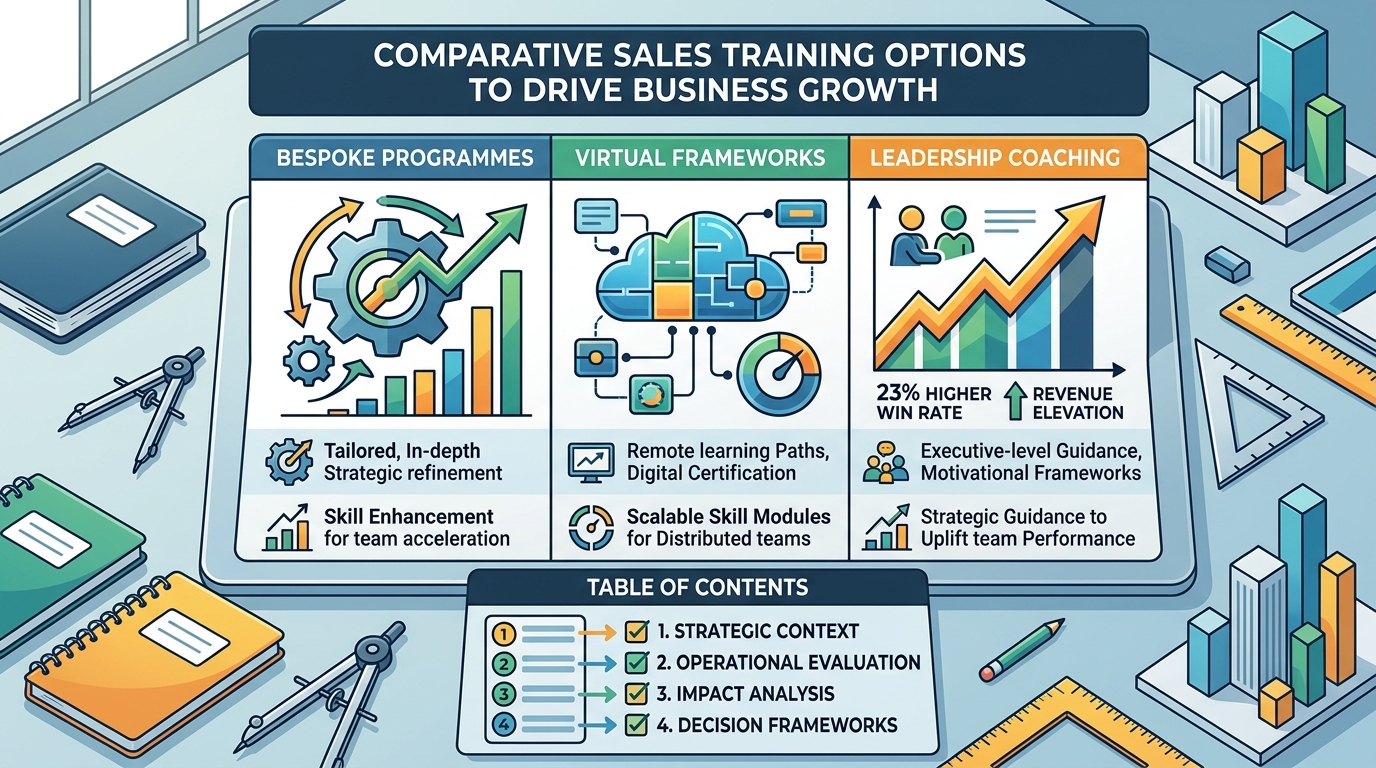
Companies investing in structured sales development programs report a 23% higher win rate compared to untrained teams, according to sales development benchmarks. Organizations seeking to elevate their revenue engine must evaluate diverse instructional models beyond traditional classroom settings. This analysis compares bespoke programmes, virtual frameworks, and leadership coaching to help decision-makers select the most effective path for their specific operational context.
Understanding Modern Sales Training Methodologies
Sales enablement is the strategic alignment of content, tools, and training to empower sales teams. Modern enterprises require flexible approaches that adapt to evolving market dynamics. Businesses can choose from open courses, in-house workshops, or fully customized curricula. The selection depends on team maturity, budget constraints, and specific skill gaps.
Bespoke sales training is a customized educational framework designed to address specific organizational challenges and revenue goals. This approach ensures that every module directly correlates with your unique sales cycle and customer persona. Teams receive immediate applicability without generic theory. Organizations often prioritize this method when standard solutions fail to address niche market complexities.
Industry reports indicate that leadership coaching correlates with a 15% increase in team retention, highlighting the importance of managerial support in training success. Sales training effectiveness relies heavily on reinforcement mechanisms and continuous feedback loops. Companies must align their chosen methodology with long-term business development objectives to sustain growth.
Research demonstrates that virtual training models can reduce operational costs by up to 40% while maintaining engagement levels. Sales performance improvements often stem from the integration of technology-enabled learning platforms. Decision-makers should assess whether their teams require hands-on role-playing or digital simulation exercises.
Bespoke Programmes Versus Open Courses
The choice between bespoke programmes and open courses represents a fundamental strategic decision. Open courses provide standardized curricula that cover foundational sales techniques. These options are cost-effective for teams with basic skill gaps or new hires requiring onboarding support. Businesses can access specific modules such as telesales training or LinkedIn course content to address targeted competencies.
Bespoke sales programmes offer a 1 to 5-day intensive format tailored to your exact environment. This model allows trainers to meet your team at their current knowledge level and elevate performance rapidly. Explore bespoke sales programmes to discover how customized curricula drive Day 1 impact and accelerate revenue generation.
Open courses excel in scalability and accessibility. Teams can enroll individuals in specific areas like advanced sales training or sales management course content without disrupting broader operations. However, open courses may lack the contextual relevance required for complex enterprise sales cycles. Organizations dealing with high-value transactions often require the precision of a tailored framework.
Telesales training is a specialized instructional method focused on remote communication skills and call center efficiency. This discipline remains critical for businesses relying on outbound strategies. Whether delivered via open course or bespoke programme, telesales instruction must address modern digital channels and objection handling techniques.
Companies must weigh the trade-offs between standardization and customization. Open courses offer immediate availability and lower per-seat costs. Bespoke programmes demand higher initial investment but deliver higher conversion rates and faster ramp-up times. The optimal choice depends on your team's current performance baseline and growth targets.
Virtual and Remote Training Models
The shift toward remote work has transformed how sales training is delivered. Virtual training models offer flexibility and accessibility for geographically dispersed teams. These programmes utilize digital platforms to facilitate live interaction, role-playing, and real-time feedback. Organizations benefit from reduced travel expenses and the ability to schedule sessions around peak business hours.
In-house training provides the advantage of a controlled environment where trainers can observe team dynamics firsthand. This model allows for immediate adjustments to content based on participant engagement and questions. Businesses can host in-house sessions at their offices to minimize distractions and maximize focus. Leadership training delivered in-house often yields stronger cultural alignment and knowledge transfer.
Virtual training requires robust technical infrastructure and disciplined facilitation. Trainers must leverage interactive tools to maintain engagement and prevent screen fatigue. Successful virtual programmes incorporate breakout rooms, digital whiteboards, and collaborative exercises. Companies should assess their team's digital literacy before selecting a delivery mode.
Data shows that sales teams utilizing structured enablement strategies achieve faster ramp-up times when training is delivered in bite-sized, recurring modules. Sales teams benefit from continuous learning rather than one-time events. Hybrid approaches that combine virtual modules with in-person workshops often deliver the best results.
Businesses must also consider the long-term sustainability of their training delivery model. Virtual programmes can be recorded and reused as onboarding resources for new hires. In-house sessions allow for deeper customization but require more logistical coordination. The decision should align with your organization's operational rhythm and resource availability.
Leadership and Management Development
Sales training extends beyond individual contributors to encompass leadership development. Effective sales managers require specialized coaching to guide their teams toward consistent performance. Leadership coaching helps management teams standardize sales methodology across a growing organization. This alignment ensures that every team member follows the same proven processes and metrics.
Sales management course content focuses on pipeline oversight, forecasting accuracy, and performance coaching. Managers must transition from top performers to effective coaches to drive team success. Training programmes that address this transition often yield significant improvements in overall revenue. Business development strategies benefit from strong leadership that reinforces best practices.
Tailored leadership and management training addresses the unique challenges of scaling sales operations. Programmes cover topics such as conflict resolution, performance management, and strategic planning. Organizations that invest in leadership development report higher employee engagement and lower turnover rates. This investment creates a sustainable foundation for long-term growth.
Industry reports suggest that companies with robust leadership coaching frameworks achieve 20% higher quota attainment. Sales performance metrics improve when managers are equipped with the right tools and methodologies. Leadership training should be integrated into the broader sales enablement strategy to maximize impact.
Businesses should evaluate whether their current managers possess the coaching skills necessary to drive training adoption. If gaps exist, leadership development programmes should prioritize skill-building and behavioral change. This approach ensures that training investments translate into measurable business outcomes.
Measuring Training Effectiveness and ROI
Measuring the return on investment for sales training requires clear metrics and consistent tracking. Organizations must define success criteria before launching any programme. Key performance indicators include win rates, average deal size, sales cycle length, and ramp-up time. These metrics provide objective data to evaluate training impact.
Companies achieving 6X average ROI from sales training demonstrate the value of strategic investment. Sales development programmes that align with business goals deliver measurable improvements. Businesses should conduct pre- and post-training assessments to quantify knowledge acquisition and behavior change.
Feedback loops play a crucial role in optimizing training effectiveness. Regular check-ins with participants and stakeholders help identify areas for improvement. Organizations that continuously refine their programmes based on data tend to achieve higher long-term results. This iterative approach ensures that training remains relevant and impactful.
Research indicates that sales teams with access to ongoing coaching resources show 19% higher sales growth. Sales training ROI increases when reinforcement mechanisms are embedded in daily workflows. Businesses should allocate resources for post-training support to sustain momentum and drive adoption.
Calculating training ROI involves comparing the cost of the programme against the incremental revenue generated. Organizations must account for direct costs such as trainer fees and indirect costs like team time. A comprehensive ROI analysis provides a clear picture of the programme's financial impact. This data supports informed decisions about future training investments.
Strategic Comparison of Training Options
| Training Option | Best For | Implementation Speed | Cost Efficiency |
|---|---|---|---|
| Bespoke Sales Programmes | Organizations with complex sales cycles and specific skill gaps | 1 to 5 days | High ROI, higher upfront cost |
| Open Courses | Teams needing foundational skills or onboarding support | Immediate | Low per-seat cost, scalable |
| Leadership Coaching | Managers transitioning to coaching roles | Variable | High impact on retention and performance |
| Virtual Training | Geographically dispersed teams | Flexible scheduling | Reduced travel costs, high accessibility |
| In-House Training | Companies seeking deep customization and cultural alignment | Customizable | Higher logistical effort, maximum relevance |
Key Takeaways
- Impel Dynamic reports 99% client satisfaction across all training engagements.
- Average ROI for bespoke sales programmes reaches 6X when aligned with business goals.
- Programmes are delivered in 1 to 5-day intensive formats for rapid impact.
- Open courses cover specialized areas including Telesales, LinkedIn, and Advanced Sales.
- Virtual and in-house delivery models offer flexibility for diverse team structures.
- 25+ years of operational history ensures proven methodologies and immediate results.
- Leadership coaching standardizes sales methodology and improves team retention.
Frequently Asked Questions
What is the difference between open courses and bespoke training?
Open courses provide standardized curricula suitable for foundational skill building and onboarding. Bespoke training offers customized programmes tailored to your specific sales cycle, challenges, and goals. Bespoke options deliver higher relevance and faster application to your business context.
How does virtual training compare to in-person sessions?
Virtual training offers flexibility and cost savings for dispersed teams. In-person sessions allow for deeper interaction and observation of team dynamics. Both models can be effective when facilitated by experienced trainers using appropriate tools.
Can sales training improve leadership retention?
Yes, leadership coaching helps managers transition from performers to coaches. This development reduces turnover by providing clear career paths and support. Organizations report higher retention rates when leadership is trained to support their teams.
What metrics define successful sales enablement?
Key metrics include win rates, average deal size, sales cycle length, and ramp-up time. These indicators provide objective data to evaluate training impact and ROI. Consistent tracking ensures that training investments translate into business growth.
How long does a bespoke programme take to design?
Bespoke programmes are typically delivered in 1 to 5 days. The design phase involves assessing your team's current capabilities and specific challenges. This ensures the curriculum addresses your exact needs from Day 1.
Is telesales training still relevant in digital sales?
Telesales training remains critical for outbound strategies and remote communication. Modern programmes integrate digital channels and objection handling techniques. Teams relying on phone-based outreach benefit from specialized instruction in this area.
How do I calculate sales training ROI?
ROI calculation involves comparing programme costs against incremental revenue generated. Key factors include win rate improvements, deal size increases, and reduced ramp-up time. A comprehensive analysis provides a clear picture of financial impact.
What services does Impel Dynamic offer for sales development?
Impel Dynamic provides sales training courses, bespoke sales programmes, leadership coaching, and business development support. Services include virtual and in-house delivery options. The company reports 99% client satisfaction and 6X average ROI.
Next Steps
Ready to accelerate your sales growth? Book a call with our experts today to discuss your team's specific needs. Our proven method delivers immediate results and tailored frameworks that drive Day 1 impact. Visit impeldynamic.com to explore our full range of sales training courses and programmes.