

When a business is new to selling, the biggest challenge is rarely a lack of enthusiasm. It is knowing what to learn first, which resources are worth using, and how to turn training into confident customer conversations.
You do not need to begin with a large sales department, a complex methodology or an expensive sales technology stack. A practical starting point is a simple learning pathway that helps founders, new hires and customer-facing employees understand their target buyers, create relevant conversations, communicate value, handle concerns and agree sensible next steps.
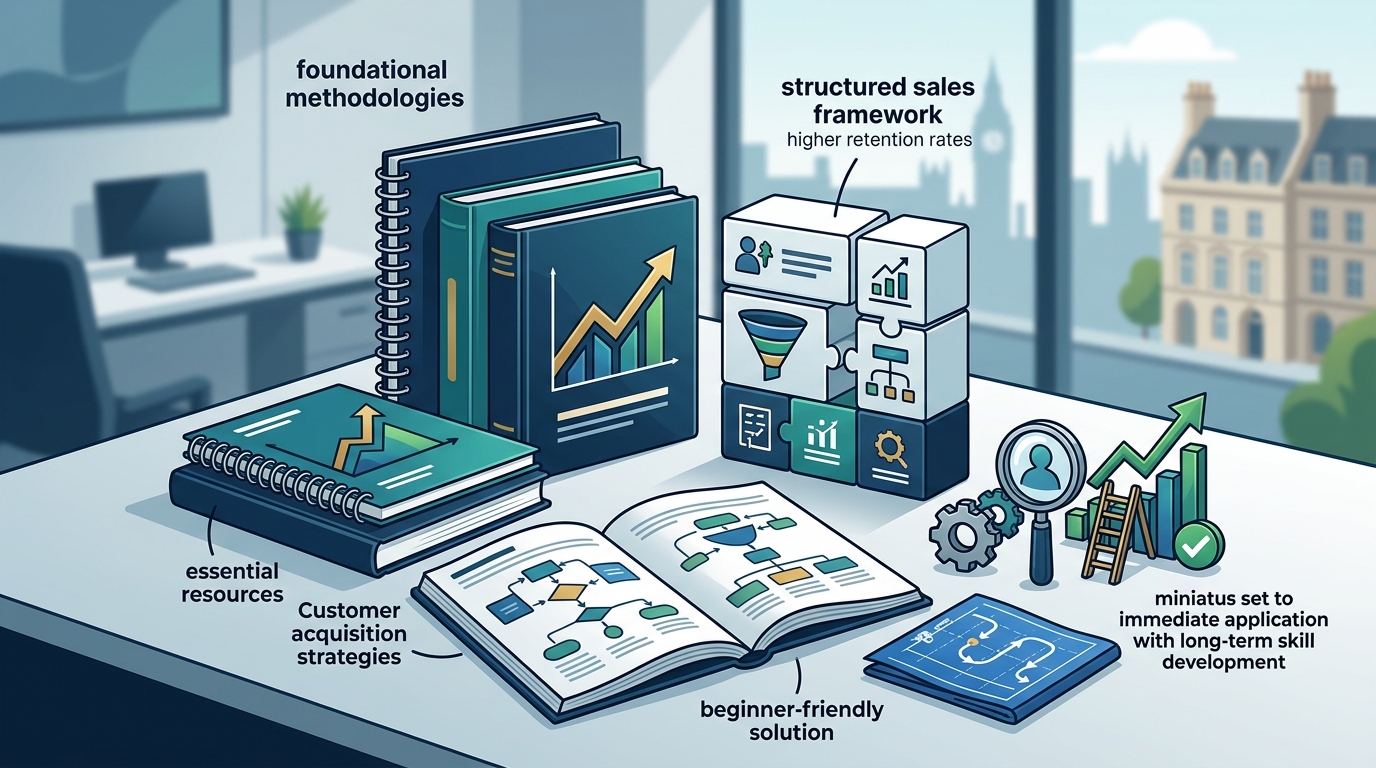
This guide brings together beginner-friendly sales training resources for businesses in London, across the UK and beyond. It covers free online learning, sales onboarding, open courses, telesales development, bespoke programmes, coaching, leadership support and practical ways to evaluate whether training is improving performance.
Short answer: most new businesses should combine a basic sales process, a reputable introductory course, real-world practice, CRM discipline and regular coaching. Use an open sales course when one or two people need focused development, and consider a bespoke sales programme when the whole team needs to adopt a consistent approach.
Start with the sales skills your business will use every week
A beginner-friendly programme should make selling easier to understand and easier to practise. Before choosing a provider, list the situations your team must handle repeatedly. The most useful starting topics usually include:
- Ideal customer profiling: defining which organisations, roles or individuals are most likely to benefit from your offer.
- Prospecting: finding suitable opportunities through referrals, networking, email, social channels, events or targeted outreach.
- Conversation planning: preparing a clear purpose, relevant questions and a realistic desired outcome before contacting a prospect.
- Discovery and questioning: uncovering the customer’s goals, problems, priorities, decision process and consequences of inaction.
- Value communication: explaining how your solution improves a customer’s situation rather than simply listing features.
- Qualification: deciding whether an opportunity is commercially suitable and worth further investment of time.
- Objection handling: responding constructively to concerns about price, timing, risk, fit or competing priorities.
- Presenting and demonstrating: connecting recommendations to the customer’s specific needs and desired outcomes.
- Negotiation and closing: agreeing appropriate commitments without applying unnecessary pressure.
- CRM and follow-up: recording conversations, owners, dates, risks and next actions so opportunities do not depend on memory.
Beginners generally benefit more from a repeatable structure than from a rigid script. A framework gives them confidence while allowing conversations to remain natural, relevant and customer-focused.
Impel Dynamic’s sales training offer includes areas such as prospecting, social selling, advanced questioning, presentation skills, objection handling, negotiating, influencing, persuasion and closing. Its programmes are intended for both B2B and B2C environments and are designed to support practical action from the first day of learning. Explore Impel Dynamic sales training.
Use free online learning to build a common sales vocabulary
Free resources are often the best first step for a founder, small business owner or new salesperson who wants to understand the basics before committing to formal training. They are flexible, accessible and useful for identifying the subjects where your team needs deeper support.
Beginner-friendly resource types
- Introductory sales courses: useful for learning terms such as prospecting, discovery, qualification, pipeline and conversion.
- CRM tutorials: help sellers understand how to manage contacts, tasks, opportunities, notes and follow-up activity.
- Conversation templates: call-planning sheets, discovery-question prompts, email structures and objection-handling checklists can reduce uncertainty.
- Short videos and webinars: make it easier to introduce one skill at a time before practising it.
- Customer interview guides: help founders learn what buyers value, what language they use and what problems they are actively trying to solve.
- Industry case studies: show how buying decisions, stakeholders and commercial pressures vary between sectors.
HubSpot Academy provides free introductory sales education, including an Inbound Sales Certification. The course is designed for small business owners, sales professionals and people seeking to improve their sales presentations and closing skills. Its stated curriculum includes identifying suitable buyers, personalised outreach, exploratory conversations and sales presentations; the course page lists seven lessons, 22 videos, five quizzes and approximately three hours and six minutes of content. View the HubSpot Inbound Sales Certification. ([academy.hubspot.com](https://academy.hubspot.com/courses/inbound-sales?library=true&utm_source=openai))
HubSpot also describes its free sales training as covering inbound sales, sales enablement and sales software. This can be useful if your business is building its process around a CRM, but the learning should still be connected to your own customers, offer and sales cycle. Review HubSpot sales training resources. ([hubspot.com](https://www.hubspot.com/sales/sales-training?utm_source=openai))
Build a 30/60/90-day sales learning roadmap
If you are hiring your first salesperson, moving away from founder-led selling or asking an existing employee to take on business development, create a written onboarding plan. It should explain what the person needs to learn, what they should practise and what evidence will show that they are becoming competent.
A 30/60/90-day structure is a useful starting point because it divides a large subject into manageable stages. HubSpot publishes guidance and templates for structuring new sales representative onboarding across staged learning, practice and performance milestones. See HubSpot’s sales onboarding guidance. ([blog.hubspot.com](https://blog.hubspot.com/sales/new-hire-training-salespeople?utm_source=openai))
| Period | Primary learning focus | Suggested evidence of progress |
|---|---|---|
| Days 1–30 | Business strategy, customer segments, product or service knowledge, positioning, competitors, ideal customer profile, CRM basics and observation of customer conversations. | The learner can explain the offer clearly, identify suitable prospects, prepare for a sales conversation and record information accurately. |
| Days 31–60 | Prospecting, outreach, questioning, discovery, qualification, presentations, demonstrations, objections and follow-up. | The learner can conduct supervised conversations, ask relevant questions, summarise needs and agree a documented next step. |
| Days 61–90 | Pipeline management, opportunity progression, negotiation, closing, account development, forecasting and personal improvement planning. | The learner can manage a defined group of opportunities against agreed activity, quality and commercial standards. |
Include these resources in the onboarding pack
- A one-page explanation of the company’s target customers.
- Customer personas or buying-role descriptions.
- Approved positioning and value messages.
- Product, service or solution demonstrations.
- Pricing, proposal and procurement guidance.
- Qualification criteria and opportunity stages.
- CRM instructions and data-quality expectations.
- Examples of strong emails, proposals and follow-up notes.
- Call recordings or observation opportunities where appropriate.
- A clear route for escalating technical, legal or commercial questions.
Make each stage observable. “Understand the product” is difficult to assess; “deliver a five-minute explanation of the solution for a defined customer type and answer three common questions” is much clearer.
Choose an open course when you need focused development quickly
An open course allows an individual or small group to attend a structured programme with participants from other organisations. This can be a practical option when you need professional input but are not ready to commission private training for the whole business.
Open courses can suit a business that needs to:
- Give a first-time salesperson a clear introduction to professional selling.
- Help a founder or subject-matter expert become more confident in sales conversations.
- Address a specific gap such as prospecting, telesales, negotiation or closing.
- Develop one or two employees without taking the entire team away from work.
- Compare a provider’s teaching style before considering wider support.
Impel Dynamic offers open sales courses for different levels of experience, including a two-day Sales Foundations course that focuses on practical frameworks, preparation, persuasion, influencing and closing. The provider states that open courses are available in locations including London, Manchester and Birmingham, with virtual delivery also available. Explore Impel Dynamic open sales courses.
Before booking, ask whether the programme includes live practice, trainer feedback, relevant examples, clear learning outcomes, action planning and any post-course reinforcement. A course that spends the entire time presenting information may be less useful than one that gives beginners repeated opportunities to practise.
Move to bespoke training when your sales context is distinctive
Generic courses are valuable for foundational skills, but they cannot always reflect the reality of a technical product, lengthy buying cycle, tender process, multi-stakeholder decision or highly specialised market.
A bespoke programme can translate general sales principles into the conversations your team actually needs to have. A provider may begin with interviews, observation, call reviews, pipeline analysis or a diagnostic assessment. The resulting programme can then use your customer personas, value propositions, competitors, objections, proposals and commercial priorities.
Impel Dynamic’s bespoke sales programmes are presented as customised solutions built around a client’s product, audience and day-to-day sales environment. The provider states that tailored programmes can be delivered as short intensive interventions or longer-term support structures.
Bespoke training is particularly relevant when several employees face the same challenge, a new sales process is being introduced, managers need a shared coaching language, or inconsistent selling is creating measurable commercial risk.
Questions to ask a bespoke training provider
- How will you diagnose our current sales process?
- How much of the content will use our real customers and opportunities?
- What behaviours should change after the programme?
- How will managers reinforce the learning?
- What evidence will show whether the intervention worked?
- What support is available after the workshops?
Add coaching so training survives beyond the workshop
Formal training introduces concepts and gives people a chance to practise. Coaching helps those concepts become regular behaviour. This is especially important in a small business, where the founder or sales manager is often responsible for reinforcing the learning.
A short weekly coaching conversation can review:
- One customer interaction that produced a useful result.
- One point where the seller became uncertain or stuck.
- The quality of the questions asked.
- Whether the opportunity has a genuine next step.
- How clearly the seller connected the offer to customer value.
- One specific behaviour to practise before the next review.
Effective feedback is specific. Instead of saying “be more confident”, a manager might agree: “In the next discovery call, ask one follow-up question after each stated problem and summarise the buyer’s priorities before presenting a recommendation.”
Leadership development becomes important when a high-performing salesperson is promoted into management without having learned how to coach, delegate, run reviews or create accountability. Impel Dynamic’s leadership and management training includes tailored development, leadership assessments, personalised development plans and face-to-face, live online or blended delivery options.
For individual contributors, sales coaching can focus on confidence, questioning, pipeline choices, habits, deal strategy and consistent execution. For managers, coaching should also build the ability to observe behaviour and help other people improve.
Compare in-person, virtual and blended delivery
The best format is the one that supports the required behaviour change within your team’s practical constraints. Beginners usually need interaction and feedback, regardless of whether the session takes place in a room or online.
| Delivery model | Useful when | What to manage carefully |
|---|---|---|
| In-person | The team needs concentrated practice, relationship building or a shared reset of its sales approach. | Travel, venue costs, scheduling and protecting learning time. |
| Live online | The team is distributed, remote or unable to spend a full day away from customer work. | Interaction, camera and audio quality, breakout practice and avoiding passive attendance. |
| Blended | You want self-directed preparation combined with live workshops, role-play, review and coaching. | A clear sequence, ownership of each activity and follow-up between sessions. |
Impel Dynamic states that it can deliver sales and leadership programmes face-to-face, virtually or through a blended model. Its virtual sales training includes online relationship building, virtual presentations, objection handling and negotiation in digital environments.
For a beginner, online content works best when it is supported by role-play, peer review, call observation, live questioning and manager feedback. The format matters, but the quality of practice and reinforcement matters more.
Which beginner sales training resource should you choose?
| Resource | Best suited to | Main benefit | Check before choosing | Relevant Impel Dynamic option |
|---|---|---|---|---|
| Free online course | Founders and individuals building basic knowledge | Low-cost, flexible introduction to core concepts | Whether the learner will practise and apply the material | Review sales training options |
| Sales onboarding plan | New hires and first sales roles | Creates clarity, consistency and measurable milestones | Role-specific objectives and manager ownership | Discuss a structured programme |
| Open course | Individuals or small teams with a defined development need | Focused, practical learning with professional facilitation | Experience level, role-play, trainer feedback and follow-up | Explore open sales courses |
| Telesales training | SDRs, business development representatives and phone-based sellers | Improves call preparation, openings, questioning, objection handling and next steps | Whether the content fits inbound, outbound or mixed activity | View telesales training |
| Bespoke programme | Teams with a complex market, product or sales process | Connects training directly to real commercial situations | Diagnostics, measurable outcomes and reinforcement | Explore bespoke programmes |
| Sales coaching | Individuals who need personalised improvement | Builds accountability through targeted feedback | Specific actions, review points and coaching expertise | Ask about sales coaching |
| Leadership training | Managers responsible for sustaining sales standards | Improves coaching, feedback and team accountability | Whether practical people-management skills are included | View leadership resources |
| Business development support | Businesses focused on new opportunities and strategic accounts | Supports prospecting, relationship building, proposals and growth | Alignment with target sectors and buying committees | Explore business development resources |
| Other core services | Businesses needing broader commercial or performance support | Connects training with systems, processes and management | Scope, ownership and expected commercial impact | Explore other core services |
Measure whether training is changing behaviour
New businesses rarely need a complicated reporting system at the start. Choose a small number of measures that show whether people are using the skills and whether commercial outcomes are improving.
Leading indicators to track
- Number of researched and relevant prospecting attempts.
- Quality and completeness of CRM records.
- Use of agreed discovery questions.
- Percentage of opportunities with a documented next action and date.
- Completion of role-play, onboarding and coaching activities.
- Manager assessment of call preparation, listening and value communication.
Commercial indicators to review
- Qualified meeting conversion rate.
- Opportunity-to-proposal conversion.
- Proposal-to-win conversion.
- Average deal value.
- Sales-cycle duration.
- New-customer revenue.
- Expansion or repeat revenue.
Record a baseline before training where possible, then review progress after 30, 60 and 90 days. Do not assume that every change in revenue is caused by training: market conditions, pricing, lead quality, product fit, pipeline volume and seasonality also affect results.
A balanced evaluation combines data with call reviews, seller confidence, manager observations and customer feedback. If a provider shares outcome statistics, ask how satisfaction, practical application, return on investment and behaviour change were defined and measured. Provider-reported figures can offer context, but your own baseline and objectives should remain the primary reference point.
Key takeaways
- Start with core skills: prospecting, discovery, value communication, qualification, objection handling, negotiation and closing.
- Use free online learning to build vocabulary and awareness, but never treat content consumption as a substitute for practice.
- Create a written 30/60/90-day onboarding plan for every new sales role.
- Select an open course when one person or a small group needs focused development.
- Choose a bespoke programme when your market, product, buying process or sales methodology requires significant context.
- Use coaching to reinforce new behaviours after formal training ends.
- Train managers to give specific feedback and support consistent sales standards.
- Choose in-person, live online or blended delivery according to location, time and practice requirements.
- Measure a small set of behavioural and commercial indicators before and after training.
- Document the sales process as the business grows so performance does not depend entirely on founder knowledge.
Frequently asked questions
What defines a beginner-friendly sales training resource?
A beginner-friendly resource explains foundational skills in clear language, uses a logical sequence and gives learners practical actions to try. It should help a new seller understand customers, prepare conversations, ask useful questions, communicate value and agree next steps without overwhelming them with unnecessary terminology.
What is the best sales training resource for a business starting from scratch?
For most new businesses, the strongest starting combination is a simple sales process, a short introductory course, practical role-play and weekly founder or manager coaching. An open course may suit one individual, while a tailored programme may be more appropriate when several team members need a consistent approach.
Can a founder learn sales without hiring a trainer?
Yes. A founder can begin with free courses, customer interviews, sales books, templates, CRM tutorials and deliberate practice. External training or coaching becomes more valuable when the founder wants an outside perspective, a consistent methodology, faster improvement or accountability while building a team.
How much sales training does a new salesperson need?
There is no universal number of hours. A new salesperson needs enough structured learning and supervised practice to understand the offer, identify appropriate customers, conduct core conversations, manage opportunities and meet agreed quality standards. A staged 30/60/90-day plan is usually more useful than relying on one workshop.
Are open sales courses suitable for complete beginners?
Yes, if the course clearly states that it is suitable for the learner’s experience level. Check the prerequisites, agenda, practical activities, trainer experience, group size, delivery format and post-course support. Impel Dynamic offers open courses aimed at developing foundational sales capability and provides options for different levels of experience. See the open sales course options.
What should beginner telesales training cover?
It should cover preparation, opening a call, reaching relevant decision-makers, questioning, listening, communicating value, responding to objections, agreeing next steps and closing appropriately. Impel Dynamic’s telesales training highlights areas including opening with impact, reaching decision-makers, increasing deal value, overcoming obstacles and closing. View beginner telesales training.
Should sales training be online or face-to-face?
Both can work. Face-to-face delivery may be useful for concentrated practice and team interaction, while live online learning can be more convenient for remote or distributed teams. A blended model can combine online preparation with live workshops, role-play, review and coaching.
How can a small business calculate sales training ROI?
Set a baseline for selected measures such as qualified opportunities, conversion rates, average deal value, sales-cycle length and new revenue. Review the same measures after training while accounting for other factors that changed. Also assess whether sellers are using the desired behaviours consistently and whether managers can reinforce them.
When should a business move from free resources to professional sales training?
Consider professional support when learning is inconsistent, the same sales mistakes keep recurring, managers are unsure how to coach, important opportunities are being lost or the business needs a scalable sales process. Professional input is particularly useful when generic online material cannot reflect your product, market or customer conversations.
How should a new business evaluate sales training providers?
Look for relevant experience, clear learning outcomes, practical exercises, diagnostic work, trainer credibility, delivery options and a method for measuring progress. Ask for examples of how the provider has supported businesses with similar sales challenges, and clarify what happens after the training day.
What is a sales training academy?
A sales training academy is an ongoing learning structure rather than a single event. It can combine onboarding, core skills, role-specific development, certifications, coaching, manager support and regular refreshers. This model is useful when a growing business wants to make sales capability part of career development and operational rhythm.
Choose the simplest useful next step
Begin by identifying the three sales situations currently creating the greatest risk or lost opportunity. Your team may struggle to start conversations, qualify leads, explain value, handle objections or secure clear next steps.
Match those gaps to the simplest suitable resource. A free course may be enough to establish shared language. An open course may provide rapid development for one or two people. Coaching may be the priority when knowledge exists but behaviour is inconsistent. A bespoke programme may be the best choice when an entire team needs to change how it sells.
Impel Dynamic provides professional sales training, open courses, online sales training, sales coaching, leadership development, business development support and tailored programmes for organisations in London and across the UK. To discuss a beginner-friendly route, contact Impel Dynamic with details of your team’s experience, sales goals and most pressing challenges.
Related resources
Related resources
- Start with the essential sales foundations
- Use free online learning to build vocabulary and confidence
- Create a simple sales onboarding plan
- Choose tailored training when context matters
- Add coaching so learning becomes behaviour
- Compare in-person, virtual, and blended delivery
- Compare beginner sales training resources
- contact Impel Dynamic