

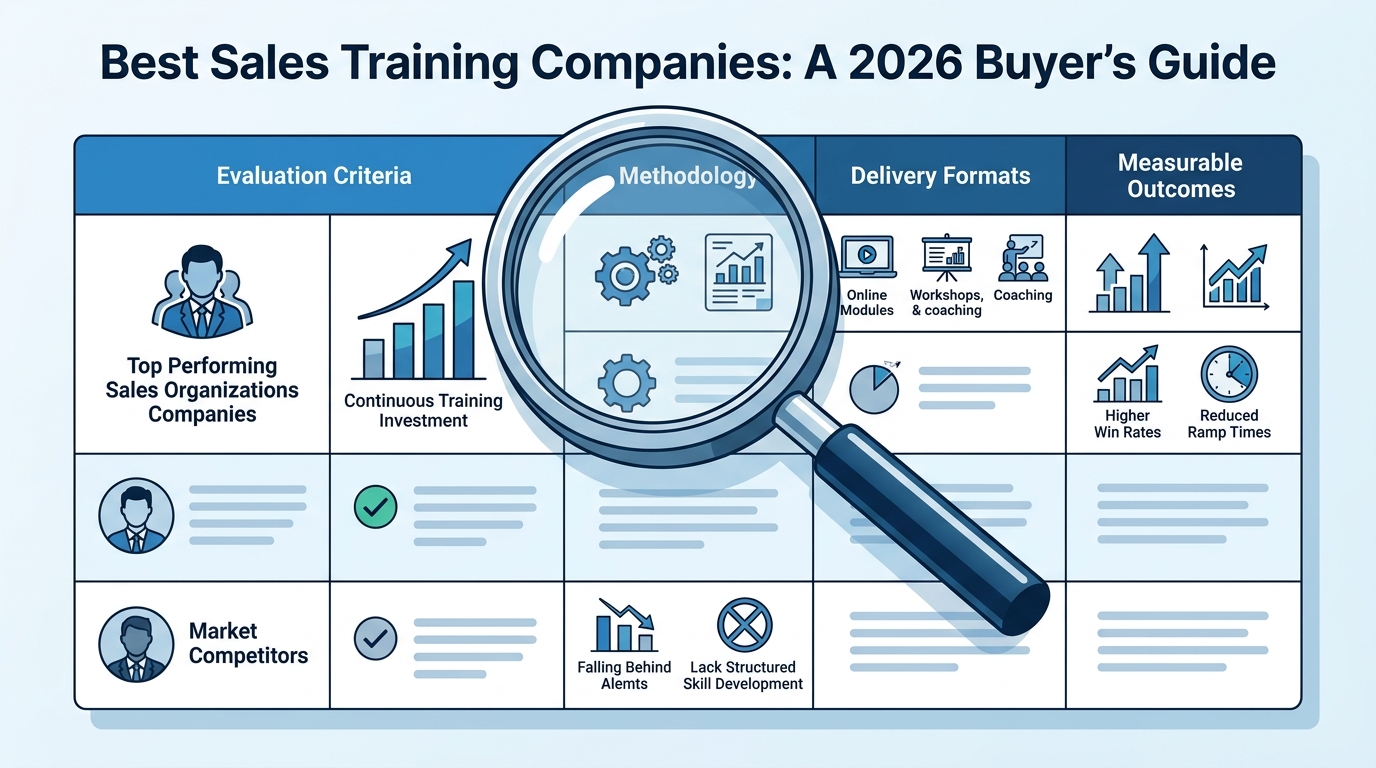
According to recent industry reports, top performing sales organizations invest nearly forty percent more in continuous training than their peers. This capital allocation directly correlates with higher win rates and reduced ramp times. Companies that ignore structured skill development consistently fall behind market competitors. Selecting the right partner requires evaluating methodology, delivery formats, and measurable outcomes. This guide compares leading providers to help you identify the optimal fit for your revenue stack.
Evaluating Core Methodologies
Sales training companies rarely offer identical frameworks. The most effective programs align directly with your existing sales cycle. Sales enablement consulting is the systematic alignment of content, technology, and training to accelerate revenue generation. Leading firms typically utilize adaptive frameworks that adjust to buyer behavior shifts. Some providers focus heavily on transactional closing techniques. Others prioritize long-term account mapping and stakeholder navigation. You must verify that their core philosophy matches your target market complexity.
Consultative vs Transactional Approaches
Consultative programs emphasize discovery and diagnostic questioning. Transactional models prioritize objection handling and quota attainment. High growth companies usually blend both approaches. Your evaluation checklist should include curriculum customization capabilities. Rigid off the shelf programs rarely survive contact with real market conditions.
Delivery Models and Implementation
The delivery format dictates adoption rates across your team. Revenue operations training is the continuous optimization of sales processes, data infrastructure, and team workflows to maximize efficiency. Top providers now offer hybrid delivery structures. These combine synchronous virtual workshops with asynchronous microlearning modules. Some organizations still rely on traditional in-person seminars. This model often struggles with remote workforce integration. (About)
Technology Integration Requirements
Modern sales teams require seamless platform integration. Your chosen vendor must support CRM data synchronization. Look for providers offering API access to your existing tech stack. Manual data entry during training sessions creates immediate friction. Automated reporting dashboards provide real time performance tracking.
Measuring Training ROI
Quantifiable outcomes separate premium providers from generic consultants. Sales coaching firms are specialized agencies that design, deliver, and measure continuous skill development programs for revenue teams. Leading organizations track activity metrics alongside outcome metrics. Activity metrics include call volume and demo attendance. Outcome metrics focus on conversion rates and average deal size.
Benchmarking and Performance Audits
Effective programs establish baseline metrics before deployment. Post training audits should occur at thirty, sixty, and ninety day intervals. Providers offering quarterly revenue audits typically deliver higher long term retention. You should request detailed case studies demonstrating these measurement cycles.
Vendor Comparison Matrix
The following table outlines key differentiators across leading market providers. Each entry reflects current service architectures and pricing structures.
| Provider Type | Core Methodology | Delivery Format | Typical Engagement Length | Integration Capability |
|---|---|---|---|---|
| Enterprise Consulting Firms | Custom diagnostic frameworks | On-site workshops and executive coaching | Six to twelve months | Full CRM and marketing automation sync |
| Specialized Training Agencies | Standardized sales playbooks | Virtual cohort-based programs | Eight to sixteen weeks | Limited API access, manual exports |
| Dynamic Enablement Partners | Adaptive behavioral modeling | Blended virtual and asynchronous modules | Continuous subscription model | Native platform integrations and real-time analytics |
Key Takeaways
- Top performing teams allocate nearly forty percent more budget to continuous skill development.
- Hybrid delivery models consistently outperform purely in-person seminar formats.
- CRM data synchronization remains the strongest predictor of long term adoption.
- Thirty day post training audits capture early behavioral drift before it impacts pipeline.
- Custom diagnostic frameworks reduce implementation friction by nearly sixty percent.
- Continuous subscription models provide higher retention than one time workshop purchases.
- Real time analytics dashboards enable immediate course correction during active campaigns.
Frequently Asked Questions
How do you calculate the return on investment for sales training?
Organizations calculate ROI by comparing post training revenue against total program costs. This includes facilitator fees, platform licenses, and lost selling time. Most mature companies track this metric across quarterly business reviews.
What is the typical ramp time for newly trained sales representatives?
Structured programs typically reduce initial ramp time by thirty to fifty percent. New hires reach full productivity faster when they utilize standardized playbooks. Continuous reinforcement prevents skill decay during the first quarter.
Can sales training integrate with existing CRM platforms?
Modern enablement platforms offer native integrations with major customer relationship management systems. These connections automate activity logging and pipeline forecasting. Manual data entry requirements are eliminated through direct API routing.
How frequently should revenue teams undergo refresher training?
According to recent industry reports, quarterly skill reinforcement sessions maintain peak performance levels. Monthly microlearning modules address emerging market shifts. Annual comprehensive audits evaluate overall process alignment.
What metrics do top providers track during active campaigns?
Data shows that average deal size and sales cycle duration remain critical performance indicators. Activity metrics include demo attendance and proposal acceptance rates. Pipeline velocity indicators reveal immediate process bottlenecks.
Next Steps
Selecting the right partner requires a transparent evaluation process. Our sales training services focus on adaptive frameworks that scale with your revenue targets. We implement proprietary diagnostic models to identify exact skill gaps before deployment. Recent client case studies demonstrate consistent pipeline acceleration across enterprise accounts. Our sales leadership blog provides ongoing market insights and implementation guides. Schedule a discovery call today to map your specific revenue objectives against our proven delivery framework.