

Sales training is often treated as a short-term response to missed targets. The more strategic view is that it is a business capability: it helps salespeople create value consistently for clients while giving employees the skills, coaching, and progression opportunities they need to grow.
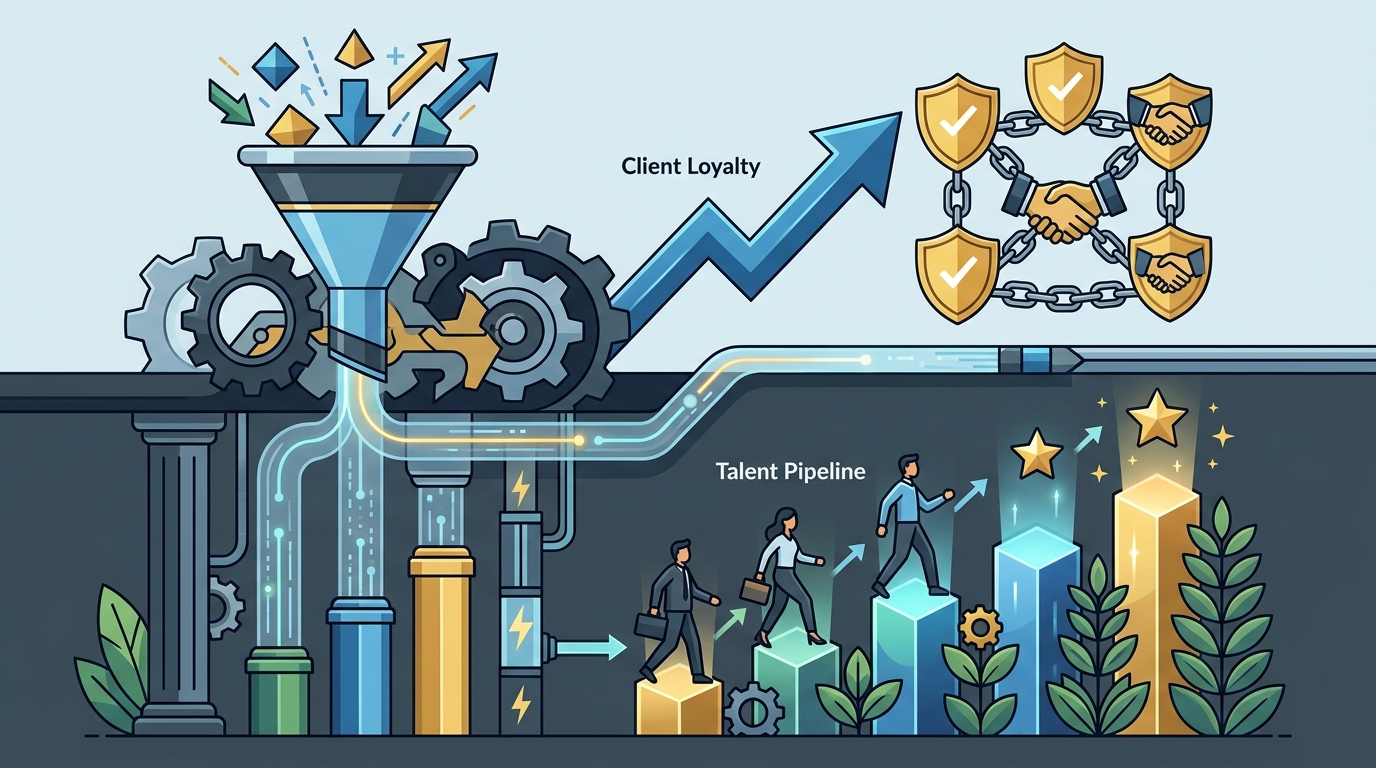
That combination matters because client retention and talent development reinforce one another. A capable, confident sales team is better equipped to understand customer priorities, protect relationships, identify expansion opportunities, and represent the organisation professionally. At the same time, a company that invests in structured development is more attractive to ambitious sales professionals and more likely to keep valuable people for longer.
For organisations in London and across the UK, the right sales training programme can therefore support more than quarterly revenue. It can strengthen account relationships, improve the consistency of the customer experience, create a stronger internal talent pipeline, and establish scalable sales processes. Impel Dynamic provides professional sales training solutions, including bespoke programmes, open courses, virtual training, sales coaching, and leadership development. Explore Impel Dynamic’s other core services to see how sales capability can connect with wider business performance.
Why sales training is both a client-retention and talent strategy
Businesses commonly separate customer success, sales performance, recruitment, and employee development. In practice, these areas are closely connected. The quality of a client relationship is influenced by the quality of the people managing it, while the quality of the people an organisation attracts is influenced by the learning environment it provides.
Effective sales training creates a common approach to important moments in the customer journey: researching an account, opening a conversation, diagnosing needs, presenting value, handling objections, negotiating, agreeing next steps, and reviewing the relationship after the sale. When these behaviours are developed and reinforced, clients receive a more dependable experience rather than one that varies according to individual instinct.
Retention also has a direct economic rationale. Bain research popularised the finding that, depending on the industry and business model, a 5% increase in customer retention can increase profits by between 25% and 95%. That range is not a universal forecast, but it demonstrates why protecting the right customer relationships deserves board-level attention. Bain & Company research ([bain.com](https://www.bain.com/contentassets/29f74ec417fa4e36a1d7d7e7479badc5/loyalty_rules_chapter_one.pdf?utm_source=openai))
On the people side, employer-sponsored career development is associated with job performance and lower turnover through stronger perceived organisational support and attachment, according to a meta-analysis covering more than 1,000 articles. Sales training is not a substitute for fair pay, good management, or a healthy culture, but it is a visible and practical part of a credible development proposition. ([journals.sagepub.com](https://journals.sagepub.com/doi/10.1177/01492063221125143?utm_source=openai))
How sales training helps retain valuable clients
Client retention is not secured by a single persuasive presentation. It is earned through a sequence of useful interactions in which the client feels understood, supported, and confident that the supplier is contributing to business outcomes. Sales training improves the behaviours that make that sequence more reliable.
1. It teaches salespeople to uncover problems before they become risks
Untrained conversations often focus on products, features, price, or the next immediate transaction. A trained salesperson is more likely to investigate the client’s priorities, constraints, decision process, internal stakeholders, measures of success, and potential sources of dissatisfaction.
This diagnostic approach helps the team identify warning signs earlier. For example, a key account may appear healthy because it is still renewing, while the real decision-maker has changed, adoption has fallen, or a competitor has started offering a more relevant solution. Structured questioning and account-review skills make these issues easier to surface before they become renewal problems.
2. It replaces reactive selling with proactive account management
Valuable clients need more than occasional contact when a contract is approaching renewal. Training can give account teams practical routines for planning stakeholder meetings, reviewing outcomes, sharing relevant insight, and identifying new risks or opportunities.
A proactive account conversation might include questions such as:
- Which business objectives have changed since the last review?
- Where is the client experiencing friction or lost productivity?
- Which outcomes can be evidenced with data or customer feedback?
- What upcoming strategic, regulatory, operational, or market changes may affect the account?
- Who else in the client organisation needs to be involved in the relationship?
These conversations position the salesperson as a commercially useful partner rather than a supplier who appears only when a purchase order is required.
3. It creates a more consistent customer experience
When every salesperson uses a different approach, clients may receive inconsistent messages, follow-up standards, and levels of preparation. A shared methodology establishes minimum standards without forcing every conversation to sound scripted.
Consistency can cover practical details such as confirming agreed actions, recording stakeholder information, clarifying decision criteria, setting realistic expectations, and communicating value in the client’s language. These small behaviours reduce avoidable misunderstandings and help build trust over time.
4. It improves objection handling and difficult conversations
Client loyalty is often tested when budgets tighten, service issues arise, priorities change, or a competitor makes an attractive offer. Sales training helps people respond without becoming defensive or immediately discounting.
Effective objection handling involves acknowledging the concern, clarifying what sits behind it, testing its importance, and reconnecting the discussion to measurable value. In a relationship-led business, this approach can turn a difficult conversation into an opportunity to demonstrate responsiveness and commercial understanding.
5. It encourages value-based growth within existing accounts
Retention and expansion should not be confused with aggressive cross-selling. The strongest account-growth conversations begin with a genuine understanding of changing client needs. Training helps salespeople recognise when an additional service, capability, or solution could improve the client’s position.
Impel Dynamic’s sales training content highlights the importance of using customer feedback, building lasting connections, and becoming recognised as part of the client’s team. Its programmes also address relationship selling, virtual sales, outbound selling, qualification, persuasion, objection handling, and closing. ([impeldynamic.com](https://impeldynamic.com/?utm_source=openai))
How sales training grows the talent pool
A talent pool is not only the number of people applying for a vacancy. It is the organisation’s available capacity to attract, develop, promote, and retain people who can create commercial value. Sales training supports each stage of that pipeline.
1. It makes the employer proposition more credible
Ambitious candidates want to know what they will learn, how they will be supported, and whether strong performance can lead to greater responsibility. A company that can explain its sales methodology, onboarding plan, coaching rhythm, and progression routes presents a clearer proposition than one that simply expects new hires to “hit the ground running”.
Training also signals that success is not reserved for people who already possess a particular personality or network. With the right support, people from adjacent sectors, customer service, account management, consulting, recruitment, or technical backgrounds may be able to build successful sales careers.
2. It accelerates the development of new hires
New salespeople frequently struggle because they must learn several systems at once: the market, the product or service, ideal customer profiles, internal processes, CRM expectations, commercial terminology, and the behaviours required for effective selling.
A structured programme breaks that learning into manageable stages. It can combine classroom or virtual instruction with role-play, observation, field application, manager feedback, call reviews, and practical assignments. This makes development more deliberate and gives new hires a clearer route towards independent performance.
3. It turns experience into repeatable organisational knowledge
Many businesses rely on a few experienced salespeople whose knowledge is not documented. When these individuals leave, the organisation may lose account history, market insight, objection-handling techniques, and informal relationships.
Sales training encourages teams to define what good practice looks like. Managers can capture successful discovery questions, qualification standards, account-planning principles, negotiation approaches, and examples of strong value messaging. This converts individual experience into a capability that can be taught to future colleagues.
4. It creates visible progression for high performers
Not every successful salesperson wants to become a sales manager, but every high performer benefits from a clear development conversation. Progression may involve larger accounts, strategic business development, mentoring, sales enablement, specialist industry responsibility, coaching, or leadership.
Leadership and management training is particularly important when strong individual contributors are promoted. Selling well and managing a sales team require different skills. New managers need to learn how to coach behaviour, inspect opportunity quality, give useful feedback, set expectations, manage performance, and build accountability without damaging motivation.
5. It supports employee commitment
Development opportunities can strengthen the relationship between employees and the organisation. Research on formal training and development in small and medium-sized enterprises found that employees who participated in more development events were less likely to consider leaving and less likely to display neglectful behaviour. ([onlinelibrary.wiley.com](https://onlinelibrary.wiley.com/doi/10.1111/j.1540-627X.2010.00295.x?utm_source=openai))
The practical implication is not that every course will prevent turnover. Rather, development works best when it is relevant, applied, supported by managers, and connected to a believable future within the organisation.
Why consultative selling strengthens both client relationships and careers
Consultative selling is an approach in which the salesperson seeks to understand the client’s situation and recommend an appropriate path forward instead of pushing a predetermined product. It requires questioning, active listening, commercial curiosity, empathy, business acumen, and the ability to connect solutions with outcomes.
For clients, this creates a more relevant and less transactional experience. The salesperson can help clarify a problem, compare options, build internal consensus, and define what success should look like. For sales professionals, it creates a richer role that involves analysis and problem-solving rather than repetitive pitch delivery.
This is especially relevant in complex B2B sales, where several stakeholders may influence a decision and the buyer may have researched possible solutions before speaking with a supplier. Training can help salespeople add value earlier by bringing insight, asking more precise questions, and tailoring the conversation to the client’s commercial context.
Impel Dynamic describes its approach as helping organisations win more business, create scalable sales processes, and define both current best practice and future-focused next practice. Its trainers are experienced salespeople, which supports a practical connection between training-room concepts and real commercial conversations. ([impeldynamic.com](https://impeldynamic.com/?utm_source=openai))
How to design a sales training programme that produces lasting change
A one-off workshop can create awareness, but lasting performance improvement normally requires a broader system. Before selecting a provider or course, organisations should define the business problem, the target behaviours, the manager’s role, and the measures that will indicate progress.
Step 1: Start with commercial and client evidence
Review sales and account data alongside qualitative feedback. Useful inputs include win rates, loss reasons, sales-cycle length, average deal value, renewal rates, client complaints, expansion revenue, forecast accuracy, pipeline quality, and the reasons experienced salespeople leave.
Interview salespeople, managers, customer-success colleagues, and selected clients. The objective is to distinguish symptoms from causes. For example, a low close rate may result from weak discovery, poor qualification, unclear value messaging, inadequate stakeholder coverage, or an offer that does not match the market.
Step 2: Define the behaviours to change
“Improve selling” is too broad to guide training. More useful objectives include:
- Conduct a structured discovery conversation with senior stakeholders.
- Qualify opportunities against agreed business and decision criteria.
- Translate features into client-specific commercial outcomes.
- Build multi-threaded relationships across a strategic account.
- Handle price pressure without defaulting to discounting.
- Create a documented account-growth plan for priority clients.
- Coach opportunity strategy during weekly one-to-one meetings.
Step 3: Make managers responsible for reinforcement
Managers determine whether training becomes a habit. They can reinforce learning through pre-call planning, deal reviews, role-play, call observation, field coaching, and targeted feedback. Every training module should answer a practical question: what will the manager observe in the next customer conversation?
Step 4: Practise realistic situations
Role-play is most effective when it reflects the organisation’s real market. Use actual buyer personas, products, pricing structures, objections, procurement dynamics, competitors, and renewal risks. Participants should practise both the conversation and the preparation behind it.
Step 5: Connect learning to the customer journey
Training should not stop at the point of sale. Include behaviours for onboarding handover, account reviews, renewal planning, escalation, stakeholder mapping, and expansion. This helps sales and client-facing teams provide a joined-up experience.
Step 6: Build a reinforcement calendar
A practical reinforcement plan might include weekly manager coaching, fortnightly peer practice, monthly opportunity reviews, quarterly account-planning sessions, and a six-month evaluation of behavioural and commercial outcomes. The cadence should fit the organisation’s sales cycle and workload.
Choosing the right sales training delivery model
The best delivery model depends on the organisation’s objectives, team size, geography, sales complexity, and level of customisation required.
| Model | Best suited to | Strengths | Potential limitation |
|---|---|---|---|
| Open course | Individuals, small teams, or organisations seeking core skills | Efficient access to a structured curriculum and interaction with professionals from other organisations | Less opportunity to adapt examples, language, and processes to one company |
| Bespoke programme | Teams facing specific market, process, product, or performance challenges | High relevance, stronger alignment with business goals, and the ability to practise real scenarios | Requires more diagnostic work and stakeholder involvement |
| Virtual training | Distributed, international, or hybrid teams | Flexible participation, lower travel requirements, and easier access across locations | Needs strong facilitation, preparation, and interaction to maintain engagement |
| Face-to-face training | Teams needing intensive collaboration, practice, or cultural alignment | Rich discussion, immediate feedback, and focused group energy | More challenging to schedule for geographically dispersed teams |
| Blended programme | Organisations seeking a combination of flexibility and live practice | Combines digital learning, live sessions, coaching, and workplace application | Requires clear coordination and ownership between learning activities |
Open courses can be a practical entry point for individual development or foundational skills. Bespoke programmes are often more suitable when an organisation needs to improve a specific sales process, address inconsistent account management, introduce a common methodology, or align teams across regions. Impel Dynamic offers open and tailored sales training alongside face-to-face, online, and blended approaches.
For teams that need to improve leadership capacity, a programme should also include sales management and coaching. Without manager reinforcement, new skills can remain isolated in the training room and fail to influence everyday pipeline and account decisions.
How to measure the impact on clients, talent, and revenue
Sales training should be evaluated at more than one level. Immediate participant satisfaction can be useful, but it does not prove that behaviour or business results have changed.
Client and commercial measures
- Client retention and renewal rate.
- Revenue retention or recurring revenue retention, where relevant.
- Expansion revenue from existing accounts.
- Customer feedback and relationship-health scores.
- Number and quality of senior client relationships.
- Sales-cycle duration and conversion between key stages.
- Average deal value and discount levels.
- Forecast accuracy and opportunity progression.
Talent and capability measures
- Time to productivity for new sales hires.
- Internal promotion and mobility rates.
- Participation in coaching and development activity.
- Employee confidence in core sales behaviours.
- Quality of manager feedback and one-to-one coaching.
- Voluntary turnover among high-performing salespeople.
- Candidate acceptance rates and employee referrals.
- Evidence that the agreed methodology is being used in live opportunities.
Impel Dynamic publishes client-reported performance indicators including 99% of clients saying they would recommend the provider, 92% reporting a significant return on investment, 95% of managers seeing a positive change in behaviour, and a stated 6X average ROI. These figures are Impel Dynamic’s own reported client data rather than an industry-wide benchmark, so organisations should establish their own baseline and evaluation method. ([impeldynamic.com](https://impeldynamic.com/?utm_source=openai))
A sensible evaluation plan compares the position before training with results at approximately 30, 90, and 180 days. Attribution should be handled carefully because pricing, market conditions, product changes, leadership, and hiring can also affect performance. The most credible approach combines quantitative measures with observed behaviour and client or manager feedback.
A practical 90-day implementation plan
Days 1–30: Diagnose and align
- Identify the priority client-retention and talent challenges.
- Review sales, renewal, recruitment, and employee-development data.
- Interview leaders, managers, salespeople, and selected clients.
- Define the target behaviours and baseline measures.
- Agree the role of managers in reinforcement.
Days 31–60: Train and practise
- Deliver the core or bespoke learning programme.
- Use realistic account, prospect, renewal, and negotiation scenarios.
- Require participants to apply the method to live opportunities.
- Give managers a coaching guide and observation checklist.
- Capture examples of effective messaging and account planning.
Days 61–90: Reinforce and inspect
- Review live opportunities and priority-account plans.
- Observe selected calls or meetings where appropriate.
- Run short practice sessions focused on persistent gaps.
- Compare early behaviour and pipeline indicators with the baseline.
- Decide which skills require additional coaching or advanced training.
This approach turns training from an isolated event into an operating rhythm. It also gives leadership a clearer basis for deciding whether the programme should be expanded, adapted, or targeted at a particular segment of the team.
Key takeaways
- Sales training supports client retention by improving discovery, proactive account management, objection handling, value communication, and relationship consistency.
- Retaining valuable clients protects revenue and can materially influence profitability; the commonly cited 5% retention improvement statistic is an industry-dependent Bain finding, not a guaranteed result for every company. ([bain.com](https://www.bain.com/contentassets/29f74ec417fa4e36a1d7d7e7479badc5/loyalty_rules_chapter_one.pdf?utm_source=openai))
- A structured development offer can make an organisation more attractive to capable sales candidates and help existing employees see a future within the business.
- Consultative selling benefits both sides: clients receive more relevant advice, while salespeople develop commercially valuable problem-solving skills.
- Bespoke programmes are useful when training must reflect a company’s market, sales process, product complexity, client base, or strategic priorities.
- Open courses can provide an efficient foundation for individuals or small teams seeking broadly applicable sales skills.
- Manager coaching is essential because reinforcement determines whether new behaviours become part of everyday sales practice.
- Measure impact across client, commercial, behavioural, and talent indicators rather than relying only on post-course satisfaction scores.
- Impel Dynamic has more than 25 years of experience according to its published website information and offers professional sales training for B2B and B2C organisations. ([impeldynamic.com](https://impeldynamic.com/?utm_source=openai))
Frequently asked questions
How does sales training improve client retention?
Sales training improves client retention by helping teams understand customer needs more deeply, communicate value clearly, identify risks earlier, manage objections constructively, and maintain consistent follow-up. A consultative approach makes the salesperson more useful throughout the relationship rather than relevant only at the point of purchase.
Can sales training help a business attract better sales candidates?
Yes. A clear training and coaching structure can strengthen an employer’s development proposition. Candidates are more likely to see the organisation as a place where they can build skills and progress, particularly when the business can explain its onboarding, coaching, methodology, and career pathways. Training should complement, not replace, competitive rewards and good management.
How does sales training grow an internal talent pool?
It gives employees a common language, practical skills, feedback, and opportunities to take on greater responsibility. Over time, this can support faster new-hire development, internal promotion, mentoring, specialist roles, and the transition of experienced salespeople into management or coaching positions.
What is the difference between an open sales course and bespoke sales training?
An open course follows a broadly applicable curriculum and is suitable for individuals or small groups seeking core sales skills. Bespoke training is designed around one organisation’s market, goals, process, products, customers, and performance challenges. Bespoke programmes generally require more discovery but can provide greater relevance for complex team or transformation objectives.
How quickly can a business see results from sales training?
Some improvements, such as better call preparation, clearer questioning, and more disciplined follow-up, can appear immediately when participants apply the learning. Larger outcomes, including higher retention, improved conversion, reduced discounting, or stronger employee progression, usually require several months of practice, manager reinforcement, and measurement. Impel Dynamic states that tailored programmes can deliver impact from day one, but results will vary by organisation and implementation quality.
Is sales training only appropriate for new starters?
No. New hires need foundational skills, while experienced salespeople may need development in strategic account management, consultative selling, negotiation, virtual selling, business development, or changing buyer expectations. Sales managers also need coaching and leadership skills to make performance repeatable across the team.
What sales training services does Impel Dynamic provide?
Impel Dynamic provides open sales training courses, bespoke sales programmes, virtual and face-to-face training, blended learning, business development training, relationship selling, outbound sales, virtual sales, leadership and management training, and sales coaching. Its website presents the programmes as suitable for B2B and B2C organisations of different sizes. ([impeldynamic.com](https://impeldynamic.com/?utm_source=openai))
How does consultative selling differ from traditional transactional selling?
Transactional selling concentrates on the immediate product or service exchange. Consultative selling begins with the client’s situation, priorities, challenges, stakeholders, and desired outcomes. The salesperson acts more like a trusted commercial adviser, recommending a solution when there is a clear fit and continuing to create value after the initial sale.
Build stronger client relationships and a deeper sales talent pipeline
Sales training creates the greatest value when it is connected to real commercial priorities. If clients are exploring competitors, account relationships are inconsistent, new hires take too long to become productive, or managers lack a common coaching approach, the answer may be more than a motivational session. It may require a structured capability programme that changes how people prepare, sell, manage accounts, and lead.
Visit Impel Dynamic to explore sales training courses and professional sales training programmes. To discuss the needs of your organisation, contact Impel Dynamic about a tailored approach for your team.