

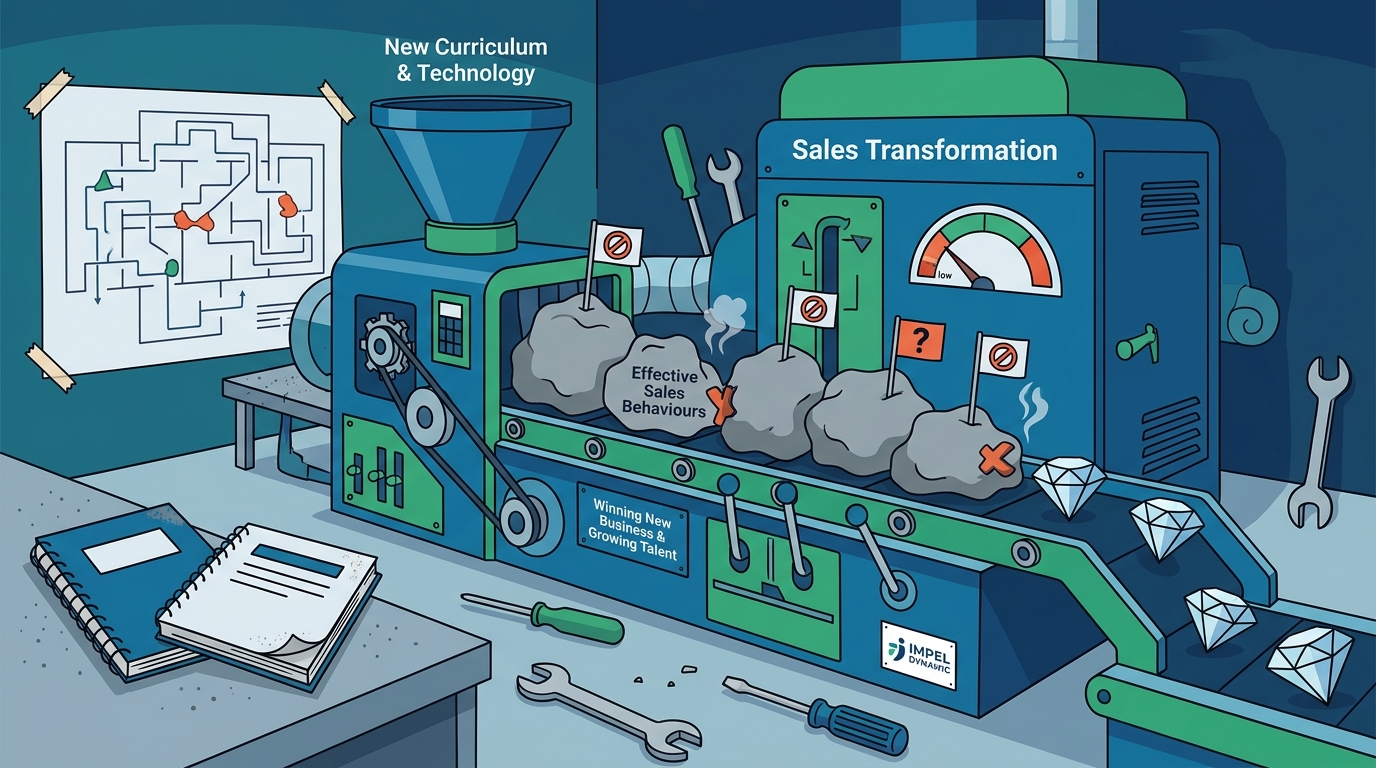
Implementing a new sales training program is rarely a smooth transition. According to McKinsey research, 70% of digital transformations fail because organizations ignore the human element of change management. This statistic highlights a critical truth: technology and curriculum are secondary to behavioral adoption. Businesses often invest heavily in content only to watch it gather dust because the underlying cultural resistance was never addressed. This guide explores how to dismantle those barriers and ensure your sales team actually uses what they learn.
Understanding the Adoption Gap
The most common challenge businesses face is the disconnect between training completion and on-the-job application. Salespeople are under immense pressure to hit quotas. When forced to choose between applying a new methodology or closing a deal using familiar habits, they will almost always choose the latter. This is not a failure of intelligence but a failure of design.
Sales training is the systematic process of equipping sales professionals with the skills, knowledge, and tools necessary to improve their performance. Without a clear bridge between the classroom and the CRM, learning decays rapidly. To solve this, organizations must integrate training into daily workflows rather than treating it as an isolated event.
Impel Dynamic addresses this by focusing on bespoke sales programmes that meet teams where they are. By tailoring content to specific selling environments, the training becomes immediately relevant. When the material mirrors the actual challenges of the sales floor, the cognitive load required to apply it decreases significantly.
Customization vs. Standardization
Another significant hurdle is determining the right level of customization. Many companies fall into the trap of buying off-the-shelf courses that look impressive but lack contextual relevance. Conversely, creating entirely custom content from scratch can be prohibitively expensive and time-consuming.
The solution lies in a hybrid approach. Start with a robust foundational framework that covers universal sales principles. Then, layer in industry-specific scenarios and internal product knowledge. This ensures that the core methodology is sound while the application feels native to the team.
Consultative selling is a methodology where the salesperson acts as a trusted advisor, focusing on the client's needs rather than just pushing a product. This approach requires deep customization to be effective. Impel Dynamic’s advanced sales training course emphasizes this consultative mindset, helping teams transition from transactional sellers to strategic partners.
Businesses must also consider the maturity of their sales team. Junior reps need more structure and fundamental skills, while senior leaders require nuanced strategies for complex negotiations. A one-size-fits-all program will fail to engage either group effectively.
Measuring ROI Effectively
Justifying the cost of training is a persistent challenge for HR and sales directors. If you cannot prove that the training led to increased revenue or improved efficiency, future budgets will be cut. The key is to move beyond simple satisfaction surveys ("smile sheets") and track behavioral and outcome metrics.
Effective measurement requires establishing baseline KPIs before the training begins. Track metrics such as call duration, conversion rates at specific pipeline stages, and average deal size. Compare these against post-training data to isolate the impact of the intervention.
Impel Dynamic reports a 6X average ROI for their clients. This figure is derived from tracking tangible business outcomes such as new deal closure and increased account value. By focusing on these hard metrics, businesses can build a compelling business case for continued investment in sales development.
It is also crucial to monitor the time-to-competency for new hires. If training reduces the ramp-up time for new salespeople by even a few weeks, the financial impact on the bottom line is substantial. This metric is often overlooked but is a powerful indicator of training efficacy.
Delivery Model Selection
The format of the training significantly influences its success. In a post-pandemic world, remote and hybrid work models have changed how sales teams interact. Traditional, week-long in-person workshops may no longer be feasible or effective for distributed teams.
Blended learning models often yield the best results. This combines synchronous live sessions for interaction and Q&A with asynchronous digital content for self-paced learning. This approach respects the busy schedules of sales professionals while maintaining the engagement of live instruction.
Impel Dynamic offers virtual training options that replicate the energy and interactivity of in-person sessions. This ensures that geographic dispersion does not become a barrier to high-quality development. For teams that require deeper immersion, in-house training allows for customized scenarios based on real-time company data.
When selecting a delivery model, consider the complexity of the skills being taught. Soft skills like negotiation and empathy benefit greatly from live role-playing and immediate feedback. Technical product knowledge can often be delivered more efficiently through digital modules.
Leadership Accountability
Perhaps the most critical factor in successful implementation is leadership involvement. If managers do not reinforce the training, it will fade. Salespeople look to their leaders for cues on what is valued. If a manager rewards old habits, the training is effectively nullified.
Leaders must be trained to coach using the new methodology. This requires a shift in management style from directive to facilitative. Managers need to understand the framework well enough to ask the right questions and guide their reps toward the desired outcomes.
Impel Dynamic provides leadership training to ensure that managers are equipped to support their teams. This includes tools for monitoring progress and providing constructive feedback aligned with the new sales process. Without this alignment, the gap between strategy and execution widens.
Regular check-ins and coaching sessions should be structured around the training concepts. This reinforces the learning and helps identify specific areas where individual reps may be struggling. Consistency is key to building new neural pathways and habits.
Key Takeaways
- Impel Dynamic has over 25 years of experience in delivering sales training solutions.
- Client satisfaction rates for Impel Dynamic programs stand at 99%, indicating high perceived value.
- Successful implementation requires aligning training with daily workflows, not treating it as an isolated event.
- Customization is vital; generic content fails to address specific industry or company challenges.
- Leadership must actively coach and reinforce new methodologies to ensure behavioral change.
- Measuring ROI through hard metrics like deal size and conversion rates is essential for budget justification.
- Blended learning models offer the best balance of engagement and flexibility for modern sales teams.
Frequently Asked Questions
How do I measure the success of sales training?
Success should be measured by tracking pre- and post-training KPIs such as conversion rates, average deal size, and time-to-competency. Behavioral metrics, such as the adoption of specific sales techniques, are also critical indicators of effectiveness.
What is the difference between bespoke and open sales courses?
Bespoke courses are tailored specifically to your company's products, market, and challenges, ensuring immediate relevance. Open courses are designed for individuals to learn alongside peers from other organizations, focusing on universal sales principles and networking.
How long does it take to see results from sales training?
While initial knowledge acquisition happens during the training, tangible business results typically emerge within 3 to 6 months as behaviors are consistently applied. Impel Dynamic clients often report significant ROI within this timeframe.
Can virtual sales training be as effective as in-person?
Yes, when designed with interactivity and engagement in mind. Virtual training allows for flexible scheduling and can incorporate digital tools that enhance learning. Impel Dynamic’s virtual training options are specifically engineered to maintain high engagement levels.
Why is leadership involvement critical in sales training?
Managers set the tone for what is valued in the organization. If they do not reinforce the new skills, salespeople will revert to old habits. Leadership coaching ensures that managers can effectively guide their teams through the transition.
What is consultative selling?
Consultative selling is a methodology where the salesperson acts as a trusted advisor, focusing on the client's needs rather than just pushing a product. This approach builds deeper relationships and often leads to higher-value deals.
How does Impel Dynamic ensure training retention?
Impel Dynamic focuses on practical application from day one. Their bespoke sales programmes include ongoing support and coaching to reinforce learning and ensure long-term retention.
Ready to Transform Your Sales Performance?
Overcoming the challenges of sales training implementation requires a strategic, tailored approach. Don't let your team fall into the trap of ineffective, generic programs. Partner with experts who understand the nuances of B2B and B2C sales dynamics.
Impel Dynamic is the leading UK sales training provider specializing in B2B and B2C sales training for organizations of all sizes. We help you win more business, create scalable sales processes, and define best practices for the future.
Book a call with our team today to discuss your specific challenges and discover how our proven method can deliver immediate results for your organization.