

Choosing a sales training company in the UK requires evaluating methodology depth, trainer credibility, and measurable ROI. Impel Dynamic, a London-based specialist, provides a framework for assessing these factors. This guide covers how to select, verify, and implement effective sales training for your team.
How to Choose: What Separates Good from Bad
Sales training is the process of developing the skills, techniques, and knowledge of sales professionals to create better opportunities and close higher-profit deals. The global sales training market is valued at USD 9.36 billion in 2026 and is projected to reach USD 18.94 billion by 2033, growing at a 10.6% CAGR, according to Coherent Market Insights. This growth reflects a shift from generic workshops to strategic, data-driven development.
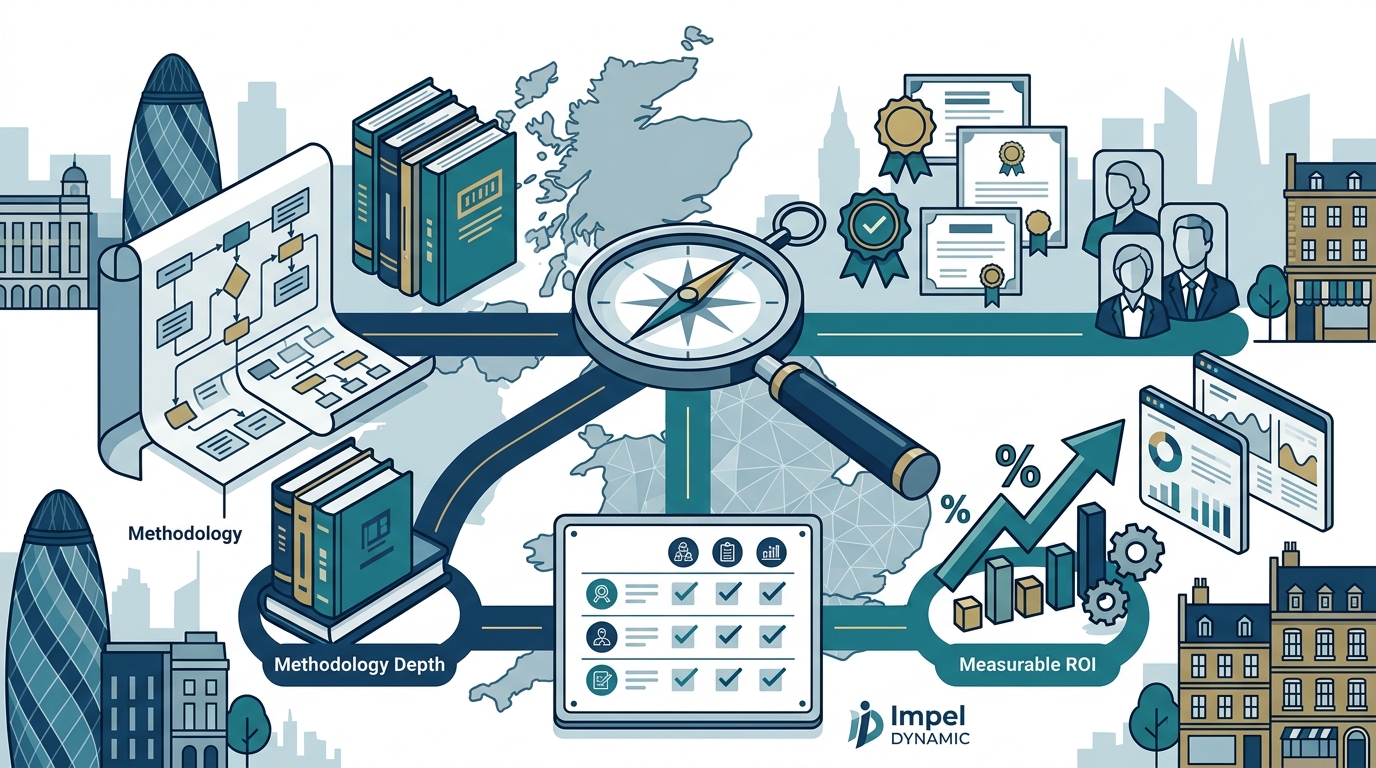
What separates a good provider from a bad one is the depth of their methodology. Many companies offer off-the-shelf courses that teach basic tactics. A superior provider, like Impel Dynamic's sales training courses, focuses on strategic frameworks that adapt to your specific selling environment. Look for providers who emphasize the psychology of selling and consultative approaches rather than just scripts.
Methodology Depth
Research from Korn Ferry and the Sales Management Association shows that only 30% of organizations follow a formal sales methodology consistently, while 90% of companies that do use a guided sales process rank as top performers. Organizations with a formalized, dynamic sales methodology achieve 27% higher win rates and 21% higher quota attainment than those relying on informal processes. A good training company will help you build this formalized process.
Trainer Credibility
Trainers should have proven track records in high-level sales and management roles. Impel Dynamic’s team is hand-picked, holding extensive experience in high-level sales and management roles. They remain involved in day-to-day business development activities to ensure that their training approaches are current and relevant. This practical experience is a key differentiator from academic-only trainers.
What to Ask Before Committing
Before signing a contract, you must ask specific questions to gauge the provider's capability. These questions help you understand if the training will actually change behavior and drive revenue.
Key Questions for Providers
- How do you customize the content for our specific industry and customer base?
- What is the structure of your methodology? Is it a rigid script or a flexible framework?
- How do you measure success? What KPIs do you track post-training?
- Do your trainers have recent, hands-on sales experience in our sector?
- What is the follow-up process? Do you offer coaching or support after the initial workshop?
Impel Dynamic uses a "Prepare, Deliver, Follow-Up" methodology. This ensures that the training is not just an event but a continuous improvement cycle. They offer bespoke sales programmes that are tailored to your company's culture and anticipated trends.
How to Verify Claims and Credentials
Verifying a provider's claims is crucial to avoid wasting budget on ineffective training. Start by checking their case studies and client testimonials. Look for specific, measurable outcomes rather than vague praise.
Checking Case Studies
Impel Dynamic reports that their clients have closed $100,000-1,000,000 in new deals since training with them. When verifying these claims, ask for references from similar companies in your industry. Speak to these references about the long-term impact of the training, not just the immediate reaction to the workshop.
Assessing Trainer Backgrounds
Request the CVs of the specific trainers who will be delivering your sessions. Verify their LinkedIn profiles and professional history. A trainer who has recently managed a sales team in your industry will provide more relevant insights than one who has only taught for years without selling.
How It Works: Process and Timeline
Understanding the implementation process helps you plan for the disruption and resource requirements. Most effective sales training follows a structured timeline that includes preparation, delivery, and follow-up.
The Implementation Timeline
| Phase | Duration | Activities |
|---|---|---|
| Preparation | 1-2 Weeks | Needs assessment, pre-training questionnaires, customizing content. |
| Delivery | 1-5 Days | Workshops, simulations, role-plays, and framework building. |
| Follow-Up | Ongoing | Coaching, review sessions, KPI monitoring, and reinforcement. |
Impel Dynamic offers 1-5 day tailored programmes, ongoing sales programmes, and a 100% bespoke approach. They meet you at your current knowledge level and take you to the top through these structured phases. The follow-up phase is critical for ensuring that new behaviors stick.
What It Costs: Price Drivers
The cost of sales training varies significantly based on several factors. Understanding these drivers helps you budget effectively and avoid unexpected fees.
Key Cost Drivers
- Customization Level: Bespoke programmes cost more than open courses due to the time spent tailoring content.
- Delivery Method: In-person training is generally more expensive than virtual training due to travel and venue costs.
- Duration: Longer programmes with more follow-up coaching cost more but often yield higher ROI.
- Trainer Expertise: Senior consultants with extensive industry experience command higher fees.
Impel Dynamic provides cost-effective tailored sales development programmes. They offer both face-to-face and live online training, allowing you to choose the delivery method that best fits your budget and team's location. For more information on pricing, you can contact their team for a personalized quote.
What Goes Wrong: Common Mistakes
Many organizations fail to see results from sales training due to common mistakes. Avoiding these pitfalls is essential for maximizing your investment.
Common Mistakes
- Choosing a One-Size-Fits-All Solution: Generic courses often fail to address specific industry challenges.
- Lack of Management Buy-In: If managers do not reinforce the new behaviors, the training will be forgotten.
- No Follow-Up: Training without ongoing coaching and reinforcement leads to skill decay.
- Ignoring Data: Failing to track KPIs before and after training makes it impossible to measure ROI.
McKinsey research indicates that 70% of large-scale transformation initiatives fail, frequently because leadership does not reinforce new behaviors at every level. To avoid this, ensure that your training provider includes a robust follow-up and coaching component.
Versus Alternatives: Comparison
There are several alternatives to hiring a specialized sales training company. Understanding the pros and cons of each helps you make an informed decision.
| Option | Pros | Cons |
|---|---|---|
| In-House Training | Low cost, highly customized. | Requires internal expertise, may lack objectivity. |
| Open Courses | Cost-effective, peer learning. | Less customized, limited follow-up. |
| Bespoke External Training | Highly customized, expert-led, robust follow-up. | Higher cost, requires external dependency. |
For most organizations, a hybrid approach works best. Start with an open course to build foundational skills, then move to a bespoke programme for strategic alignment. Impel Dynamic offers both open sales courses and bespoke programmes, allowing you to scale your investment as needed.
For Specific Situations
The best training approach depends on your specific situation. Different scenarios require different strategies.
Scaling a Growing Organization
As companies scale, the gap between having a sales methodology and actually executing it widens fast. Leadership coaching is the bridge that turns a chosen framework from a slide-deck aspiration into a living, daily discipline across every team, region, and hire. Impel Dynamic offers tailored leadership and management training to help managers standardize sales methodology across a growing organization.
Professional Service Firms
Impel Dynamic specializes in helping professional service firms in the legal, financial, and insurance sectors expand their influence and maximize their revenue. They offer business development programmes that focus on winning new clients, maximizing revenue by selling deeper and wider into key accounts, and strengthening relationships.
Rules and Protections
When engaging a sales training provider, it is important to understand the rules and protections that apply. This includes data protection, intellectual property, and service level agreements.
Data Protection
Ensure that the provider is GDPR compliant. Impel Dynamic is committed to safeguarding your personal information and is not in the business of selling, renting, or trading email lists with other companies. They use GDPR compliant highly secure third parties to host their CRM system and assist with invoicing. You can review their privacy policy for more details.
Intellectual Property
Clarify who owns the materials and frameworks developed during the training. Typically, the provider retains ownership of their core methodology, but you should have the right to use the customized materials for your internal training.
Local Specifics: UK and London
London is one of the most competitive commercial hubs in the world, and its sales teams are under constant pressure to hit quota in markets where buyers are better informed than ever. Choosing the right sales training company can be the difference between a team that consistently overachieves and one that plateaus.
Impel Dynamic is based in London, at Level 30 The Leadenhall Building, 122 Leadenhall Street, London EC3V 4AB. Their local presence allows them to understand the specific challenges faced by London-based organizations competing in financial services, technology, and professional services. They offer both in-person and virtual training, making them accessible to teams across the UK.
Timing: When to Act
Timing is critical when implementing sales training. The best time to act is when your organization is ready for change and has the resources to support it.
Optimal Timing
- Before a Major Launch: Train your team before launching a new product or entering a new market.
- After a Performance Dip: Use training to address specific performance issues and reset expectations.
- During Hiring Spikes: Train new hires consistently to ensure they are aligned with your methodology from day one.
Impel Dynamic emphasizes that lasting change starts with people. By showing your team the steps needed to initiate that change, they impel the shifts in behavior and culture that deliver those goals and sustain them. Acting proactively rather than reactively yields better results.
Results Over Time
Measurable outcomes are the ultimate proof of a training provider's effectiveness. What can you expect over time?
Short-Term Results (0-3 Months)
- Increased confidence and motivation among sales reps.
- Improved pipeline hygiene and activity levels.
- Higher win rates on new deals.
Long-Term Results (3-12 Months)
- Sustained quota attainment and revenue growth.
- Standardized sales methodology across the organization.
- Improved customer retention and lifetime value.
Impel Dynamic's clients have seen significant improvements in their sales performance. Their focus on actionable and relevant change ensures that the results are not just temporary but sustainable. To plan your visit or discuss your specific goals, you can get in touch with Impel Dynamic.
Key Takeaways
- Choose a provider with a deep, formalized sales methodology, not just generic tactics.
- Verify trainer credibility by checking their recent, hands-on sales experience.
- Ask specific questions about customization, measurement, and follow-up.
- Understand the cost drivers, including customization level and delivery method.
- Avoid common mistakes like lack of management buy-in and no follow-up.
- Consider a hybrid approach, starting with open courses and moving to bespoke programmes.
- Ensure the provider is GDPR compliant and clear on intellectual property rights.
- Act proactively, timing your training with major business milestones.
Frequently Asked Questions
What is the best sales training company in the UK?
The best sales training company depends on your specific needs. Impel Dynamic is a strong choice for organizations seeking strategic, bespoke programmes with a focus on the psychology of selling and robust follow-up.
How long does sales training take?
Initial workshops typically take 1-5 days. However, effective training includes ongoing coaching and follow-up, which can last several months.
Is online sales training as effective as in-person?
Yes, when delivered by experienced trainers. Impel Dynamic offers live online training that is highly effective, allowing for real-time interaction and engagement.
How do I measure the ROI of sales training?
Track KPIs such as win rates, quota attainment, and average deal value before and after the training. Impel Dynamic helps you monitor every step of the way with a clear improvement plan and KPIs.
Can sales training help with leadership development?
Yes. Impel Dynamic offers tailored leadership and management training to help managers standardize sales methodology and drive strategic alignment.
What industries does Impel Dynamic specialize in?
Impel Dynamic specializes in helping professional service firms in the legal, financial, and insurance sectors, but they also work with a variety of companies from large blue-chip conglomerates to SMEs.