

Advanced sales training should do more than give salespeople another set of techniques to remember. The strongest programmes change how teams identify opportunities, engage decision-makers, communicate value, negotiate, manage accounts and create predictable revenue.
For a business, that means the investment can be assessed through practical outcomes: more qualified pipeline, stronger conversion, larger opportunities, shorter sales cycles, better customer relationships and improved performance management. Impel Dynamic helps organisations in London, across the UK and internationally connect sales capability with these commercial results through bespoke programmes, open courses, online sales training, sales coaching and sales management development.
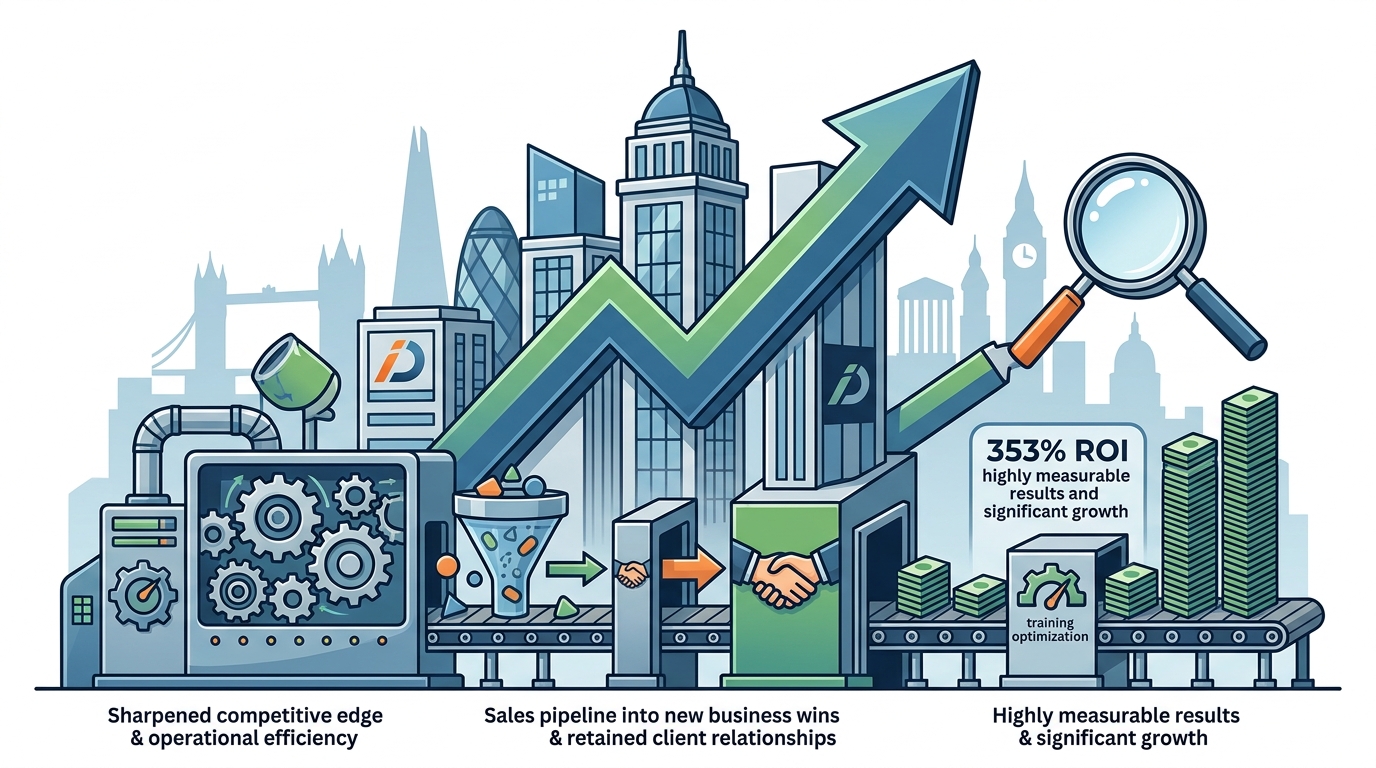
Industry research frequently cites a 353% return on investment for corporate learning, equivalent to approximately $4.53 returned for every $1 invested. That figure is a broad training benchmark rather than a guaranteed result for every sales team, so each organisation should establish its own baseline and measure commercial performance before and after training. ([forbes.com](https://www.forbes.com/councils/forbesbusinessdevelopmentcouncil/2026/03/04/sales-training-roi-turning-investment-into-tangible-results/?utm_source=openai))
1. More profitable commercial growth
The clearest reason to invest in advanced sales training is to help the team win business that would otherwise be missed. Skilled salespeople are better equipped to uncover business problems, position a solution around measurable value and guide buyers through a complex decision.
This is particularly important when a company is selling a high-value, technical or consultative service. A product-led conversation may result in price comparisons. A value-led conversation gives the buyer a clearer reason to change, invest and choose one provider over another.
Impel Dynamic positions its programmes around tangible outcomes such as winning new clients, creating scalable sales processes, maximising value from existing accounts and preparing teams for C-suite conversations. Its website also reports a 6X average ROI and states that 92% of clients experienced a significant return on their investment; these are provider-reported results and should be considered alongside an organisation's own measurement plan. ([impeldynamic.com](https://impeldynamic.com/?utm_source=openai))
Examples of commercial growth outcomes may include:
- More opportunities progressing from initial conversation to qualified pipeline.
- Greater revenue generated per salesperson.
- More consistent performance against monthly, quarterly or annual targets.
- New access to accounts, sectors or decision-makers that were previously difficult to reach.
- Improved ability to protect value instead of relying on discounting.
For examples of how a tailored programme can address specific growth barriers, explore Impel Dynamic's bespoke sales programmes.
2. Better conversion and qualification
Many sales problems begin before the proposal stage. Teams may spend time on prospects that lack a compelling need, the authority to buy, sufficient resources or a realistic decision process. Advanced training improves the quality of early-stage conversations so that salespeople can distinguish genuine opportunity from activity that is unlikely to produce revenue.
Effective qualification is not simply a checklist. It involves asking commercially meaningful questions, listening for implications, identifying the buyer's priorities and agreeing a credible next step. When these behaviours become consistent, the pipeline becomes more accurate and sales leaders gain a clearer view of future revenue.
Businesses can measure this outcome through:
- Lead-to-opportunity conversion rate.
- Opportunity-to-close win rate.
- Percentage of opportunities with a documented business problem and buying process.
- Pipeline coverage and forecast accuracy.
- Number of opportunities removed early because they did not meet agreed qualification criteria.
Training Industry recommends linking learning objectives to specific business measures and comparing pre-training and post-training performance rather than relying on anecdotal feedback alone. ([trainingindustry.com](https://trainingindustry.com/articles/sales/proving-the-roi-of-sales-training-metrics-that-matter/?utm_source=openai))
Why qualification affects revenue
Suppose a team creates 100 opportunities but only 20 are properly qualified. Salespeople may waste time preparing proposals, attending meetings and negotiating with buyers who were never likely to proceed. If training helps the team prioritise the 20 strongest opportunities, the business may improve productivity even before the total number of leads increases.
3. Higher-value opportunities and improved margins
Advanced sales training can help salespeople move beyond transactional selling. They learn to explore the wider commercial impact of a problem, identify additional stakeholders and connect the proposed solution to outcomes such as revenue growth, risk reduction, productivity or customer retention.
This creates more opportunities to increase average deal value through appropriate upselling, cross-selling, packaging and strategic account development. It can also improve margins because the salesperson is better able to explain why the solution is worth its price.
Impel Dynamic's bespoke training specifically includes areas such as psychology of selling, relationship building, conversion improvement and discovering upsell and cross-sell opportunities. ([impeldynamic.com](https://impeldynamic.com/?utm_source=openai))
From product features to business value
A feature-led message might explain what a service does. A value-led message explains what changes for the customer, how that change can be measured and why it matters now. For example:
| Conversation level | Example | Commercial effect |
|---|---|---|
| Feature | “The platform provides automated reporting.” | Describes functionality but may invite price comparison. |
| Benefit | “Managers receive reports without manual preparation.” | Connects the feature to convenience and efficiency. |
| Business value | “Your managers recover two hours per week for each team member and can act on performance issues earlier.” | Creates a stronger case for investment and expansion. |
Training Industry identifies average deal size, revenue generation, win rate and sales-cycle reduction as useful measures when evaluating the commercial impact of sales training. ([trainingindustry.com](https://trainingindustry.com/articles/sales/proving-the-roi-of-sales-training-metrics-that-matter/?utm_source=openai))
4. Stronger access to senior decision-makers
Complex deals often involve several stakeholders with different priorities. A finance director may focus on return and risk, an operational leader may focus on implementation, and a senior executive may focus on strategic impact. Advanced sales training prepares sellers to adapt the conversation without losing a coherent value proposition.
The result is a more strategic sales process. Rather than relying on a single enthusiastic contact, the salesperson can build multi-level relationships, map decision criteria and create internal momentum for change.
Impel Dynamic's advanced sales training course covers areas including senior-level communication, purchasing drivers and consultative selling frameworks. Its broader complex and enterprise sales approach focuses on engaging key decision-makers, managing multiple stakeholders and shortening lengthy buyer decision processes.
Business outcomes of executive-level selling
- Improved access to budget holders and economic buyers.
- More effective executive presentations and proposals.
- Fewer opportunities stalled because the salesperson has only one contact.
- Better alignment between the seller's solution and the customer's strategic priorities.
- Greater resilience when a champion leaves or internal priorities change.
5. More confident, adaptable sales professionals
Confidence in sales is not the same as enthusiasm. Professional confidence comes from preparation, questioning skill, commercial understanding and the ability to respond constructively when a buyer challenges price, timing, relevance or risk.
Advanced programmes give experienced salespeople a structured way to improve the behaviours that matter in difficult conversations. These may include opening a meeting with relevance, asking more useful questions, handling objections, presenting to different audiences, negotiating without unnecessary concessions and gaining a clear commitment.
Impel Dynamic reports that 97% of clients consider its programmes extremely practical, while 95% of managers see a positive change in behaviour. These figures are based on the provider's reported client feedback and illustrate the importance of making learning usable in day-to-day sales activity. ([impeldynamic.com](https://impeldynamic.com/?utm_source=openai))
Confidence becomes commercially valuable when it changes observable behaviour. A more confident salesperson is more likely to:
- Contact a senior prospect with a relevant business reason.
- Challenge an unclear requirement rather than accept it passively.
- Discuss value before negotiating price.
- Ask directly for the next step or decision.
- Recover constructively after an objection or lost opportunity.
6. Consistent execution through coaching
A single workshop rarely changes a sales organisation by itself. Learning must be reinforced through practice, manager observation, feedback and repeated use in live opportunities. This is where sales coaching turns training content into working capability.
Coaching may involve reviewing calls, rehearsing an upcoming executive meeting, analysing a lost deal, improving a proposal or agreeing one behaviour to practise during the next week. The purpose is not to provide generic encouragement; it is to help the salesperson apply a specific skill in a specific commercial situation.
Research and practitioner guidance on training measurement emphasise the importance of monitoring behaviour change and knowledge retention, not just learner satisfaction. ([trainingindustry.com](https://trainingindustry.com/articles/sales/stop-the-guesswork-connecting-sales-training-with-measurable-business-results/?utm_source=openai))
What a reinforcement plan can include
- Before training: Establish baseline metrics, interview managers and identify priority opportunities.
- During training: Use role-play, practical scenarios, questioning exercises and deal-based application.
- Within 30 days: Review whether new behaviours appear in calls, meetings and opportunity plans.
- Within 60 to 90 days: Compare pipeline quality, conversion, deal progression and manager observations.
- After 90 days: Identify which behaviours are embedded and where additional coaching or process changes are needed.
Impel Dynamic offers sales training courses and post-training support, including coaching and practical application. For managers, its open sales management course focuses on leadership, objectives, accountability and team performance.
7. Stronger talent retention and customer relationships
Sales training can affect more than revenue. When employees receive relevant development, practical support and a visible route to improve, they may feel better equipped to succeed in their role. That can support engagement and reduce the operational disruption associated with avoidable turnover.
Retention is especially valuable in sales because departing employees can take customer knowledge, account history and hard-won relationships with them. Developing internal capability helps preserve institutional knowledge and creates a stronger talent pool for future leadership roles.
The customer can also benefit. Salespeople who understand relationship selling are better positioned to act as trusted advisers rather than one-off suppliers. They can uncover new opportunities, maintain relevance between purchases and identify ways to create additional value for existing clients.
Training Industry notes that sales training impact may extend beyond immediate sales measures to areas such as customer satisfaction and retention, although these outcomes should be tracked over an appropriate period and not automatically attributed to training without supporting evidence. ([trainingindustry.com](https://trainingindustry.com/articles/sales/proving-the-roi-of-sales-training-metrics-that-matter/?utm_source=openai))
Relationship selling in practice
Relationship selling means understanding the customer's professional and human context, maintaining credibility, using feedback and continuing to create value after the initial sale. Impel Dynamic describes relationship-selling development as a way to build loyal customer relationships, encourage repeat business and generate referrals.
How to measure the business impact of advanced sales training
The most credible measurement approach combines financial results, sales-process indicators, behaviour change and employee outcomes. Begin with a baseline before training, define a realistic review period and agree how much influence the training is expected to have alongside factors such as pricing, market demand, product changes and sales capacity.
| Measurement area | Useful indicators | What it can reveal |
|---|---|---|
| Revenue performance | Revenue per rep, gross margin, closed-won revenue | Whether improved capability is contributing to financial growth. |
| Pipeline quality | Qualified pipeline, stage conversion, forecast accuracy | Whether sellers are prioritising realistic opportunities. |
| Deal effectiveness | Win rate, average deal size, discount rate | Whether sellers are creating and defending more value. |
| Sales efficiency | Sales-cycle length, activities per opportunity, time to first meaningful meeting | Whether the process is becoming more focused and productive. |
| Behaviour change | Question quality, opportunity plans, call reviews, role-play assessments | Whether learning is appearing in daily sales practice. |
| People outcomes | Retention, internal promotion, manager confidence | Whether the programme is strengthening the wider talent system. |
A simple sales-training ROI formula
ROI (%) = [(Incremental profit attributable to training − training cost) ÷ training cost] × 100
Use incremental profit rather than revenue where possible. For example, if a programme costs £20,000 and the business can reasonably attribute £80,000 of additional gross profit to improved sales performance, the calculated ROI is 300%. Attribution should be documented, especially where several commercial initiatives ran at the same time.
Do not rely only on end-of-course ratings. A participant may enjoy a programme without changing their sales behaviour, while a demanding programme may produce significant results after several months. A stronger evaluation sequence measures reaction, learning, application and commercial impact at separate points.
How to make the outcomes more likely
Advanced sales training is most effective when it is connected to the organisation's real sales environment. Before selecting a provider, business leaders should clarify the commercial problem they want to solve and the behaviour that needs to change.
Use this preparation checklist
- Define the priority outcome, such as increasing enterprise win rates or improving account expansion.
- Review current performance by team, role, segment and manager.
- Identify where the sales process breaks down: prospecting, discovery, qualification, proposal, negotiation or closing.
- Use real opportunities and customer scenarios during training.
- Equip managers to reinforce the method through one-to-one coaching.
- Decide which metrics will be reviewed at 30, 60, 90 and 180 days.
- Adapt delivery for the workforce, using in-person, virtual or blended learning as appropriate.
For distributed teams or organisations that need flexible delivery, Impel Dynamic provides virtual sales training using workshops, individual sessions and practical simulations.
Key takeaways
- Advanced sales training can connect individual selling behaviour with measurable business outcomes.
- The most common commercial gains include stronger qualification, higher conversion, larger deal values and more reliable revenue.
- Experienced salespeople benefit when training develops strategic selling, executive engagement, negotiation and complex-deal capability rather than repeating basic scripts.
- Confidence matters when it produces observable actions such as better questions, stronger value conversations and clearer commitments.
- Manager coaching and post-training reinforcement are essential for transferring learning into live opportunities.
- Retention, customer relationships and internal leadership capability are important secondary outcomes.
- Businesses should establish a baseline and measure revenue, pipeline, deal, behaviour and people metrics over at least three to six months.
- Published ROI benchmarks, including the often-cited 353% corporate-training figure, are useful context but do not replace organisation-specific evidence. ([forbes.com](https://www.forbes.com/councils/forbesbusinessdevelopmentcouncil/2026/03/04/sales-training-roi-turning-investment-into-tangible-results/?utm_source=openai))
Frequently asked questions
What is advanced sales training?
Advanced sales training is structured development for sales professionals who need to improve performance in areas such as consultative selling, complex deals, executive engagement, negotiation, value communication, account growth and strategic sales planning. It goes beyond introductory product knowledge or basic prospecting techniques.
What outcomes can a business expect from advanced sales training?
Potential outcomes include higher win rates, better-qualified pipeline, increased revenue per salesperson, larger average deal values, shorter sales cycles, improved negotiation, stronger customer relationships, better manager coaching and improved sales-team retention. The exact outcome depends on the organisation's starting point, sales process and follow-through.
How soon do sales-training results appear?
Early behavioural improvements may appear within the first month, particularly in questioning, qualification, meeting structure and objection handling. Commercial impact usually needs to be assessed over three to six months because opportunities may take time to progress through the pipeline and because behaviour must become consistent before it affects results.
Can advanced sales training help experienced salespeople?
Yes. Experienced sellers often need development in strategic areas such as accessing senior stakeholders, navigating multiple decision-makers, defending value, managing complex sales cycles and expanding existing accounts. Advanced training should be tailored to their experience rather than treating them as beginners.
How is sales coaching different from sales training?
Sales training normally provides a structured learning experience for a group or cohort. Sales coaching is ongoing, personalised support that helps an individual apply the learning to live deals, calls and customer conversations. Combining both generally gives the organisation a better chance of sustaining behaviour change.
Which metrics should be tracked after sales training?
Track metrics that reflect the programme's objectives. Common measures include revenue per rep, quota attainment, win rate, average deal size, discount rate, sales-cycle length, pipeline quality, forecast accuracy, customer retention and employee retention. Add behaviour measures such as opportunity-plan quality, discovery-question quality and manager observation.
Can advanced sales training be delivered virtually?
Yes. Virtual delivery can include live workshops, breakout practice, role-play, digital collaboration, one-to-one coaching and follow-up reviews. The design should remain interactive and closely connected to real sales opportunities rather than becoming passive video-based learning.
How can a London or UK business choose the right provider?
Start by asking whether the provider understands your market, sales motion, customer journey and commercial objectives. Review the methodology, trainer experience, practical components, manager involvement, post-training reinforcement and approach to measuring results. A discovery process before delivery is a useful sign that the programme will be tailored rather than generic.
Turn sales training into a measurable growth plan
The right advanced sales training investment should answer three questions: what commercial result matters most, which behaviours will create that result, and how will the organisation know the change is lasting?
Impel Dynamic works with organisations seeking to win new business, develop sales talent and retain valuable clients. Explore the sales training courses available from Impel Dynamic or discuss a tailored programme built around your team's priorities.
Related resources
- Impel Dynamic
- Measurable Revenue Growth
- Higher Win Rates and Larger Deal Sizes
- Elevated Confidence and Selling Skills
- A Stronger Coaching Culture
- How to Measure Sales Training ROI
- Key Takeaways
- Your Next Step
- predictable revenue growth
- Training Industry research
- 4x higher adoption of new behaviours
- 24% higher profit margins