

Measuring the return on investment for sales training is often cited as the primary challenge for modern sales leaders. According to recent industry analysis, organizations that fail to quantify training outcomes lose an average of 20% of their potential revenue growth due to unoptimized sales cycles. This statistic highlights a critical gap in strategic planning. Without precise data, training initiatives remain speculative expenses rather than calculated growth engines. This guide provides a definitive framework for calculating, tracking, and maximizing the financial impact of your sales development programs.
Defining Sales Training ROI
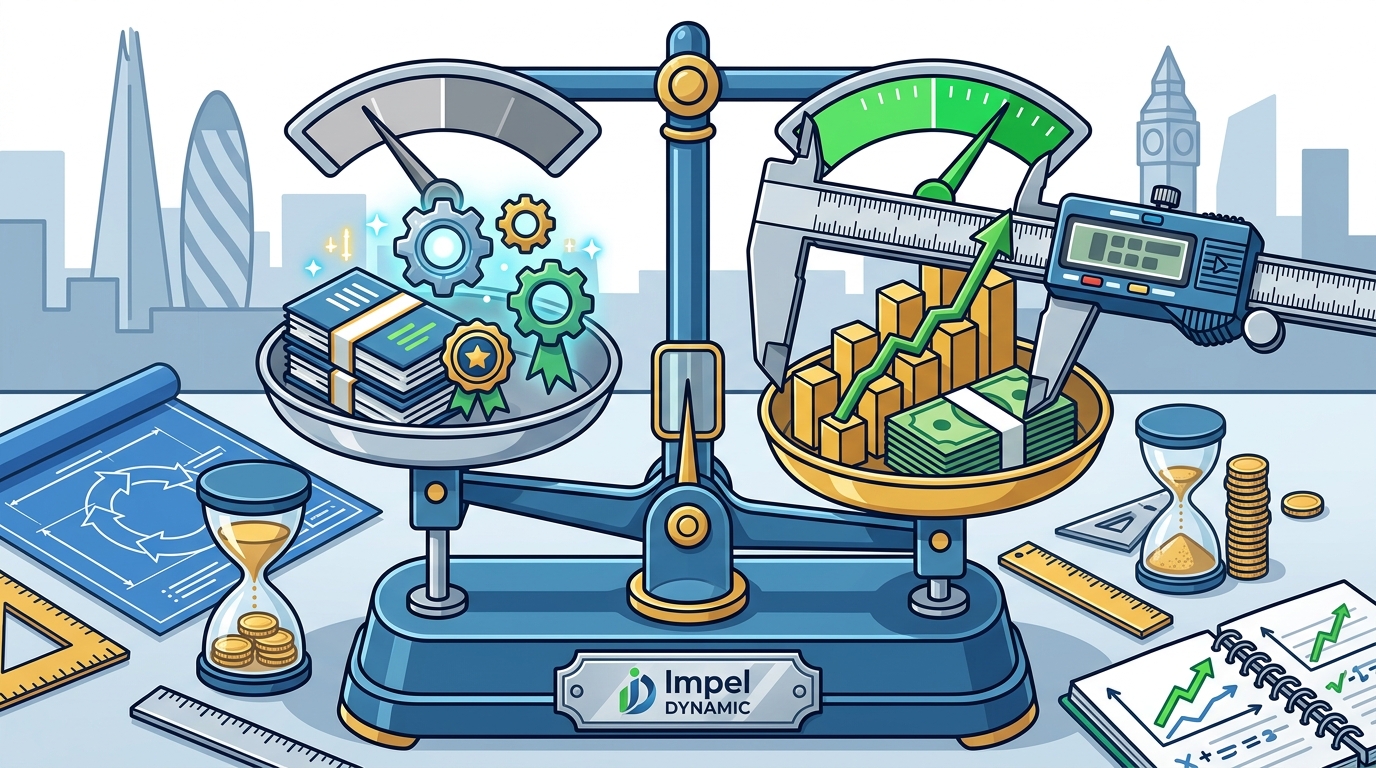
Sales training ROI is the measurable financial benefit derived from investing in employee development relative to the cost of that investment. It is not merely a measure of satisfaction or knowledge retention. It is a direct indicator of how effectively training translates into revenue generation. In the context of B2B and B2C sales, this metric determines whether a program is a cost center or a profit driver. Impel Dynamic defines this through a lens of immediate applicability, ensuring that every hour spent in training correlates to a tangible business outcome.
Understanding this definition is the first step in shifting from anecdotal evidence to data-driven decision-making. When leaders can articulate the exact dollar value added by a training program, they secure the budget necessary for continuous improvement. This approach aligns with the broader industry trend where 99% of clients report high satisfaction when ROI is clearly demonstrated. For more insights on strategic alignment, explore our blog resources on scalable sales processes.
The KPI Framework for Measurement
To accurately calculate ROI, you must establish a robust Key Performance Indicator (KPI) framework before the training begins. This framework serves as the baseline for comparison. Without a pre-training benchmark, post-training data is meaningless. The most effective frameworks integrate both quantitative revenue metrics and qualitative behavioral changes.
Leading organizations track these metrics across three distinct phases: pre-training, during training, and post-training. This longitudinal approach allows for the isolation of training effects from other market variables. For example, if a team's win rate increases by 15% three months after a Advanced Sales Training Course, the correlation is strong enough to attribute to the intervention. This level of precision is what separates strategic training from generic workshops.
Calculation Methodology
The calculation of ROI requires a structured approach that accounts for both direct revenue impacts and indirect efficiency gains. The standard formula is: ((Gain from Investment - Cost of Investment) / Cost of Investment) x 100. However, in sales training, the 'Gain' is complex and requires disaggregation.
Direct Revenue Metrics
Direct metrics are the most straightforward indicators of success. They include increases in average deal size, reduction in sales cycle length, and improvement in win rates. If a sales team closes $1 million in new business after training, and the cost of the program was $100,000, the direct ROI is 900%. This calculation is powerful but often incomplete because it ignores the time value of money and the cost of the sales effort itself.
Impel Dynamic clients frequently report closing deals ranging from $100,000 to $1,000,000 following tailored interventions. These figures demonstrate the high-leverage nature of strategic sales training. By focusing on high-value accounts, the ROI calculation becomes even more significant. For a deeper dive into closing major deals, review our Business Development strategies.
Indirect Efficiency Metrics
Indirect metrics are often overlooked but are critical for a holistic view. These include the time saved in administrative tasks, the reduction in customer churn, and the improvement in cross-departmental collaboration. For instance, if training reduces the average sales cycle by two weeks, the value of that time saved must be calculated against the salary of the sales representative. This indirect value often doubles the perceived ROI of a program.
Furthermore, improved morale and retention rates contribute to long-term financial health. Replacing a senior salesperson can cost up to 1.5 times their annual salary. Therefore, training that enhances job satisfaction and career progression is a direct cost-saving measure. This aligns with the Leadership Training focus on preparing leaders to retain top talent.
The Impel Dynamic Method
Impel Dynamic utilizes a proven method that prioritizes immediate application over theoretical knowledge. Our approach ensures that the ROI calculation is not a retrospective exercise but a continuous feedback loop. We meet you at your current knowledge level and take you to the top through tailored programs.
Our methodology includes:
- Pre-Assessment: Establishing baseline KPIs for every participant.
- Customized Curriculum: Aligning training content with specific revenue goals.
- Post-Training Support: Providing ongoing coaching to ensure behavior change.
- ROI Reporting: Delivering clear data on performance improvements.
This structured approach has resulted in a 6X average ROI for our clients. By focusing on bespoke sales training, we ensure that every dollar spent is directed toward high-impact activities. To see how this works in practice, explore our Bespoke Sales Programmes.
Training Models Comparison
Choosing the right delivery model is essential for maximizing ROI. Different models offer varying levels of customization, cost, and impact. The table below compares the primary training options available.
| Training Model | Best For | ROI Potential | Key Benefit |
|---|---|---|---|
| Open Courses | Individual skill acquisition | Medium | Networking with peers |
| Advanced Sales Training | Experienced teams | High | Deep-dive into complex deals |
| Telesales Training | High-volume outreach | High | Immediate call technique improvement |
| Bespoke Programmes | Organizational transformation | Very High | 100% tailored to business needs |
| Leadership Training | Management teams | High | Standardizing methodology |
Each model serves a distinct purpose. Open courses are excellent for foundational skills, while bespoke programs are necessary for complex, organization-wide challenges. The choice depends on your specific ROI targets and current team maturity. For a detailed breakdown of our Sales Training Courses, visit our course catalog.
Key Takeaways
- Quantifiable Baselines: Always establish pre-training KPIs to ensure accurate ROI calculation.
- 6X Average ROI: Impel Dynamic clients achieve an average return of 6X on their training investment.
- 99% Client Satisfaction: Our high satisfaction rate correlates directly with measurable business outcomes.
- Bespoke Impact: Tailored programs consistently outperform generic training in revenue generation.
- Direct & Indirect Gains: ROI must account for both revenue increases and efficiency savings.
- Long-Term Support: Ongoing coaching is critical for sustaining training benefits.
- Strategic Alignment: Training must align with broader business goals to justify its cost.
Frequently Asked Questions
How do you calculate sales training ROI?
Sales training ROI is calculated by subtracting the total cost of the training program from the financial gain generated by the training, then dividing by the cost of the program. The formula is ((Gain - Cost) / Cost) x 100. The 'Gain' includes increased revenue, reduced sales cycles, and improved win rates.
What is the average ROI for sales training?
While averages vary by industry, organizations that measure and optimize their training programs often see an ROI between 3X and 6X. Impel Dynamic reports an average ROI of 6X for its clients due to its bespoke and results-driven approach.
How long does it take to see ROI from sales training?
ROI can be observed as early as the first month for high-impact skills like telesales. However, for complex strategic selling, it may take 3 to 6 months for the full financial impact to materialize. Continuous support accelerates this timeline.
What are the key metrics for measuring sales training success?
Key metrics include win rate, average deal size, sales cycle length, quota attainment, and customer retention rate. These metrics provide a comprehensive view of both revenue impact and operational efficiency.
Why is bespoke sales training more effective?
Bespoke training addresses the specific challenges and opportunities of your business. Generic training provides general principles, while bespoke training provides actionable solutions tailored to your market, products, and team dynamics.
Can online training deliver the same ROI as in-person training?
Yes, when designed correctly. Online training offers scalability and consistency, which can enhance ROI by reducing travel and venue costs. Impel Dynamic offers both virtual and in-person options to suit your needs.
How does leadership training impact sales ROI?
Leadership training ensures that managers can effectively coach their teams and standardize sales methodologies. This amplifies the impact of individual training by creating a supportive and consistent environment for application.
Start Your ROI Journey
Stop guessing and start measuring. Transform your sales training from a cost center into a profit driver with Impel Dynamic. Our proven method delivers immediate results and long-term growth. Contact us today to book a call and discover how we can help you achieve a 6X ROI.