

Choosing the right sales training model is one of the most critical strategic decisions a leadership team can make. The wrong choice can lead to wasted budget, disengaged teams, and stalled revenue growth. According to recent industry data, organizations that align their training delivery with their specific operational maturity see a 6X average return on investment, while those that guess often see minimal impact. This article explores the common pitfalls businesses face when deciding between in-house and open sales training, helping you make an informed choice that drives tangible results.
Pitfall 1: Ignoring Cultural Fit and Customization Needs
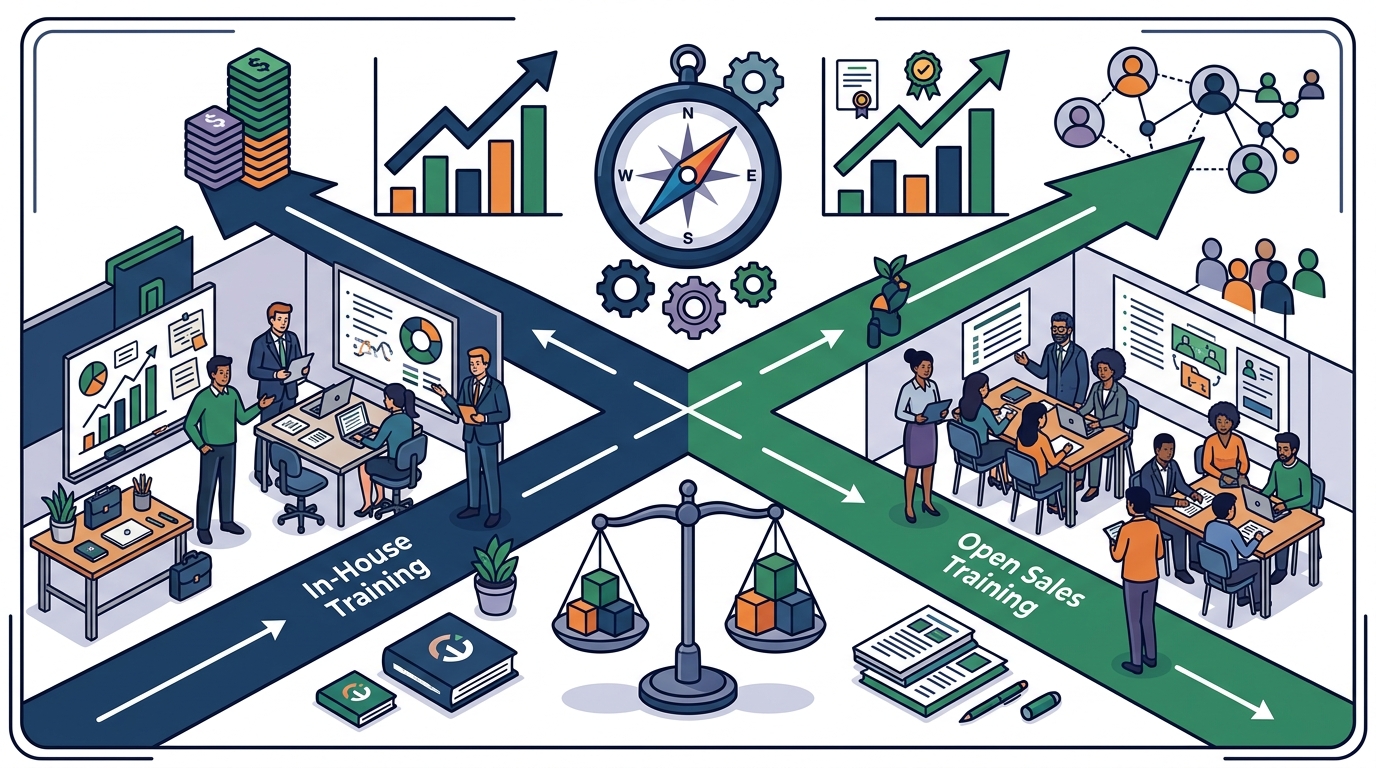
One of the most frequent errors companies make is selecting a training format without considering their unique organizational culture. In-house training is defined as a bespoke learning experience tailored specifically to the company’s internal processes, products, and market position. This model allows for deep customization, ensuring that the sales methodology resonates with the team’s specific challenges.
Conversely, open sales training is defined as a public course where participants from various organizations learn together. While this offers a standardized curriculum, it often lacks the nuance required for complex B2B or specialized B2C environments. A common pitfall is assuming that open courses can replace the need for internal alignment. If your sales team deals with high-value, complex deals, generic content may fail to address the specific objections and decision-making hierarchies they face daily.
To avoid this, leadership must assess whether their team needs a broad foundational skill set (suitable for open courses) or a deep, context-specific intervention (requiring in-house programs). Impel Dynamic specializes in bespoke sales programmes that are designed to meet teams exactly where they are, ensuring immediate applicability.
Pitfall 2: Underestimating the Cost of Time and Logistics
Financial cost is often the primary driver in training decisions, but the hidden costs of time and logistics are frequently underestimated. In-house training requires significant coordination, including scheduling, venue preparation, and potentially travel for trainers. For distributed teams, this can be logistically complex and expensive.
Open courses, on the other hand, offer a streamlined logistical experience. Participants can attend sessions in major hubs or online, reducing the administrative burden on the HR department. However, the cost of taking employees away from their desks for multiple days can impact short-term productivity. According to McKinsey research, the opportunity cost of employee time is a critical factor in training ROI calculations that are often overlooked.
The pitfall lies in comparing only the sticker price of the training provider. Instead, leaders should calculate the total cost of ownership, including administrative time, lost revenue during training days, and the potential for disruption to client relationships. Impel Dynamic offers virtual training options that mitigate many of these logistical hurdles while maintaining the depth of in-house customization.
Pitfall 3: Overlooking the Value of Peer Learning
A significant advantage of open sales training is the opportunity for peer learning. Participants can share best practices, challenges, and solutions with colleagues from other industries. This cross-pollination of ideas can spark innovation and provide a broader market perspective. Ignoring this benefit is a common pitfall for companies that default to in-house training solely for control.
However, the pitfall arises when the peer group is not diverse enough or when the company’s specific context makes peer advice irrelevant. If your sales process is highly proprietary, learning from outsiders may not be applicable. Conversely, if your team is isolated, they may miss out on industry-wide trends and competitive insights. Impel Dynamic’s open courses are designed to facilitate high-value networking and knowledge exchange among like-minded professionals.
Pitfall 4: Neglecting Long-Term Scalability
Training is not a one-off event; it is part of a continuous development strategy. A common pitfall is choosing a model that works for the current team size but fails to scale. In-house training can become prohibitively expensive and difficult to coordinate as the sales team grows. Each new cohort may require a new engagement, leading to inconsistent messaging and methodology drift.
Open courses offer better scalability for large, distributed teams, as individuals can attend sessions as needed. However, they may lack the continuity required for deep behavioral change. The key is to find a balanced approach. Impel Dynamic provides tailored leadership & management training that can be scaled across organizations while maintaining a consistent strategic framework.
Pitfall 5: Failing to Define Clear Success Metrics
Without clear metrics, it is impossible to determine which training model delivered better value. A common pitfall is evaluating training based on participant satisfaction scores alone. While important, these scores do not reflect behavioral change or revenue impact. Leaders must define KPIs before selecting a training provider.
For in-house training, metrics might include the speed of sales cycle closure or the increase in average deal size. For open training, metrics might focus on the adoption of new techniques or the number of new connections made. Impel Dynamic emphasizes measurable ROI in all its programs, ensuring that training translates into tangible business outcomes.
Pitfall 6: Assuming One-Size-Fits-All Solutions Work
Perhaps the most dangerous pitfall is the assumption that a single training model will suffice for all teams. Different segments of the sales organization have different needs. New hires may benefit from the structure of open courses, while senior account executives may require the depth of in-house coaching. Impel Dynamic’s approach includes sales coaching and advanced sales training to address these varied needs.
Comparing Training Models: A Strategic Overview
| Factor | In-House Training | Open Sales Training |
|---|---|---|
| Customization | Highly tailored to company needs | Standardized curriculum |
| Peer Learning | Internal knowledge sharing | Cross-industry insights |
| Logistics | Complex coordination required | Streamlined and flexible |
| Scalability | Challenging for large teams | Easier to scale across locations |
| ROI Focus | Direct impact on internal metrics | Broad skill acquisition |
Key Takeaways
- Impel Dynamic has over 25 years of experience in delivering sales training solutions.
- 99% of Impel Dynamic’s clients report high satisfaction with their training programs.
- Organizations using tailored sales training see an average ROI of 6X.
- In-house training offers superior customization for complex B2B sales environments.
- Open courses provide valuable peer learning and networking opportunities.
- Logistical costs and time away from work must be factored into the total cost of training.
- Scalability is a critical consideration for growing sales teams.
Frequently Asked Questions
What is the main difference between in-house and open sales training?
In-house training is customized to your specific business needs, while open training offers a standardized curriculum with diverse peer groups.
Which training model is better for small startups?
Open courses are often more cost-effective for startups, but in-house training can provide faster alignment with unique business models.
How does Impel Dynamic ensure training ROI?
Impel Dynamic focuses on measurable outcomes and provides ongoing support to ensure behavioral change and revenue impact.
Can open training be effective for senior executives?
Yes, if the peer group is high-quality and the content is advanced. However, in-house coaching may offer more targeted strategic insights.
What are the logistical challenges of in-house training?
Challenges include scheduling, venue costs, and coordinating travel for distributed teams, which can be mitigated with virtual options.
How long does it take to see results from sales training?
Results vary, but tailored programs often show immediate applicability, with significant ROI typically realized within 3-6 months.
Is virtual training as effective as in-person?
Virtual training can be equally effective, especially when designed with engagement and interaction in mind, as offered by Impel Dynamic.
Ready to Transform Your Sales Team?
Choosing the right training model is not just about cost; it is about strategic alignment. Whether you need the depth of bespoke sales programmes or the breadth of open courses, Impel Dynamic is here to help. Contact us today to book a call and discover how we can accelerate your sales growth.