

Common Pitfalls When Implementing Different Sales Training Formats
Sales training is often cited as a critical lever for revenue growth, yet the implementation phase remains the primary point of failure for many organizations. According to recent industry analyses, nearly 70% of digital transformation initiatives fail due to poor user adoption, a statistic that directly correlates with how sales methodologies are rolled out to frontline teams. When companies select a training format, they often focus on the content rather than the delivery mechanism, leading to disjointed learning experiences. This article outlines the specific pitfalls associated with each major sales training format and provides strategic solutions to ensure your investment yields measurable returns.
Pitfalls of Open Courses and Cohort-Based Learning
Open courses are designed for individuals to attend alongside peers from other organizations. While this format offers networking opportunities, it introduces significant implementation challenges for corporate teams.
The Context Gap
The primary pitfall is the lack of organizational context. Open courses teach universal principles, but they do not address your specific CRM workflows, pricing structures, or buyer personas. When salespeople return to the office, they struggle to translate generic frameworks into their daily reality. This gap between theory and practice often leads to rapid skill decay.
Disrupted Workflow
Sending multiple team members to external open courses can disrupt daily operations. Unlike in-house training, which can be scheduled during low-activity periods, open courses often require travel and full-day absences. This logistical burden can lead to resentment among team members who feel their core responsibilities are being neglected for training that may not be directly applicable.
Limited Accountability
In an open course setting, accountability is diffuse. There is no direct line of sight for your internal management team to monitor progress or enforce application of new skills. Without a structured follow-up plan, the learning impact diminishes significantly within weeks of completion.
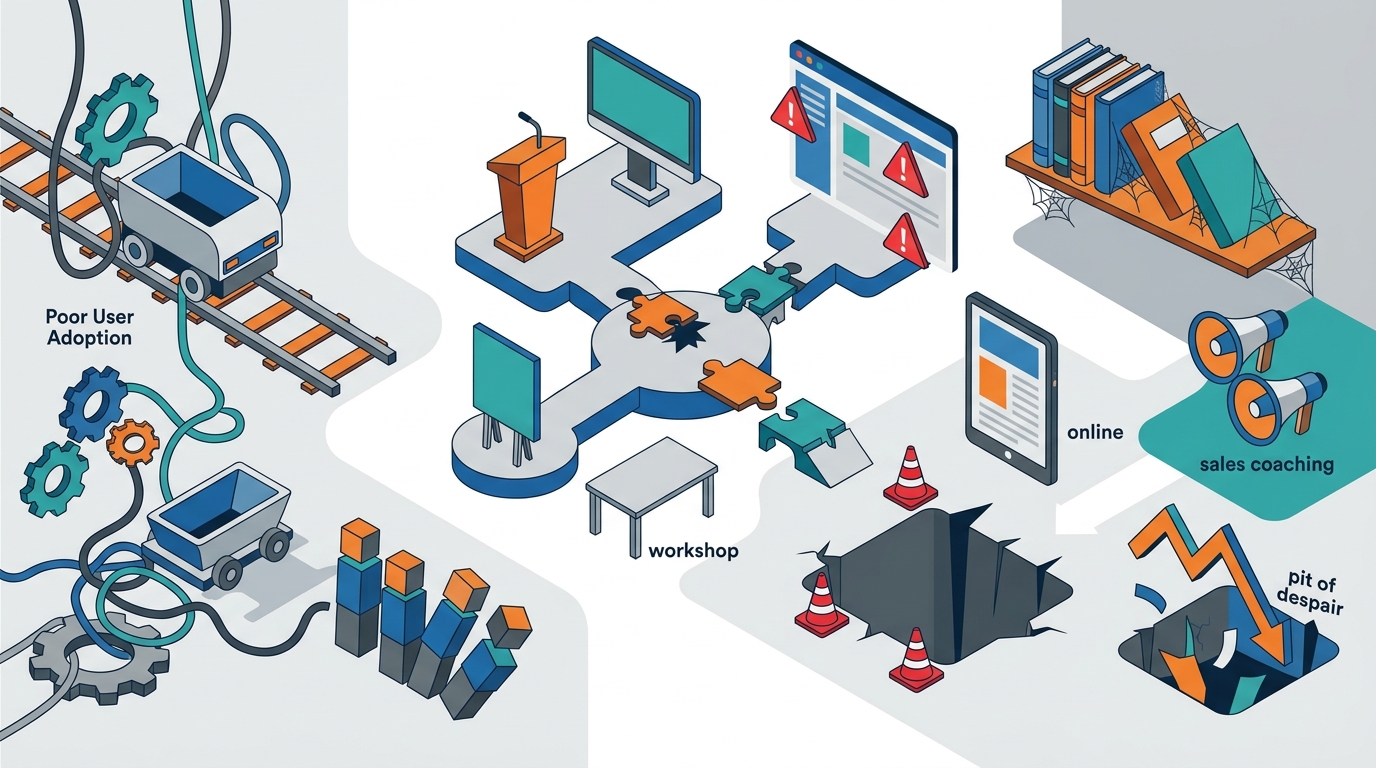
Challenges in Virtual and Online Training Delivery
Virtual training has become a staple in the modern sales ecosystem, offering flexibility and scalability. However, implementing online sales training requires careful design to avoid common engagement traps.
Passive Consumption vs. Active Application
Many organizations mistake video libraries for complete training solutions. Passive consumption of content does not equate to skill acquisition. Sales is a behavioral discipline that requires practice, feedback, and correction. Without interactive elements, role-plays, or live coaching components, virtual training often fails to change behavior. Effective online sales training must include mechanisms for active application, such as recorded pitch reviews or simulated negotiation exercises.
Technical and Engagement Fatigue
Virtual environments are prone to attention drift. Long, unbroken sessions lead to cognitive overload and disengagement. A common pitfall is scheduling multi-day virtual workshops without adequate breaks or varied instructional methods. To combat this, training must be broken into micro-learning modules that respect the attention span of adult learners.
Lack of Peer Interaction
While virtual training connects geographically dispersed teams, it can sometimes hinder the organic peer-to-peer learning that occurs in physical settings. Facilitators must intentionally design breakout rooms and collaborative exercises to replicate the energy of a live classroom.
Risks in Bespoke and In-House Programme Design
Bespoke sales programmes are tailored specifically to your organization’s needs. While this offers the highest potential for relevance, it carries unique implementation risks.
Over-Customization and Complexity
One of the most significant pitfalls is over-customizing the curriculum to the point of complexity. When a programme tries to address every minor nuance of your business, it can become overwhelming for the sales team. The methodology may become so specific that it loses its strategic clarity. A successful bespoke approach, such as those offered by Impel Dynamic, balances customization with simplicity, ensuring that core principles remain easy to remember and apply.
Internal Bias in Content Creation
If an organization attempts to develop bespoke training internally without external expertise, it risks embedding existing biases and outdated practices into the curriculum. Internal trainers may inadvertently teach "how we have always done it" rather than "how we should do it." External facilitators bring fresh perspectives and proven methodologies that challenge the status quo.
Insufficient Follow-Through
Bespoke programmes often suffer from the "one-and-done" mentality. Organizations invest heavily in a multi-day workshop but fail to provide ongoing reinforcement. Sales skills require continuous coaching and reinforcement to stick. Without a long-term development plan, the initial enthusiasm fades, and old habits resurface.
Comparing Training Formats for Maximum ROI
Choosing the right format depends on your specific goals, team size, and current maturity level. The table below summarizes the key characteristics of each approach.
| Training Format | Best For | Primary Pitfall | Mitigation Strategy |
|---|---|---|---|
| Open Courses | Individual skill building and networking | Lack of organizational context | Pair with internal debriefing sessions |
| Virtual Training | Scalability and geographic dispersion | Passive consumption and fatigue | Use micro-learning and interactive tools |
| In-House Training | Team cohesion and immediate application | High cost and logistical complexity | Focus on high-impact, short-duration modules |
| Bespoke Programmes | Strategic alignment and deep customization | Over-complexity and bias | Engage expert facilitators for objectivity |
Key Takeaways
- Context is King: Regardless of format, training must be tied directly to your specific sales processes and CRM tools to ensure applicability.
- Active Learning Required: Passive content consumption does not drive behavior change. Incorporate role-plays, simulations, and live coaching.
- Follow-Through is Critical: The majority of training impact is lost without ongoing reinforcement. Plan for continuous development, not just initial delivery.
- Bespoke vs. Generic: Open courses offer breadth, while bespoke programmes offer depth. Choose based on your team's specific maturity level.
- Virtual Needs Structure: Online training requires deliberate design to prevent fatigue and ensure engagement through interactive elements.
- Expert Facilitation: Internal bias can undermine bespoke training. External experts provide objective, proven methodologies.
- ROI Measurement: Define clear KPIs before training begins. Track metrics such as win rates, deal size, and sales cycle length to measure success.
Frequently Asked Questions
What is the most effective sales training format for remote teams?
For remote teams, a blended approach is often most effective. Combining virtual training modules with regular live coaching sessions ensures scalability while maintaining personal connection and accountability.
How do I know if my sales team needs bespoke training?
If your team struggles with applying generic frameworks to your specific market conditions, or if you have unique sales processes that differ from industry standards, bespoke training is likely necessary. It addresses specific knowledge gaps and aligns directly with your business goals.
Can open courses be effective for large teams?
Open courses can be effective for individual development but are less efficient for large teams due to the lack of contextual customization. For large teams, in-house or bespoke programmes ensure consistent messaging and application across the organization.
What is the typical ROI of sales training?
While ROI varies by program, organizations that implement structured, ongoing training often see significant returns. Impel Dynamic reports an average ROI of 6X for clients who engage in tailored sales development programmes.
How long should a sales training programme last?
Effective training is not defined by duration but by continuity. While intensive workshops may last 1-5 days, sustainable results require ongoing coaching and development plans that extend over months or years.
What are the key components of a successful sales training implementation?
Key components include clear objectives, relevant content, active learning methods, management involvement, and post-training reinforcement. Without these elements, training initiatives often fail to drive measurable performance improvements.
How can I measure the success of my sales training?
Measure success by tracking changes in key performance indicators (KPIs) such as conversion rates, average deal size, sales cycle length, and quota attainment. Pre- and post-training assessments can also help gauge knowledge retention.
Next Steps for Your Sales Team
Implementing the right sales training format is not just about choosing a course; it is about designing a system for continuous improvement. Avoid the common pitfalls of context gaps, passive learning, and insufficient follow-through by partnering with experts who understand the nuances of B2B and B2C sales. Impel Dynamic specializes in delivering tailored sales training that drives tangible results. Contact us today to schedule a consultation and discover how we can help your team win more business.