

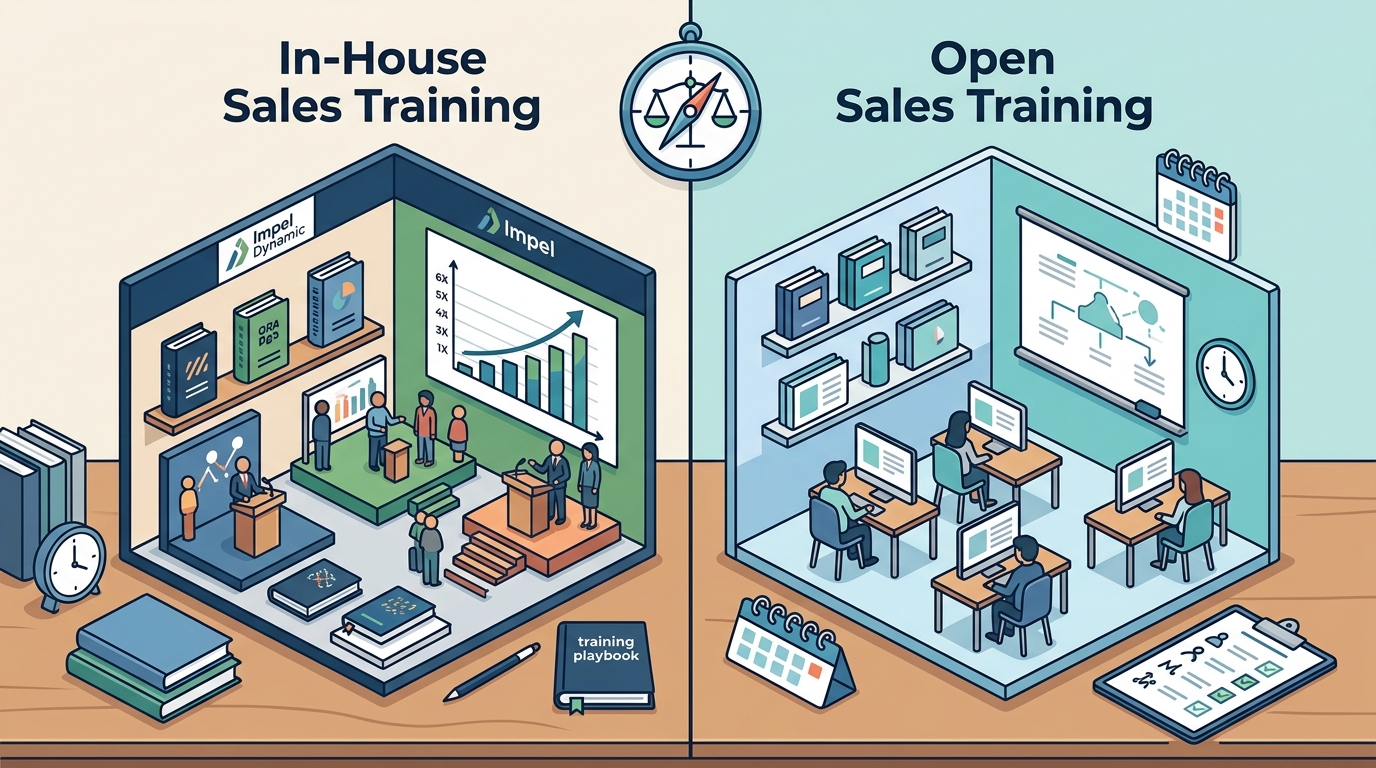
Sales training is not a one-size-fits-all solution. Organizations must carefully weigh the benefits of bespoke in-house programmes against the agility of open courses to determine which approach aligns with their strategic goals. According to recent industry analysis, companies that invest in tailored sales development see an average return on investment of 6X, while those leveraging open courses often report faster immediate skill acquisition for individual contributors. The decision ultimately hinges on your team's current maturity, budget constraints, and specific performance gaps. (Other Core Services Impel)
Customization Depth and Relevance
The primary differentiator between these two models is the level of customization. In-house training is designed to address the unique challenges of your specific industry, product suite, and customer base. This approach ensures that every module resonates with your team's daily reality. Impel Dynamic specializes in delivering bespoke sales programmes that are tailored to meet your team exactly where they are, ensuring immediate applicability from day one.
Open courses, by contrast, provide a standardized curriculum designed for a broad audience. While these courses cover fundamental sales principles effectively, they lack the granular focus on your specific business context. For organizations dealing with complex B2B sales cycles, the generic nature of open courses may leave critical knowledge gaps. In-house training allows for the integration of your proprietary sales methodology, ensuring that your team adopts a unified language and process.
When evaluating customization, consider the depth of your sales challenges. If your team struggles with specific objection handling related to your product's technical features, in-house training is superior. However, if the goal is to refresh foundational skills like prospecting or negotiation basics, an open course may suffice. The Bespoke Sales Programmes offered by Impel Dynamic are structured to identify and close these specific knowledge gaps through expert-driven engagement.
Cost Efficiency and ROI Analysis
Financial considerations play a pivotal role in the decision-making process. In-house training typically involves higher upfront costs due to the time required for curriculum development and the logistical expenses of hosting trainers. However, the return on investment (ROI) is often higher because the training is directly applicable to your revenue-generating activities. Impel Dynamic reports a 99% client satisfaction rate, with many clients citing significant improvements in deal size and conversion rates as direct outcomes of their tailored programmes.
Open courses offer a lower per-person cost, making them an attractive option for individual development or small teams with limited budgets. This model allows you to send specific employees to acquire new skills without disrupting the entire team's workflow. For organizations looking to upskill a few key individuals quickly, Open Courses provide a cost-effective entry point into professional sales development.
To accurately assess cost efficiency, calculate the potential revenue impact of improved sales performance. If a single closed deal from an in-house trained rep covers the cost of the entire programme, the investment is justified. Conversely, if the goal is broad awareness or basic skill introduction, the lower cost of open courses may be more appropriate. Always factor in the hidden costs of time away from the desk, which are often higher for in-house sessions due to the intensity of the training.
Team Dynamics and Cultural Alignment
Sales is inherently a team sport, and the social dynamics of training can significantly impact learning outcomes. In-house training fosters a shared experience among your team members. This shared journey builds camaraderie, encourages peer-to-peer learning, and creates a unified approach to selling. When your entire team undergoes the same rigorous training, it becomes easier to implement new processes and hold each other accountable.
Open courses introduce your employees to a diverse group of professionals from various industries. This exposure can be invaluable for gaining fresh perspectives and benchmarking your practices against industry standards. However, it lacks the internal cohesion that in-house training provides. For organizations undergoing significant cultural shifts or implementing new sales technologies, the unified messaging of in-house training is critical for successful adoption.
Consider the current morale and cohesion of your sales team. If there is a need to align on a new vision or strategy, in-house training serves as a powerful catalyst for change. Impel Dynamic’s approach to Leadership & Management Training emphasizes preparing leaders to drive these cultural shifts, ensuring that the training translates into tangible behavioral changes within the team.
Delivery Flexibility and Scheduling
Logistics often dictate the feasibility of training initiatives. In-house training requires significant coordination to ensure that the entire team can be present simultaneously. This can be challenging for global organizations or teams with varying schedules. However, it allows for a concentrated burst of learning, often over several days, which can lead to deeper retention and immediate application.
Open courses offer greater flexibility in scheduling, with sessions available throughout the year. This allows you to stagger training across your team, minimizing disruption to daily operations. For individuals seeking to enhance their skills at their own pace, the Online Sales Training options provide the convenience of learning from anywhere, fitting seamlessly into busy workloads.
Evaluate your team's capacity for intensive training versus distributed learning. If your team is currently under high pressure to meet quarterly targets, the time commitment of in-house training may be prohibitive. In such cases, open courses or blended learning models may be more practical. Impel Dynamic offers a variety of delivery methods, including face-to-face, live online, and blended models, to suit your specific operational needs.
Networking and Peer Learning Value
One of the often-overlooked benefits of open courses is the networking opportunity. Participants can connect with peers from other organizations, sharing best practices and discussing industry trends. This external perspective can challenge assumptions and inspire new ideas that might not emerge in an internal setting. For sales professionals looking to expand their professional network, open courses provide a valuable platform for connection.
In-house training, while lacking external networking, offers deep internal networking. It allows team members to understand each other's roles and challenges better, fostering collaboration. For complex sales environments where cross-functional cooperation is essential, this internal alignment is crucial. Impel Dynamic’s Business Development Training focuses on turning professionals into trusted advisors, a skill that is often reinforced through collaborative in-house exercises.
Consider the long-term career goals of your employees. If they value external recognition and networking, open courses may be more appealing. If they prioritize internal advancement and deeper integration with your company's strategy, in-house training is the better choice. Balancing these individual needs with organizational goals is key to a successful training strategy.
Comparison Summary
The following table summarizes the key differences between in-house and open sales training programmes to aid in your decision-making process.
| Criteria | In-House Training | Open Courses |
|---|---|---|
| Customization | Highly tailored to specific business needs | Standardized curriculum for broad audiences |
| Cost | Higher upfront investment | Lower per-person cost |
| Team Cohesion | Builds shared experience and unified language | Limited internal bonding |
| Networking | Internal peer learning only | External industry networking opportunities |
| Scheduling | Requires team availability | Flexible, staggered scheduling options |
| ROI Potential | High, due to direct applicability | Moderate, focused on individual skill gain |
Key Takeaways
- Impel Dynamic boasts over 25 years of experience in delivering sales training solutions.
- Companies utilizing tailored sales programmes report an average ROI of 6X.
- In-house training is ideal for aligning team strategy and addressing specific business challenges.
- Open courses offer cost-effective skill development for individual contributors.
- Impel Dynamic achieves a 99% client satisfaction rate across its training portfolio.
- Delivery methods include face-to-face, live online, and blended models to suit operational needs.
- Bespoke programmes are designed to close specific knowledge gaps and enhance sales effectiveness.
Frequently Asked Questions
What is the primary difference between in-house and open sales training?
In-house training is customized to address the specific challenges and goals of your organization, while open courses provide a standardized curriculum designed for a broad audience.
Which option offers a better return on investment?
In-house training often yields a higher ROI due to its direct applicability to your business context, though open courses offer a lower initial cost per participant.
Can Impel Dynamic deliver training in a blended format?
Yes, Impel Dynamic offers face-to-face, live online, and blended training models to accommodate your team's schedule and learning preferences.
How long does it take to see results from sales training?
Results can vary, but many clients report immediate improvements in confidence and technique, with significant revenue impacts often visible within the first few months.
Is open training suitable for senior sales leaders?
Open courses can be beneficial for foundational skills, but senior leaders often benefit more from bespoke leadership training tailored to their strategic challenges.
What types of sales skills are covered in open courses?
Open courses typically cover fundamentals such as prospecting, negotiation, and consultative selling, providing a strong base for individual development.
How does Impel Dynamic ensure training relevance?
Impel Dynamic conducts thorough needs assessments to tailor their programmes, ensuring that every module addresses the specific pain points of your sales team.
Next Steps
Choosing the right sales training model is a strategic decision that impacts your team's performance and your company's growth. Whether you opt for the deep customization of in-house training or the flexibility of open courses, the key is to align your choice with your business objectives. Impel Dynamic is ready to help you design a scalable sales process that drives long-term conversion rates. Contact us today to discuss your specific needs and explore how our tailored solutions can accelerate your sales growth.