

Selecting the Right In-Person Sales Training Provider Across UK Regional Locations
Organizations investing in face-to-face sales development report a 23% higher retention rate of training concepts compared to purely digital alternatives, according to data from the Association for Talent Development. This statistic underscores a critical reality for UK-based enterprises: while digital tools scale efficiently, the nuanced art of negotiation, objection handling, and relationship building demands physical presence. As businesses expand across diverse regions from London to Edinburgh, identifying a training partner capable of delivering consistent, high-impact in-person experiences becomes a strategic imperative rather than a logistical afterthought.
Why In-Person Training Still Dominates Sales Development
The shift toward remote work has not eliminated the need for physical interaction in sales. Instead, it has elevated the value of face-to-face engagement. Sales professionals operate in a high-stakes environment where non-verbal cues, tone modulation, and immediate feedback loops are essential for mastery. In-person training provides a controlled environment where these soft skills can be practiced, observed, and corrected in real-time. (About)
Sales training is the systematic process of equipping sales teams with the knowledge, skills, and tools necessary to close deals effectively. When delivered in person, this process allows for role-playing scenarios that mimic real-world pressure. Trainers can observe body language and adjust coaching strategies instantly, a capability that virtual platforms struggle to replicate with the same depth.
Furthermore, the psychological impact of physical presence cannot be overstated. Being in a room with peers and mentors fosters a sense of accountability and community. This social cohesion drives higher engagement levels and motivates participants to push beyond their comfort zones. For UK companies with dispersed teams, bringing them together physically signals a commitment to their professional growth, boosting morale and retention.
Navigating Regional Logistics Across the UK
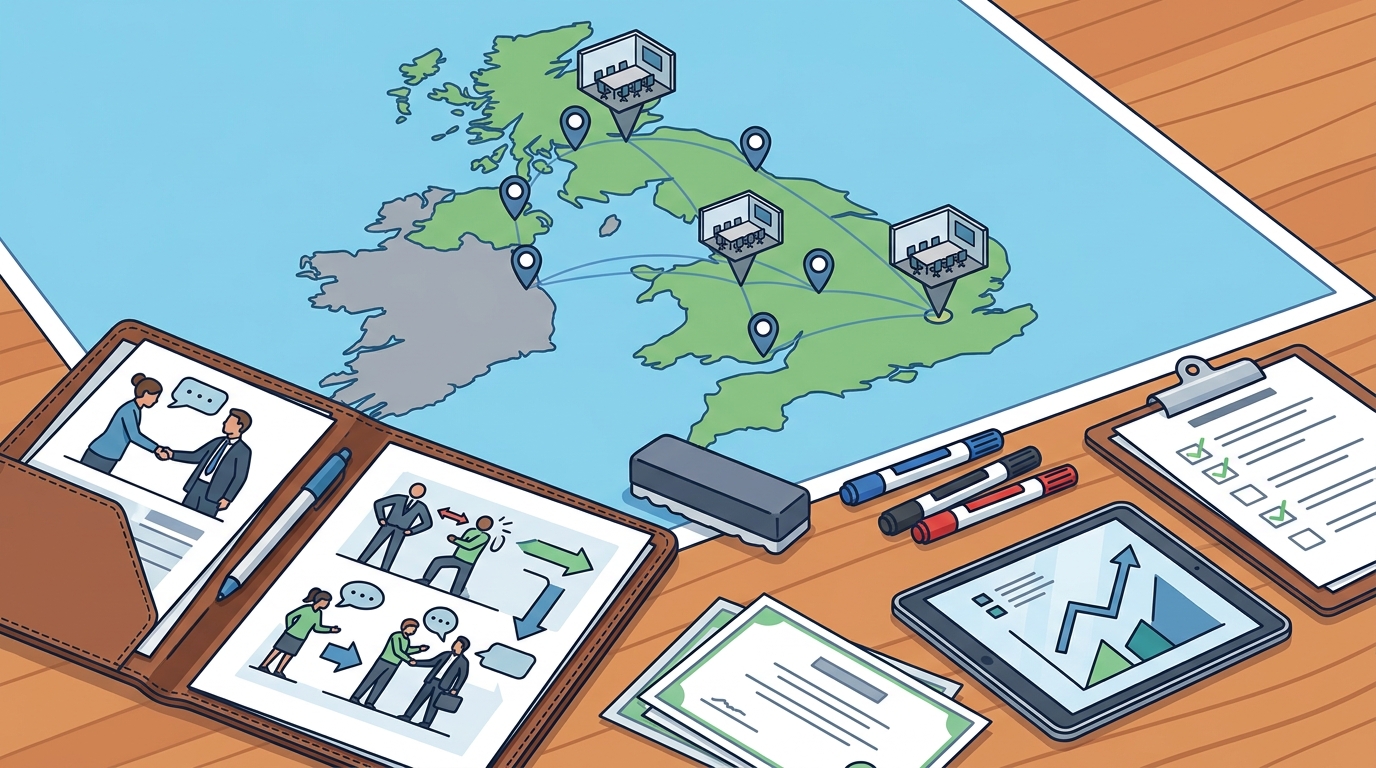
The United Kingdom presents unique logistical challenges for training providers. The geographic diversity means that a provider based in London may face significant travel costs and scheduling complexities when serving clients in Glasgow, Cardiff, or Belfast. Conversely, a provider with a strong regional footprint can offer more agile and cost-effective solutions.
When evaluating providers, consider their ability to mobilize resources across different regions. A provider with a network of facilitators in multiple cities can reduce travel time and ensure that training sessions start on time, regardless of location. This agility is crucial for maintaining momentum in fast-paced sales cycles.
Additionally, regional providers often possess a deeper understanding of local market dynamics. Sales strategies that work in the financial hub of London may need adaptation for the industrial sectors in the Midlands or the tech hubs in Manchester. A provider with regional expertise can tailor content to reflect these nuances, ensuring relevance and applicability for your specific audience.
Evaluating Provider Expertise and Methodology
Not all sales training providers are created equal. The quality of training depends heavily on the facilitator's experience and the methodology employed. Look for providers who specialize in sales development rather than general corporate training. Specialization ensures that the content is sharp, relevant, and up-to-date with current market trends.
Examine the provider's track record. Do they have case studies demonstrating success in your industry? Have they worked with companies of similar size and complexity? Experience in your specific sector can significantly reduce the learning curve and increase the immediate applicability of the training.
Ask about their methodology. Effective sales training is rarely a one-way lecture. It should be interactive, incorporating role-plays, simulations, and peer feedback. Providers who use evidence-based frameworks, such as SPIN selling or Challenger Sale, often deliver more measurable results. Ensure that the provider can articulate how their methods translate into tangible sales outcomes.
At Impel Dynamic, we prioritize a consultative approach to sales training. Our methodology is designed to integrate seamlessly with your existing sales processes, ensuring that the skills learned are immediately applicable. We focus on practical application rather than theoretical knowledge, helping your team close more deals faster.
Comparing Training Delivery Models
Understanding the different ways in-person training can be delivered is essential for making an informed decision. Each model has its own advantages and disadvantages depending on your team's size, location, and budget.
| Delivery Model | Best For | Pros | Cons |
|---|---|---|---|
| On-Site Training | Large teams with centralized locations | High customization, minimal travel for participants | Higher provider travel costs, potential workplace distractions |
| Off-Site Venue | Teams needing immersion and focus | Undivided attention, professional environment | Logistical complexity, accommodation costs |
| Regional Hub Training | Dispersed teams across the UK | Reduced travel time, regional market relevance | Requires provider with strong regional network |
| Blended In-Person | Ongoing development programs | Combines depth of in-person with flexibility of digital | Complex scheduling, requires robust digital infrastructure |
Choosing the right model depends on your specific goals. If your team is spread across the UK, a regional hub approach might be most efficient. If you need deep immersion, an off-site venue could be better. Impel Dynamic offers flexible solutions tailored to your unique needs, ensuring maximum ROI on your training investment.
Key Takeaways
- In-person sales training yields a 23% higher retention rate of concepts compared to digital-only methods.
- Regional providers offer logistical advantages and deeper understanding of local market dynamics.
- Specialization in sales development is critical for delivering relevant and effective training content.
- Interactive methodologies, such as role-playing and simulations, are essential for skill mastery.
- Provider expertise in your specific industry can significantly accelerate the learning curve.
- Flexible delivery models, including regional hubs, can optimize cost and engagement for dispersed teams.
- Impel Dynamic provides consultative, practical sales training designed for immediate application.
Frequently Asked Questions
How do I choose between an on-site and off-site training venue?
On-site training is ideal for large teams to minimize travel, while off-site venues provide an immersive environment free from workplace distractions. The choice depends on your team size and the level of focus required.
What is the average duration for effective in-person sales training?
Effective in-person sales training typically ranges from two to five days. Shorter sessions may not allow for sufficient practice, while longer sessions can lead to fatigue. Impel Dynamic designs programs that balance depth with engagement.
Can in-person training be customized for specific industries?
Yes, top providers customize content to reflect industry-specific challenges and sales cycles. This ensures that the training is relevant and immediately applicable to your team's daily work.
How does regional location impact training costs?
Regional location affects costs primarily through travel and accommodation expenses for both the provider and participants. Providers with a strong regional network can often reduce these costs significantly.
What metrics should I use to measure the ROI of sales training?
Key metrics include changes in win rates, average deal size, sales cycle length, and revenue per rep. Tracking these metrics before and after training helps quantify the impact.
Is blended learning an option for in-person training?
Blended learning combines in-person sessions with digital reinforcement. This approach supports long-term retention and allows for continuous learning beyond the initial training event.
How important is the trainer's experience in my industry?
Industry experience is crucial. Trainers familiar with your sector can provide more relevant examples and anticipate specific challenges your team faces, leading to more effective coaching.
Next Steps
Investing in the right in-person sales training provider is a strategic decision that can transform your team's performance. By considering regional logistics, provider expertise, and delivery models, you can select a partner that aligns with your business goals. Impel Dynamic is ready to help you achieve your sales objectives through tailored, high-impact training solutions. Contact us today to schedule a consultation and discover how we can support your team's growth.